

How to Avoid Missed Calls During Peak Season with These 5 Easy Changes

The Real Cost of Unanswered Phones in Home Services Peak Season
If you've ever wondered how to avoid missed calls during peak season, you're already ahead of most contractors — because the first step is recognizing just how much those missed calls are costing you. Here's a quick breakdown of the five changes that make the biggest difference:
1. Forecast demand early — use last year's call data to staff up before the surge hits
2. Set up smart call routing — send emergency calls to the right person instantly
3. Build an overflow system — simultaneous ringing and ring groups catch calls before they drop
4. Enable instant text-back — auto-reply to missed calls so leads don't go cold
5. Switch to 24/7 live answering — real people answer after hours, on weekends, and during lunch
Peak season for home service businesses — think summer HVAC emergencies, winter pipe bursts, or spring storm damage — brings a wave of inbound calls that most small operations simply aren't built to handle. And the numbers are sobering. Research shows that 74.1% of calls to home service businesses go unanswered even during normal operations. During a surge, that number climbs even higher. Meanwhile, 82% of callers who hit voicemail won't leave a message — they just move on and call the next contractor Google suggests.
That's not a staffing problem. That's a systems problem.
For a trade business booking jobs worth anywhere from $300 to well over $1,000 per visit, even a handful of missed calls a day can quietly drain thousands from your bottom line every month. The busy season that should be your most profitable period can become your most wasteful one — if your phones aren't ready for it.
I'm Anna Lynn Wise, CEO of Contractor In Charge, and I've spent decades working inside the trades — starting as a dispatcher at eighteen and later owning and managing a plumbing, HVAC, and remodeling company — so I understand what it takes to build the call coverage systems that keep jobs flowing when demand peaks. In this guide, I'll walk you through five practical changes that directly address how to avoid missed calls during peak season, without adding unnecessary overhead or complexity to your operation.

Why Home Service Businesses Struggle with High Call Volumes
When the heat index hits triple digits in Tampa, Florida, or a sudden freeze sweeps across Texas, the phones do not just ring—they explode. The sudden jump in call volume can easily reach 300% to 500% of our typical daily rate within a matter of hours.

The primary reason home service businesses fail to capture these opportunities is administrative overload. Our office staff are already buried under daily tasks: dispatching technicians, processing invoices, ordering parts, and managing schedules. When the phones start ringing simultaneously, your team simply runs out of hands.
This creates two distinct operational bottlenecks:
• Capacity Gaps: A single human customer service representative (CSR) has a physical limit to how many calls they can handle. If we calculate real call capacity, a CSR can realistically only handle about 70% of their theoretical maximum before call quality drops and hold times skyrocket.
• Coverage Gaps: Calls do not only come in between 8 AM and 5 PM. Homeowners often wait until they get home from work, meaning a surge of high-intent calls hits between 5:30 PM and 9:00 PM, during lunch hours (12:00 PM to 2:00 PM), or over the weekend.
When these gaps exist, we see a massive wave of voicemail abandonment. If a customer has a broken air conditioner in the middle of a Texas summer, they will not wait for a callback. They will hang up and call the next business. This high rate of competitor switching represents a massive loss of immediate revenue and long-term customer lifetime value.
To understand the full financial impact of these leaks, read our detailed guides on How Missed Calls Cost Home Service Businesses Money and How Much Revenue Are Contractors Losing from Missed Calls.
How to Avoid Missed Calls During Peak Season: 5 Easy Changes
To protect your marketing investments and keep your technicians' schedules full, you must transition from a reactive "firefighting" mode to a proactive, system-driven approach.
Improving your call capture rate directly impacts operational efficiency, customer retention, and your ability to book high-value jobs when demand is highest. Let's look at the five practical, high-impact changes you can make to your business today to ensure you capture every lead.
For a broader look at preparing your entire operation, check out our resources on How to Stop Losing Calls During Busy Season and How to Prepare Your Service Business for Peak Season.
1. Forecast Demand and Optimize Your Dispatch Schedule
You cannot manage what you do not anticipate. The first change is using historical data to predict exactly when your phones will start ringing.
Look back at your CRM and phone records from last year. You will likely find highly predictable patterns. For example, across the home services sector, Monday mornings between 10:00 AM and 12:00 PM are consistently the highest-volume windows of the week.
Additionally, keep a close eye on weather triggers. In Florida and Texas, a sustained three-day heatwave or an unexpected winter storm warning should immediately trigger your peak-season staffing protocols.
To optimize your workforce planning, consider the following scheduling adjustments:
• Implement Micro-Shifts: Schedule extra office support specifically during your peak hours (such as the mid-day lunch rush or Monday mornings) rather than trying to staff up for entire eight-hour blocks.
• Build a Scheduling Buffer: Do not book your technicians to 100% capacity with routine maintenance visits during peak season. Keep a 15% to 20% buffer in your daily dispatch schedule to accommodate emergency service calls that come in throughout the day.
By aligning your office staff and technician schedules with forecasted demand, you can keep hold times low and book jobs immediately. For more strategies on managing this balance, read How to Handle High Call Volume During Peak Season.
2. Implement Smart Call Routing and Emergency Triage
During a seasonal surge, not all calls are created equal. A customer calling to schedule a routine, non-urgent system check-up should not block a homeowner experiencing an active plumbing flood or a complete heating system failure in freezing weather.
Smart call routing and emergency triage allow us to separate high-value, urgent service requests from routine inquiries.
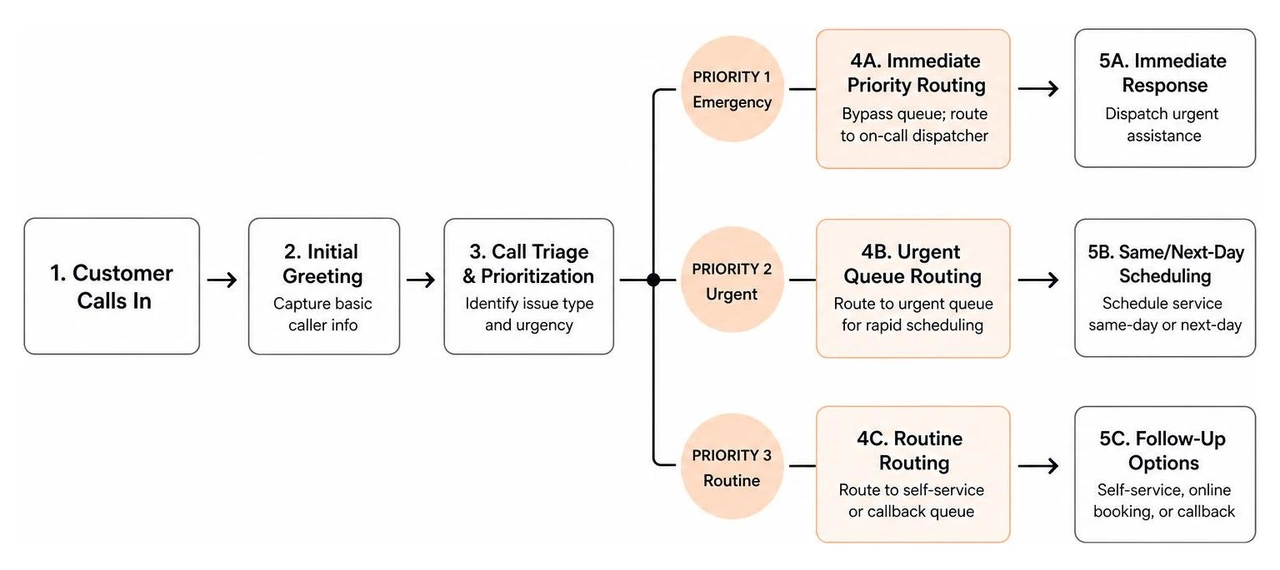
When designing your call routing system, establish a clear triage protocol:
1. Category 1: Emergency (Life-Safety & Property Damage): Active water leaks, no heating in freezing conditions, or no AC for elderly clients in extreme heat. These must bypass standard holds and route directly to a priority queue or an on-call dispatcher.
2. Category 2: Urgent (No Comfort/Service): System down but no immediate safety hazard. These are scheduled for same-day or next-day service.
3. Category 3: Routine Inquiries: Maintenance scheduling, billing questions, or warranty inquiries. These can be routed to automated self-service options, online booking, or queued for a structured callback during lower-volume afternoon hours.
By establishing these priority queues, we ensure that our highest-value and most critical leads are answered within seconds, protecting both the customer and our business's reputation.
3. Establish a Multi-Layered Overflow System
Relying on a single person or a linear phone line is a recipe for missed opportunities. If your primary CSR is on the phone, the next incoming call should not go straight to voicemail or ring endlessly.
A reliable call coverage system requires a multi-layered overflow routing setup. Think of it like a safety net: if the first layer is busy, the second layer catches the call, and if that layer is full, a third layer stands ready.
• Simultaneous Ringing (Hunt Groups): Set up your phone system so that an incoming call rings multiple desks at once. If the primary dispatcher does not pick up within two rings (approximately 10 seconds), the call should immediately ring the office manager's or owner's line.
• Conditional Call Forwarding: Configure your system with a strict "No Answer" rule. If a call is not answered by an in-house team member within 20 to 30 seconds, it must automatically forward to a dedicated partner who can answer live.
This layered approach dramatically reduces hold times and ensures that customers always reach a live voice. To learn how to optimize your answer rates, read our guide on How to Improve Call Answer Rates for Service Businesses.
4. Deploy Instant Text-Back for Unanswered Lines
Even with the best routing and overflow systems, there may be brief moments during an extreme weather event when lines are temporarily maxed out. In these rare instances, you must have an automated fallback to keep the lead from calling a competitor.
Deploying an instant missed-call text-back system is one of the fastest ways to save a hot lead.
The moment a call is missed or abandoned, your system should automatically send a personalized SMS to the caller's mobile number within 30 seconds. A simple, friendly template works best:
"Hi! We’re sorry we missed your call. We are currently helping other local homeowners with emergency service. Would you like to book a technician or text us your emergency here? We are standing by."
Because text messages have an incredible 98% open rate, this immediate response stops the customer from searching for another contractor. It transforms an unanswered call into an active, two-way text conversation, allowing you to collect their details, confirm their emergency, and schedule the job via SMS.
5. Transition to 24/7 Live Answering Coverage
The ultimate solution to the missed call problem is simple: ensure a professional, trained human is always available to answer the phone, 24 hours a day, 7 days a week, 365 days a year.
Many contractors believe they can handle after-hours calls by setting up an on-call rotation for their technicians or dispatchers. However, this often leads to rapid employee burnout. A technician who has been working in hot attics all day in Tampa cannot provide exceptional, compassionate customer service while trying to sleep with a ringing phone next to their bed.
By transitioning to a professional 24/7 live answering service, you protect your team's sanity while ensuring every customer gets a world-class first impression.
A dedicated, trade-trained answering partner can:
• Answer calls instantly, even at 2 AM on a Sunday.
• Filter out spam, sales calls, and low-priority inquiries.
• Triage true emergencies based on your exact protocols.
• Directly access your CRM and dispatch software to book jobs and schedule technicians in real time.
This coverage helps you catch middle-of-the-night emergencies and weekend installation opportunities. Explore your options further with our articles on After-Hours Call Handling Options for Contractors and our dedicated 24-Hour Live Answering Service.
Implementing a Scalable Call Coverage System Year-Round
While peak season is the ultimate test of your phone systems, maintaining a scalable call coverage system is vital for year-round business growth.
As your home service business grows, your administrative needs will naturally fluctuate. Trying to manage this growth solely by hiring in-house staff can lead to high overhead costs during shoulder seasons and severe understaffing during peak demand.
To help you evaluate the best path forward for your business, here is a direct comparison of managing your phones entirely in-house versus partnering with an outsourced call coverage specialist like Contractor In Charge:
• Simultaneous Call Capacity — In-House Staffing Only: Limited to the number of physical desks/employees in your office. — Outsourced Call Coverage (Contractor In Charge): Virtually unlimited; scalable to handle sudden 500% volume spikes.
• After-Hours & Weekend Coverage — In-House Staffing Only: Requires expensive overtime, shift differentials, or on-call rotations. — Outsourced Call Coverage (Contractor In Charge): Fully included 24/7/365 coverage with no additional staffing logistics.
• Management Overhead — In-House Staffing Only: High; requires continuous hiring, training, benefits, and management. — Outsourced Call Coverage (Contractor In Charge): None; managed entirely by industry-trained supervisors.
• CRM & Dispatch Integration — In-House Staffing Only: Dependent on manual data entry and staff availability. — Outsourced Call Coverage (Contractor In Charge): Direct, real-time booking into your ServiceTitan, Housecall Pro, etc.
• Response Time (Peak Hours) — In-House Staffing Only: Often exceeds 2–5 minutes, leading to high abandonment. — Outsourced Call Coverage (Contractor In Charge): Calls answered within seconds by dedicated professional teams.
Analyze Call Metrics to Learn How to Avoid Missed Calls During Peak Season
To continuously improve your phone operations, we must treat our call data as a diagnostic tool. Regularly reviewing your call analytics will highlight exactly where your system is leaking revenue.
Key performance indicators (KPIs) to track include:
• Abandonment Rate: The percentage of callers who hang up before speaking to a human. Your goal should be to keep this under 5%.
• Average Speed to Answer (ASA): How long a customer waits on hold. Ideally, every call should be answered within 30 seconds (about three to four rings).
• Average Handle Time (AHT): The duration of a call. While we want to be thorough, a highly efficient, scripted booking process keeps this metric optimized so lines clear quickly for the next customer.
To learn how to audit and evaluate your phone performance effectively, check out our guide on How to Evaluate Your Answering Service Performance.
Leverage Technology and Human Support to Know How to Avoid Missed Calls During Peak Season
The most successful home service businesses in Florida and Texas utilize a hybrid system that combines cutting-edge communication technology with genuine, empathetic human support.
By integrating your phone systems directly with your CRM and dispatch software, an outsourced CSR can see a customer's history the moment they call. They can check your real-time technician availability, book the job directly into your schedule, and dispatch the nearest technician without your in-house team ever having to lift a finger.
This seamless integration ensures that your business runs like a well-oiled machine, keeping your calendar full and your technicians productive throughout the busiest seasons of the year.
Frequently Asked Questions About Managing Peak Call Volume
What are the most common reasons contractors miss calls during busy seasons?
The most common reasons include administrative overload (staff are busy with existing customers or paperwork), lunch breaks (when office staff are away but homeowners are active), after-hours calls (evenings and weekends), and technical limitations (not having enough phone lines to handle simultaneous incoming calls).
How can we balance emergency dispatching with routine inquiries?
The best approach is to establish a clear triage protocol. Use smart routing to send emergency calls (like active floods or no heating/cooling in extreme weather) to a priority queue. Route routine inquiries, such as maintenance scheduling or billing questions, to automated self-service booking options or schedule them for a structured callback during lower-volume periods.
Why is voicemail ineffective for booking jobs during a surge?
Voicemail is passive and slow. Research shows that 82% of callers who hit a voicemail will hang up without leaving a message. In the home services industry, a customer with an emergency will simply hang up and call the next competitor on Google to get an immediate response. Relying on voicemail quietly drains thousands of dollars in lost jobs. For more details on these hidden costs, read our post on the Cost of Missed Calls for HVAC & Plumbing Companies.
Conclusion
Your phones are the lifeblood of your home service business. During peak season, every ring represents an opportunity to secure a new customer, book a high-value job, and grow your business. But if your team is overwhelmed and calls are slipping to voicemail, you are simply handing those profitable jobs directly to your local competitors.
At Contractor In Charge, we help plumbing, HVAC, and electrical contractors across Florida, Texas, and the USA eliminate missed calls once and for all. Founded by an industry veteran, we provide a scalable, dedicated team of professional, trade-trained CSRs who combine advanced dispatch technology with old-fashioned customer care. We do not just take messages — we log into your CRM, schedule appointments, dispatch technicians, and handle your bookkeeping, keeping your business running smoothly 24/7.
Do not let another busy season overwhelm your office. Take control of your phones, protect your hard-earned reputation, and start booking every job. To build a scalable, stress-free call coverage system for your business, Partner with Peak Solutions Group today!