

Stepping Away from the Dispatch Board: A Blueprint for Owner Dependency Reduction

The Dispatch Trap: When the Owner Becomes the Bottleneck
Your technicians are out in the field, the phone is ringing off the hook, and you are stuck staring at a screen. Every incoming call represents potential revenue, but acting as the sole dispatcher is keeping you chained to the desk. If you want to break this cycle, stepping away from the dispatch board: a blueprint for owner dependency reduction is exactly what you need to scale your business. The problem is simple but devastating: when an HVAC business relies entirely on the owner to route calls, the owner becomes the primary operational bottleneck. This becomes painfully obvious during the peak summer cooling season when dispatch volume overwhelms a single owner, leading to missed opportunities and extreme burnout.
The realization phase: In our years of helping home service businesses scale, we see a constant pattern where owners reach a critical decision point—realizing their personal capacity has become the company's revenue ceiling. You cannot focus on strategic growth, marketing, or technician training if you are spending eight hours a day dragging and dropping appointments on a digital calendar. Delegation is not a loss of control; it is a systematic handover that actually increases your visibility into the business. By implementing a phased blueprint to safely transition scheduling responsibilities, you protect your time and allow your company to operate smoothly, even when you are not in the room.
To successfully navigate this transition, it is essential to build a foundation that supports your operations. Learn more about establishing solid back office solutions to support your growth.
The Psychological and Operational Cost of Manual Routing
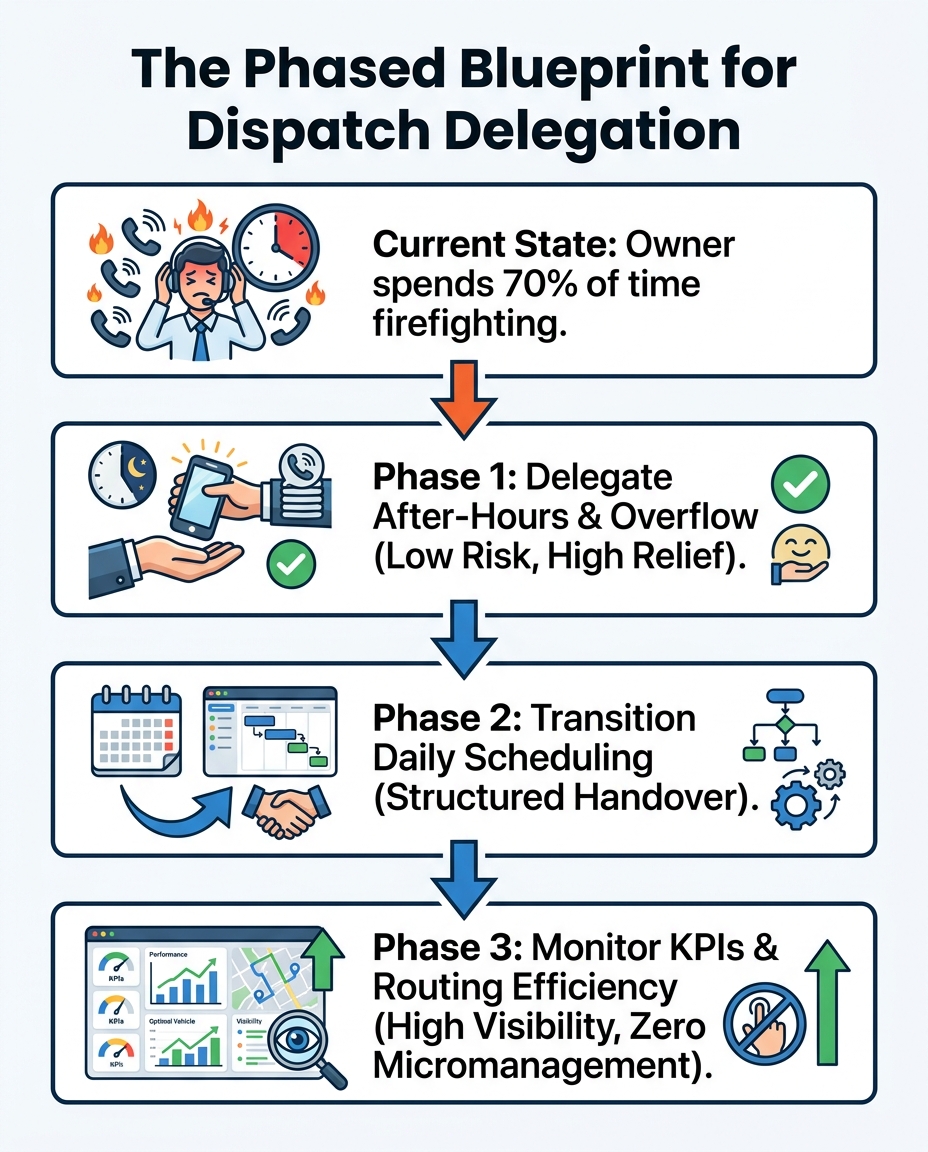
The Problem: Giving up control of the daily schedule is one of the hardest psychological hurdles for any service business owner. You built your company on personal relationships, and there is a lingering fear that handing over the phones will result in a loss of customer relationship quality. In our experience, this fear is exactly why small business owners often spend up to 70% of their time on daily operations and firefighting rather than working on business strategy. This reactive state is especially dangerous during the peak summer cooling season when dispatch volume overwhelms a single owner, leaving no room for error.
The Cause: Manual, owner-led routing usually degenerates into reactive dispatching. When you are taking calls back-to-back, you stop optimizing for travel time and start dispatching based on whoever is screaming the loudest. This leads to massive inefficiencies.
• Excessive windshield time: Technicians crisscross the same zip codes multiple times a day because calls were booked reactively instead of geographically.
• Unapplied time spikes: Gaps in the schedule go unfilled because the owner is too busy handling a customer complaint to notice a technician is sitting idle.
• Missed maintenance opportunities: When overwhelmed, owners focus only on emergency breakdowns, completely ignoring the outbound calls needed to schedule preventative maintenance.
The Solution: You must reframe delegation as the key to removing the company's revenue ceiling. Handing over the board allows a dedicated professional to focus entirely on route optimization and customer experience. When you implement proper virtual customer service, you are not abandoning your customers; you are ensuring they get faster, more organized responses than a single, overwhelmed owner could ever provide.
• Routing Efficiency — Owner-Led Dispatching (Reactive): Technicians sent across town based on call order. — Delegated Dispatch Management (Proactive): Technicians clustered by geographic zones.
• Call Answer Rate — Owner-Led Dispatching (Reactive): Calls go to voicemail when the owner is on the other line. — Delegated Dispatch Management (Proactive): Dedicated agents capture every incoming lead.
• Strategic Focus — Owner-Led Dispatching (Reactive): Owner spends 70% of the day putting out fires. — Delegated Dispatch Management (Proactive): Owner reviews daily KPIs and focuses on growth.
Recognizing Your Capacity Breaking Point
Every service business has a breaking point, and our team typically sees that it takes an external trigger to expose the fragility of having a single person manage the board. Sudden extreme weather events—like prolonged summer heatwaves or unexpected winter freezes—turn a manageable daily schedule into complete chaos. When the peak summer cooling season hits and dispatch volume overwhelms a single owner, the cracks in the system become impossible to ignore.
Signs your current system is failing the customer experience:
• Dropped calls and abandoned leads: Customers are hanging up after long hold times and calling your competitors.
• Delayed routing and missed windows: Technicians are consistently arriving late because the schedule was packed too tightly without accounting for travel time.
• Technician frustration: Your field staff is sitting in their vans waiting for their next assignment because the board hasn't been updated.
• Zero proactive scheduling: You have completely stopped booking club memberships or seasonal tune-ups because you are drowning in emergency calls.
Proactive vs. Reactive Delegation: There is a distinct difference between proactive delegation (planned growth) and reactive delegation (burnout response). Proactive delegation happens before the busy season hits. You take the time to train a team, set up protocols, and slowly hand over the reins. Reactive delegation happens when you are already drowning, forcing you to hand off the board with zero preparation, which often leads to mistakes and frustration. Recognizing these warning signs early allows you to build a structured handover plan before the weather forces your hand.
Phase 1: Delegating After-Hours and Overflow Call Volume
The most effective way to step away from the board is not to drop everything at once, but to use a phased blueprint. Phase 1 focuses on delegating after-hours and overflow call volume. This allows you to test the waters of delegation with much lower risk while providing immediate relief to your personal schedule. It is particularly vital during the peak summer cooling season when dispatch volume overwhelms a single owner even after normal business hours.
1. Capture lost revenue without the burnout: Capturing after-hours calls prevents lost revenue, but it should not require you to sleep with your phone on your chest. By routing these calls to a dedicated team, you ensure every customer speaks to a live person.
2. Establish clear routing protocols: You must document exactly how calls should be handled. A broken AC in a home with elderly residents might be an emergency dispatch, while a noisy fan motor can be scheduled for the next morning.
3. Build trust through overflow management: Once you see that a team can successfully manage your overflow and after-hours calls without your direct involvement, you build the psychological trust required to hand over the daily board.
Consider how this plays out in the real world. One plumbing and HVAC business we partnered with realized they needed a reliable partner during a busy winter season to manage their after-hours calls and protect their customer service quality. By bringing in a dedicated call center extension, they successfully handed off their after-hours support. The agents provided seamless service, and the business owners saw a significant improvement in call handling without having to wake up at 2 a.m. for non-emergencies. Implementing 24/7 live agent call center services is the perfect first step in this phased approach.
Setting Overflow Parameters
To make Phase 1 work, you need strict parameters. First, define exactly what constitutes an emergency dispatch for your specific business. Does a water heater leak warrant a 3 a.m. truck roll, or just a scheduled first-call for the morning? Second, create clear escalation paths for the delegation team. If a VIP customer calls, or if a commercial account has a critical failure, the team needs to know exactly which technician or manager to contact, ensuring you are only bothered when absolutely necessary.
Phase 2: Transitioning the Full Daily Schedule
Once after-hours and overflow are running smoothly, you are ready for Phase 2: handing over the core daily dispatch board to a dedicated team. This is the structured handover of daily routing, and its primary goal is prioritizing technician billable hours and reducing windshield time. Doing this before the peak summer cooling season when dispatch volume overwhelms a single owner is critical for maintaining operational stability.
The mechanics of the handover: Transitioning the daily schedule requires a period of co-piloting. You do not just hand over the login credentials and walk away. For the first week, you review the board alongside the dispatch team. You explain why you group certain zip codes together and how you match specific technicians to specific job types based on their skill levels. Gradually, you step back and transition to reviewing end-of-day reports rather than watching the live board minute-by-minute.
Seamless software integration: A successful handover requires seamless integration with your existing field service management software. The dispatch team must work directly inside your system, updating statuses, notes, and tags in real-time. This ensures your customer records remain accurate and your technicians see the updates instantly on their mobile devices.
For example, at the end of 2023, one service company we worked with suddenly lost their primary dispatcher and call taker right in the middle of the winter rush. The owner simply could not handle the incoming call volume alone. Our team at Contractor in Charge stepped in to take over full-time dispatch and call-taking duties, providing trained CSRs and management support. Because of this complete handover, the company stabilized, continued to grow, and successfully ran their operations without the owner having to micromanage the board. Building this kind of resilience requires the right infrastructure, which is why choosing the proper systems you need to scale a service business is so important.

Maintaining Operational Visibility Without Micromanaging
The Problem: Owners often confuse "watching the dispatch board" with "managing the business." When you step away from the live screen, you might feel a sudden sense of blindness. This anxiety is common, especially during the peak summer cooling season when dispatch volume overwhelms a single owner and the stakes are highest.
The Cause: This feeling stems from a lack of standardized reporting. If the only way you know a technician is running late is by staring at a digital map, you have an operational flaw. True management is about looking at data, not watching dots move on a screen.
The Solution: Proper delegation actually increases visibility through standardized reporting. Instead of watching the board, you identify and monitor key metrics and KPIs. You review the data at the end of the day or week to ensure the dispatch team is hitting their targets. To achieve this, you need more than just a basic message-taking service; you need a partner capable of true dispatch management. A simple answering service might take a message, but a dedicated dispatch team actively routes your trucks and manages your capacity.
Key Metrics to Monitor Instead of the Board:
• Call Booking Rate: Are the dispatchers successfully converting inbound calls into booked appointments?
• Technician Unapplied Time: How much of the day are technicians sitting idle or driving compared to turning wrenches?
• Average Response Time: How quickly are emergency calls being assigned and dispatched?
• Revenue per Route: Are dispatchers prioritizing high-value calls and optimizing travel to maximize daily revenue?
To keep everything aligned, implement weekly strategy meetings with your dispatch team. Review these KPIs, discuss any routing hiccups from the previous week, and adjust your parameters as needed. This keeps you in total control of the business without being trapped in the daily weeds.
The Advantage of Trade-Specific Dispatch Support
When it comes to delegation, you generally have two choices: hire and train an entry-level in-house dispatcher, or leverage specialized remote support. While hiring in-house might seem like the traditional route, it comes with massive overhead, training delays, and the constant risk of turnover. HVAC dispatching requires specific industry knowledge. A dispatcher needs to understand the difference between a split system and a package unit, why a cracked heat exchanger is an emergency, and how long a typical coil replacement takes.
Time-to-value and scalability: Training an in-house hire to understand these trade nuances can take months. If they quit, you are back to square one, staring at the board again. Partnering with a specialized B2B service offers immediate time-to-value. This is where our team at Contractor in Charge makes a critical difference. By providing specialized, trade-specific remote administrative and dispatching support, we enable owners to step away without sacrificing operational control. Our teams already know the industry terminology and the software, meaning they can jump in and provide relief almost instantly.
Protecting the customer experience: Trade-specific support protects the customer experience during the initial phone call. When a homeowner calls in a panic because their AC is blowing warm air, they want to speak to someone who understands their problem, not a generic call center rep reading from a script. Furthermore, remote support offers unmatched scalability during unexpected volume spikes. When the peak summer cooling season when dispatch volume overwhelms a single owner finally arrives, a remote team can easily scale their efforts to handle the surge, ensuring no call goes unanswered and no revenue is left on the table.
Reclaiming Your Time for Strategic Growth: Stepping Away from the Dispatch Board
The journey from acting as the primary operational bottleneck to becoming a strategic business leader requires intention and a solid plan. By implementing a phased blueprint, you can safely hand over daily scheduling without sacrificing routing efficiency or customer satisfaction. You start by delegating the after-hours and overflow calls, build trust in the process, and eventually transition the full daily schedule to a team of trade-specific professionals.
You no longer have to dread the peak summer cooling season when dispatch volume overwhelms a single owner. Instead, you can focus your energy on high-level growth, technician training, and expanding your market share. Evaluate your current capacity today, look honestly at how much time you spend reacting to the board, and take the first step toward delegation. Mastering the process of stepping away from the dispatch board: a blueprint for owner dependency reduction is the key to unlocking your company's true potential. When you finally let go of the daily routing, you gain the freedom to build the business you always intended to run.
Frequently Asked Questions
How do I transition out of daily operations in my HVAC business?
Transitioning out of daily operations requires a phased approach rather than an abrupt exit. Start by documenting your standard operating procedures and defining your emergency routing rules. Next, delegate low-risk tasks like after-hours call handling and overflow dispatching to a trusted team. Once those systems are running smoothly, you can gradually hand over the daily dispatch board and shift your focus to monitoring key performance indicators.
When is the right time to delegate dispatching?
The right time to delegate dispatching is before your personal capacity becomes a bottleneck for company revenue. If you notice an increase in dropped calls, delayed technician routing, or a complete lack of time for strategic planning, you have reached your breaking point. Proactive delegation before the busy season hits is always more effective than reactive delegation during a crisis.
What makes a good HVAC dispatcher?
A good HVAC dispatcher possesses a deep understanding of trade-specific terminology, job durations, and geographic routing. They must be able to remain calm under pressure, prioritizing emergency calls while minimizing technician windshield time. Additionally, they need strong customer empathy to reassure panicked homeowners while accurately documenting the issue in the field service software.
How do I scale my service business without losing customer quality?
Scaling without losing quality requires standardizing your customer service protocols and relying on specialized support. Instead of hiring generic call centers, partner with trade-specific dispatchers who understand the nuances of the HVAC industry. By maintaining clear escalation paths and regularly reviewing call booking KPIs, you ensure the customer experience remains consistent even as call volume grows.
What is the difference between an answering service and a remote dispatcher?
A traditional answering service simply takes a message and passes it along to you, leaving you responsible for the actual scheduling and routing. A remote dispatcher actively manages your board, assigns technicians based on geographic zones and skill levels, and updates your field service management software in real-time. Remote dispatchers take the operational burden off your plate entirely.
How can I maintain control of my schedule when I'm not the one routing calls?
You maintain control by shifting from micro-managing the live board to macro-managing the data. Establish clear routing parameters and require your dispatch team to follow them strictly. Hold weekly alignment meetings to review essential metrics like unapplied technician time, call booking rates, and average response times to ensure the schedule is being optimized effectively.