

Structuring a Handyman Retainer Agreement to Support 24/7 Call Center Overflow

The Challenge of Low-Tier Emergencies During Peak Seasons
At Contractor in Charge, we frequently see our clients' dispatch boards glowing red with incoming emergency requests, but nearly half of those calls do not actually require highly trained, licensed technicians to resolve. Structuring a Handyman Retainer Agreement to Support 24/7 Call Center Overflow is the operational solution we recommend to prevent your business from buckling under the weight of basic maintenance requests. When severe weather hits, the surge in calls can overwhelm even the most prepared teams. Sending a master technician across town just to change a clogged filter or swap a thermostat battery wastes valuable resources, delays critical repairs for other customers, and severely bottlenecks your entire operation.
To effectively capture these leads without exhausting your core team, we have helped countless home service businesses partner with a professional answering service to manage the influx of calls. The key to making this work is having a legally and operationally sound backup plan already in place.
The impact of unpredictable weather: Sudden summer heatwaves and brutal winter deep freezes create massive, unpredictable volume spikes. During these peak summer and winter extremes, we see homeowners panic over minor system hiccups that mimic total failures. Without a pre-structured backup retainer, your dispatchers are forced to either turn away paying customers or run your primary technicians into the ground. A properly structured retainer agreement allows you to safely capture overflow work, maintain customer loyalty, and keep your expert technicians focused on complex, high-value diagnostics and repairs.
Defining the Scope: Handyman vs. Licensed Professional
In our years of managing after-hours dispatching, we've found that the most critical element of any backup strategy is defining exactly what type of work your retained overflow personnel can legally perform. The boundary between a licensed HVAC technician vs. general liability insured handyman is strictly regulated by state licensing boards. Failing to respect these boundaries can result in severe fines, liability exposure, and the potential loss of your business license.
The Problem: When call volume spikes, dispatchers may panic and send the closest available worker to a no-heat or no-cool call without verifying the actual scope of the required repair. If an unlicensed handyman attempts to handle refrigerant, wire high-voltage components, or alter gas lines, your company assumes massive legal and safety liabilities.
The Cause: We often see this happen because a business has blurred lines regarding what constitutes a "basic" repair versus a restricted trade task. Without written documentation, dispatchers have no framework to follow.
The Solution: You must consult your specific state licensing board definitions to separate general maintenance from restricted trade work. Once those boundaries are clear, you can identify specific low-tier tasks suitable for a backup retainer.
Establishing Clear Work Boundaries
Documenting permitted tasks within the retainer agreement is non-negotiable. A general handyman on retainer should only be dispatched for tasks that do not require specialized trade licenses. Setting strict protocols for when a backup worker must escalate a call to a licensed technician protects your customers and your company.
• General Maintenance — Appropriate Responder: Retained Handyman — Examples of Permitted Work: Replacing air filters, clearing debris from outdoor units, swapping thermostat batteries, resetting tripped breakers (if instructed safely).
• Restricted Trade Work — Appropriate Responder: Licensed Technician — Examples of Permitted Work: Handling refrigerant, brazing lines, replacing capacitors, modifying gas valves, rewiring internal system components.
Clearly defining this scope of work in your written agreement mitigates liability. If the handyman arrives and discovers the issue requires a licensed HVAC technician vs. general liability insured handyman, the agreement must mandate an immediate escalation back to your dispatch team.
Navigating 1099 Compliance for Backup Support
Our team always reminds contractors that once you have defined the scope of work, you must correctly classify the backup worker to avoid severe tax and labor law penalties. Structuring a relationship with a backup worker requires strict adherence to IRS guidelines regarding independent contractors. If you treat a retained handyman like a traditional employee, you will face misclassification audits.
Understanding the IRS common law rules: The IRS utilizes a multi-factor test to determine the degree of control a business exerts over a worker. The core principle is operational independence. To maintain a valid 1099 status, the retained worker must control how, when, and where they perform the work, utilizing their own tools and transportation. You are dictating the desired outcome (e.g., "clear the debris from this unit"), but you cannot dictate their exact step-by-step process.
Structuring payment terms: How you pay the retained worker also impacts their classification. In the standard contractor service retainer model we see work best, you might establish a flat monthly availability fee to guarantee they will accept overflow calls, plus a per-call or per-task rate for the actual work completed. This demonstrates financial risk and opportunity for profit or loss, which is a hallmark of an independent contractor relationship.
Maintaining operational independence: Do not require the retained handyman to wear your company uniform, drive a vehicle with your logo, or attend mandatory company training sessions. The legal distinction between a licensed HVAC technician vs. general liability insured handyman extends beyond just the physical work they do; it also defines how they integrate into your business structure. They are an independent entity providing a contracted service to your company, not a subordinate employee.
Essential Clauses for Your Backup Retainer Agreement
We've learned firsthand that a handshake agreement is not sufficient when your company's reputation and liability are on the line. You need a formal, written Service Level Agreement (SLA) that outlines every expectation. This document protects both parties and ensures smooth operations during peak summer and winter extremes.
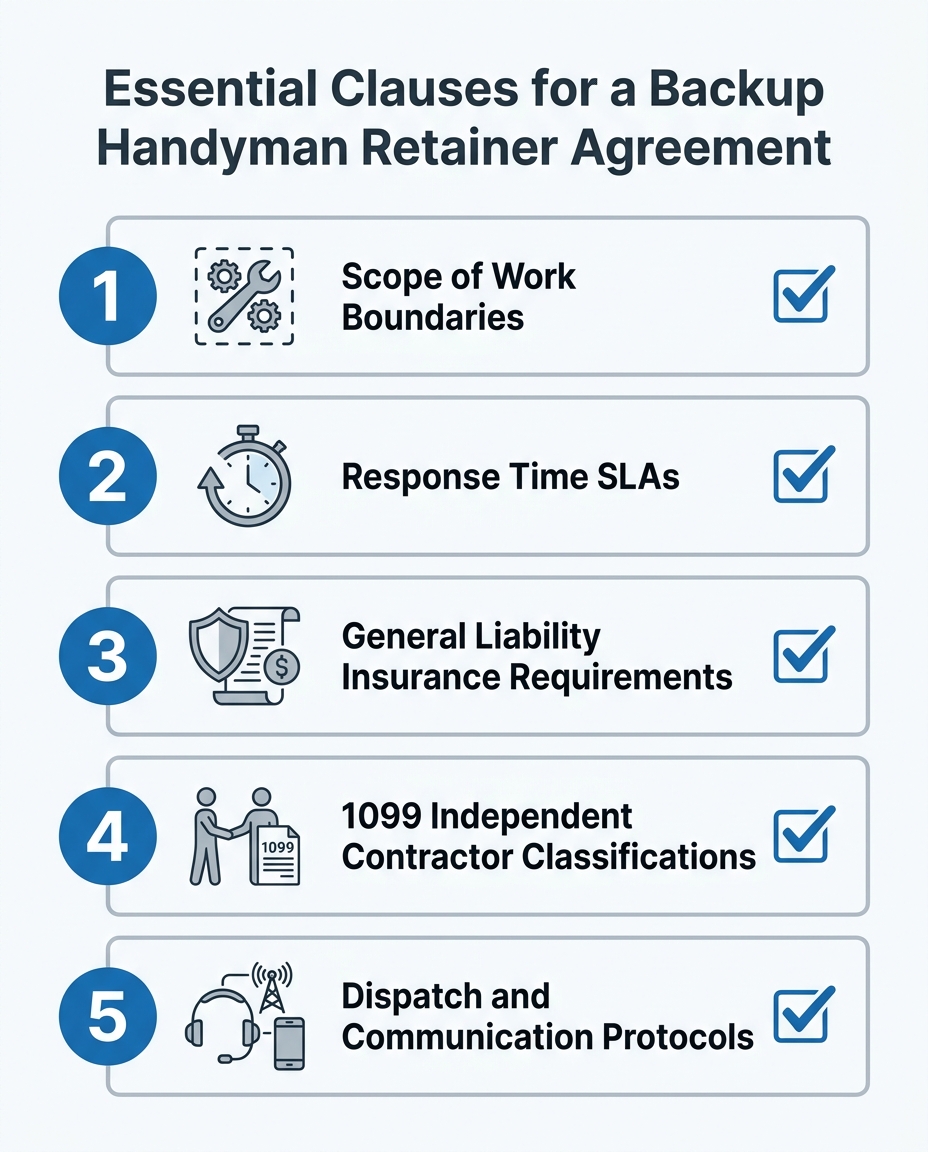
• Insurance mandates: You must require proof of general liability insurance before dispatching any independent worker. The agreement should stipulate that the contractor maintains active coverage and names your business as an additional insured. This prevents your own company's policy from absorbing the impact if the handyman damages a customer's property.
• Response time expectations: Establish clear windows for accepting and arriving at overflow calls. Note that response time SLAs must account for hazardous travel conditions during severe weather events. A standard requirement might be acknowledging a dispatch within twenty minutes and arriving on-site within a few hours, weather permitting.
• Communication and dispatch protocols: Define exactly how the backup worker receives tickets, updates their status, and closes out the call. They need a clear channel to report back to your central dispatch if a job requires escalation.
• Termination and review clauses: Ensure the partnership remains mutually beneficial by including terms for regular reviews and a clear process for terminating the agreement if the contractor fails to meet the established SLAs.

Seamless Call Routing and Triage Tactics
Having a retainer agreement in place is only half the battle. Your dispatch system must be capable of executing a tiered response strategy flawlessly. When a call comes in at two in the morning, the system must instantly determine whether the issue requires a licensed HVAC technician vs. general liability insured handyman.
1. Utilizing triage scripts: The first step is accurately categorizing incoming calls. When a customer reports a failure, the call handler must ask specific, structured questions. Is there a burning smell? Is there standing water? Are the thermostat batteries dead? These triage scripts filter out high-tier emergencies from low-tier maintenance tasks.
2. Implementing routing logic: Once the call is categorized, the routing logic automatically assigns basic tasks to the retained backup contractor. This reserves your complex issues for licensed staff. Our team at Contractor in Charge uses trade-specific live agents to seamlessly identify and route incoming calls to the appropriate tier, ensuring that a handyman is never accidentally sent to a dangerous electrical failure.
3. Enforcing legal boundaries: Ensuring the dispatch team understands the legal boundaries of the retainer agreement is vital to avoid improper assignments. For example, we recently partnered with a home services business that reached out during winter because they needed reliable after-hours support for plumbing and HVAC overflow. Our dedicated team stepped in to handle those after-hours calls, providing excellent virtual customer service. By utilizing precise triage tactics, we ensured the client received excellent support and the business maintained a reliable, legally compliant after-hours response strategy.
Protecting Your Primary Technicians from Burnout
The strategic operational benefits of the retainer model go far beyond simple lead capture. It is fundamentally about protecting your most valuable asset: your core team of licensed professionals. Maximizing lead capture without exhausting the core team is the ultimate goal we have for every growing home service business.
The hidden costs of losing leads: When your dispatch boards are full during peak summer and winter extremes, turning away callers has a compounding negative effect. You lose the immediate revenue, but you also lose the lifetime value of that customer. However, forcing your primary technicians to work endless overtime to capture every single low-tier call leads to severe burnout, mistakes, and eventual turnover.
Retaining customer loyalty: By providing prompt, reliable backup responses rather than turning callers away, you maintain your reputation as a dependable service provider. A customer who gets their filter changed promptly by your retained handyman is highly likely to call you back when they need a full system replacement.
Preserving top-tier professionals: You must preserve your top-tier professionals for high-value, complex jobs that require their specific expertise. During a recent winter, we assisted a home service company facing a severe dispatcher and call taker shortage right at the end of the year. They urgently needed full-time support to manage the overwhelming volume. By utilizing our comprehensive back office solutions to take over full-time dispatch and call-taking duties, the company experienced significant improvement. This allowed their management and primary technicians to focus entirely on specialized trade work, enabling sustainable growth and much better daily business operations.
Frequently Asked Questions About Contractor Retainer Agreements
How do you structure a contractor retainer agreement?
We recommend structuring a proper agreement by clearly defining the scope of work, response time expectations, and payment terms in writing. It must outline the specific low-tier tasks the contractor is permitted to perform and mandate proof of general liability insurance. Additionally, the structure must respect IRS guidelines for independent contractors, ensuring the worker maintains operational independence rather than being treated as an employee.
What is the difference between a licensed HVAC technician and a handyman?
The primary difference lies in state-mandated certifications, specialized training, and permitted scope of work. A licensed HVAC technician has passed rigorous exams and is legally authorized to handle refrigerants, modify gas lines, and perform complex high-voltage electrical repairs. In contrast, a general liability insured handyman is typically restricted to basic, non-hazardous maintenance tasks such as changing filters, clearing debris, or swapping out accessible batteries.
How do call centers dispatch independent contractors?
Call centers dispatch independent contractors using strict triage scripts and predefined routing logic based on the contractor's Service Level Agreement. When a call comes in, the agent asks specific questions to determine the severity and nature of the problem. If the issue falls within the permitted low-tier scope of work, the call center routes the ticket directly to the retained contractor, keeping licensed technicians free for complex emergencies.
Can a handyman legally perform emergency HVAC repairs?
No, a general handyman cannot legally perform restricted emergency HVAC repairs that require a specialized trade license. They are strictly limited to general maintenance tasks that do not involve opening sealed refrigerant systems, modifying gas valves, or altering internal electrical components. If a handyman arrives at an emergency and discovers a complex failure, they must escalate the call to a licensed professional immediately.
What insurance should an independent backup handyman carry?
An independent backup handyman must carry their own active general liability insurance policy. This coverage protects against property damage or bodily injury that may occur while they are performing tasks on a customer's property. Your retainer agreement should require them to provide a certificate of insurance naming your business as an additional insured before they are ever dispatched to a call.
Streamline Your Overflow Strategy Today
Structuring a Handyman Retainer Agreement to Support 24/7 Call Center Overflow is an essential step in preparing your business for the inevitable volume spikes of extreme weather. By establishing a legally sound contract that clearly separates the duties of a licensed HVAC technician vs. general liability insured handyman, you protect your company from liability while ensuring no customer is left waiting in the cold or the heat.
Having these operational mechanics in place before peak summer and winter extremes hit gives you the ultimate peace of mind. It allows your business to capture every possible lead without burning out your core team. We encourage you to take the time to review your current overflow strategies and consider integrating professional dispatch support to manage your tiered routing. By utilizing expert 24/7 live agent call center services, you can ensure every call is triaged accurately, dispatched legally, and handled with the utmost professionalism.