

Dispatch Prioritization Frameworks for Managing Heatwave Demands

The Impact of Summer Spikes on HVAC Call Boards
Summer is fast approaching. In our years of supporting local HVAC contractors at Contractor in Charge, we consistently see that when the first major temperature surge hits, having a clear plan for which dispatch calls come first during a heatwave is the difference between a highly profitable season and operational chaos. The sudden transition from mild spring weather to scorching July heatwaves inevitably triggers a massive influx of calls. Homeowners whose air conditioning systems have sat idle for months suddenly turn them on, only to find they fail under the immediate, heavy strain of extreme temperatures.
To navigate these sudden volume spikes without compromising your service quality or burning out your team, many successful HVAC operations rely on professional contractor answering and dispatch services to maintain order on the board.
Both industry data and our own internal call center metrics consistently show that HVAC contractors frequently experience call volume spikes of 300% or more during the first major heatwave of the summer. This creates an immediate and intense core conflict for your dispatchers: balancing existing maintenance contract obligations against highly lucrative, new emergency repairs. Your maintenance VIPs expect priority service—it is the promise you made when they signed their agreement. However, new customers calling with complete system failures represent high-margin revenue and the opportunity to secure a new lifelong client.
The problem with reactive scheduling:
• First-in, first-out failure: Relying on standard scheduling practices during peak demand means your technicians will be zig-zagging across your service area, wasting hours in traffic.
• Technician exhaustion: Without a rigid triage framework, technicians are run ragged, leading to fatigue, delayed response times, and a higher rate of callbacks.
• Lost revenue opportunities: When the board is clogged with non-urgent tune-ups during a heatwave, you lack the capacity to capture critical, high-margin emergency jobs.
Establishing a rigid operational framework is not just about answering the phone; it is about strategic revenue and relationship management. It requires a fundamental shift from reactive scheduling to proactive triage.
The Dilemma of the 'I Need It Fixed Today' Caller
When extreme temperatures set in, the stress placed on your dispatch board multiplies exponentially. Every caller insists their situation is an absolute, immediate emergency. The constant barrage of "I need it fixed today" demands puts immense pressure on your call-takers, who must navigate frustrated, uncomfortable homeowners while trying to keep the schedule intact.
This dynamic forces a strategic dilemma that every HVAC business owner must solve: how do you weigh the long-term retention value of prioritizing existing maintenance agreement customers against the immediate revenue potential of capturing new, high-margin emergency repair jobs? If you ignore a loyal VIP customer, you risk losing a recurring revenue stream and damaging your reputation. If you turn away a new homeowner with a critical failure, you leave substantial revenue on the table and miss out on acquiring a new VIP.
Managing this delicate balance requires stable, experienced staffing. At Contractor in Charge, we have seen firsthand the operational chaos that ensues when a company experiences a sudden loss of their primary dispatcher and call-taker staff right before or during a busy season. In one recent instance, when a client's leadership was unable to handle the overwhelming call volume internally, our team stepped in to take over full-time dispatching and call-taking responsibilities, immediately stabilizing the operation. With the phones managed professionally, the company was able to grow and run better than ever before, even during peak demand.
This is precisely why our 24/7 live agent call center services are invaluable. A professional team can intercept, calm the caller, and accurately categorize these demands before they ever overwhelm your in-house dispatchers. By filtering the true emergencies from the panicked but non-urgent calls, your team can focus on executing the schedule rather than constantly rearranging it.
Defining the Heatwave Dispatch Triage Matrix
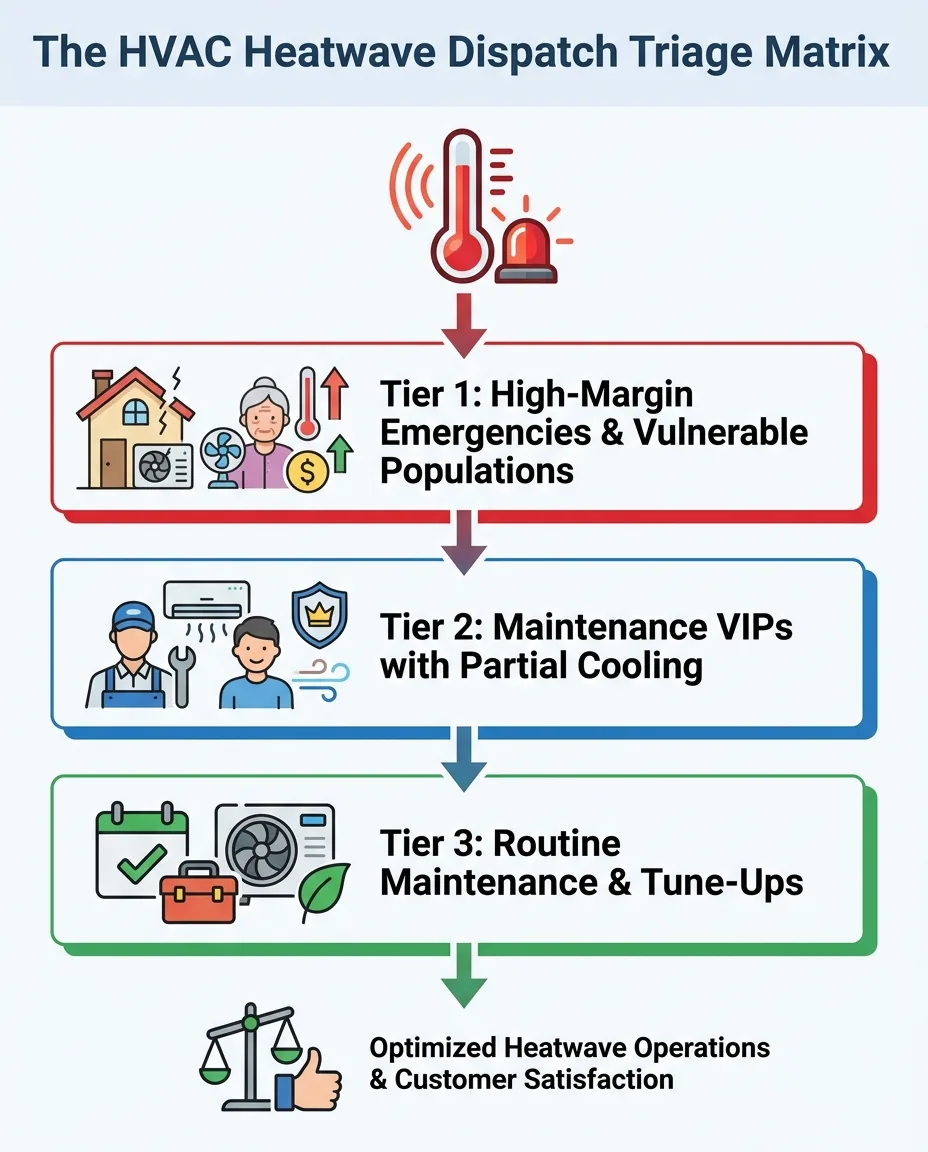
To remove the guesswork from your call takers' plates, you must implement a structured categorization system. Understanding how to handle high call volume during peak season requires shifting your dispatch board into a strict "heatwave mode," where every incoming call is filtered through a predefined matrix.
The Heatwave Dispatch Triage Framework:
1. Tier 1: High-Margin Emergencies & Vulnerable Populations. These are the absolute highest priority calls. This tier includes complete system failures in homes with elderly residents, infants, or individuals with medical conditions that require climate control. It also includes high-margin, catastrophic breakdowns where the customer is ready to approve major repairs or full system replacements. Response time for Tier 1 should be immediate or same-day.
2. Tier 2: Maintenance VIPs with Partial Cooling. This tier prioritizes your loyal customer base. If a maintenance agreement customer calls with a system that is struggling to keep up but still providing some cooling, or if they have an intermittent issue, they fall into Tier 2. You honor your contract by getting to them quickly, typically within 24 hours, but they do not bump a Tier 1 vulnerable population call.
3. Tier 3: Routine Calls and Minor Inquiries. During July heatwaves, routine maintenance, standard tune-ups, and calls about minor, non-disruptive noises must be deprioritized. These callers should be scheduled out for when the heatwave breaks. Dispatchers must be trained to politely but firmly communicate that emergency, no-cool situations are taking precedence.
4. Tier 4: Non-Customer Administrative Calls. Vendor inquiries, sales calls, and general administrative questions must be completely filtered out of the primary dispatch workflow during a heatwave to keep lines open for paying customers.
By strictly enforcing these tiers, you protect your technicians' time and ensure that your most critical obligations are met first.

Categorizing and Routing 'No-Cool' Emergencies
Once a call is triaged into the appropriate tier, the next operational hurdle is routing. The traditional method of dispatching calls in strict chronological order—sending a technician to whoever called first—is highly inefficient during peak season. With extreme summer heatwaves driving sudden 'no-cool' spikes across the region, geographic routing becomes critical to reaching more homes before peak afternoon temperatures turn uncomfortable houses into dangerous environments.
When the "I need it fixed today" calls flood in, dispatchers must act as strategic logistics coordinators. This involves mapping out efficient technician routes based on geographic clusters. If a technician is already in the north end of your service area handling a Tier 1 emergency, the dispatcher should route the next closest Tier 1 or Tier 2 call in that same zip code to them, rather than sending them across town.
Key strategies for heatwave routing:
• Geographic Clustering: Group urgent calls by zone. This drastically reduces travel time (windshield time), allowing a single technician to increase their daily call capacity by one or two extra jobs.
• GPS Tracking Integration: Dispatchers must utilize GPS tracking software in real-time to identify which technician is physically closest to a newly verified Tier 1 emergency, allowing for rapid rerouting.
• Managing Customer Expectations: When call volume is at its peak, providing exact arrival times is a recipe for broken promises. Dispatchers must communicate realistic, expanded time windows (e.g., "between 2 PM and 6 PM") to give technicians the buffer they need to handle complex repairs without rushing.
• Staging Parts: For known, common failures during heatwaves (like capacitors or contactors), ensure technicians are fully stocked before they leave the shop to minimize supply house runs.
By grouping urgent calls geographically and managing expectations upfront, you maximize your field team's efficiency and revenue-generating potential.
The Role of Trade-Specialized Agents in Accurate Triage
A triage matrix is only as effective as the person executing it. This is where generic, script-reading answering services consistently fail HVAC contractors. When a homeowner calls in a panic, a generalist call-taker will often categorize every "it's hot in here" complaint as a top-tier emergency. They lack the technical context to challenge the caller's assessment or ask the right clarifying questions.
Trade-specialized dispatchers are the only reliable executors of a complex triage framework, as they ensure maintenance agreement customers are honored while capturing high-margin emergencies. At Contractor in Charge, we highly recommend utilizing virtual customer service teams with actual HVAC backgrounds because it protects your technicians' time by filtering out false emergencies before a truck ever rolls.
Consider the difference in call handling during July heatwaves:
• Initial Assessment — Generic Answering Service: Logs the complaint verbatim and marks it as an emergency based on customer tone. — Trade-Specialized Virtual Agent: Asks technical qualifying questions (e.g., "Is the outdoor fan spinning? Is there ice on the line?").
• Troubleshooting — Generic Answering Service: Unable to provide any basic troubleshooting steps. — Trade-Specialized Virtual Agent: Can walk the customer through checking the thermostat batteries or resetting a tripped breaker.
• Triage Accuracy — Generic Answering Service: Frequently miscategorizes Tier 3 routine issues as Tier 1 emergencies. — Trade-Specialized Virtual Agent: Accurately distinguishes a blown capacitor symptom from a completely failed compressor.
• Business Impact — Generic Answering Service: Wastes technician time on false alarms, reducing overall daily revenue capacity. — Trade-Specialized Virtual Agent: Protects the bottom line by ensuring technicians are only dispatched to legitimate, profitable repairs.
Accurate initial triage directly impacts your first-time fix rates. When a specialized agent gathers detailed technical symptoms upfront, the technician arrives on-site already knowing what parts to pull from the truck, drastically reducing diagnostic time.
Preventing Dispatcher and Technician Burnout
The operational toll of sustained high-volume days cannot be overstated. When a heatwave drags on for a week or more, the constant pressure of "I need it fixed today" calls wears down even the most resilient internal staff. Burnout leads to mistakes in routing, poor customer service interactions, and ultimately, staff turnover.
Addressing the human element of peak season operations is vital for long-term success. One critical strategy is implementing robust overflow support to handle after-hours and weekend surges. Over our years of managing after-hours dispatch, we have seen businesses struggle immensely when their on-call technicians are constantly woken up for minor issues that could have waited until morning. In one specific case, a local home services operation recognized their critical need for overflow and after-hour call management. By partnering with our dedicated support team to handle these off-hours calls, they saw a significant improvement in their overall call management and responsiveness, while finally allowing their on-call technicians to get necessary rest.
Strategies for maintaining team stamina:
• Implement Overflow Call Centers: Do not let your in-house dispatchers take the brunt of the surge alone. Route overflow calls to a specialized team once wait times exceed two minutes.
• Shift Administrative Burdens: Leveraging back office solutions for tasks like bookkeeping, parts ordering, and warranty processing allows your core team to focus entirely on dispatch execution.
• Enforce Mandatory Rest Periods: Dispatch rules must include hard stops for technicians. Working a tech for 16 hours straight in extreme heat is a massive safety liability and leads to costly diagnostic errors.
• Celebrate the Wins: Keep morale high by acknowledging the hard work of both the field and office staff during the peak of the season.
Protecting your team's energy is just as important as protecting your profit margins. A burned-out dispatcher cannot effectively manage a triage matrix.
Frequently Asked Questions About Peak Season Dispatching
How do you prioritize HVAC service calls?
You prioritize HVAC service calls by using a tiered system that evaluates the customer's status, the severity of the issue, and the presence of vulnerable occupants. True emergencies, such as complete system failures in homes with elderly residents, take top priority. Next are your VIP maintenance agreement customers experiencing partial cooling issues, followed by routine tune-ups and minor inquiries, which should be scheduled for after the severe weather breaks.
What is an HVAC dispatch priority matrix?
An HVAC dispatch priority matrix is a structured framework that dictates exactly which types of calls take precedence, removing guesswork for your dispatchers. It categorizes incoming requests into specific tiers (e.g., Tier 1 for emergencies, Tier 2 for VIPs, Tier 3 for routine). This matrix ensures that high-margin repairs and contractual obligations are met efficiently during times of overwhelming call volume.
How to handle high call volume in HVAC?
To handle high call volume effectively, you must implement a "heatwave mode" protocol that shifts your team away from standard chronological scheduling. Utilize overflow call centers to ensure every call is answered, apply a strict triage matrix to categorize emergencies, and cluster your technician routing geographically. This minimizes windshield time and maximizes the number of homes your team can service in a single day.
How do dispatchers manage emergency calls?
Dispatchers manage emergency calls by triaging the technical symptoms accurately over the phone to confirm it is a true emergency, rather than a simple tripped breaker. Once verified, they use GPS tracking to route the closest available technician to the job site. They also manage customer expectations by providing realistic time windows rather than exact arrival times, allowing technicians the flexibility they need.
When should an HVAC business switch to heatwave scheduling?
An HVAC business should trigger heatwave mode immediately when local forecasts predict sustained extreme temperatures, or the moment incoming call volume exceeds internal capacity by a set threshold (such as a 50% spike). Proactively shifting to this rigid scheduling model before the board becomes completely unmanageable is key to maintaining control during July heatwaves.
Optimize Your Dispatch Board for the Next Temperature Spike
Surviving the peak season requires more than just working harder; it requires working with a strategic, rigid framework. Implementing a dispatch prioritization matrix protects both your immediate revenue and your long-term customer relationships. By categorizing calls accurately, routing technicians geographically, and filtering out false emergencies with trade-specific knowledge, you can turn the chaos of July heatwaves into your most profitable time of the year.
The key is to have this structured triage system in place long before the heat actually hits. Do not wait until your board is overwhelmed and your technicians are exhausted. Evaluate your current capacity, define your priority tiers, and ensure your team is trained to execute the plan flawlessly. If your internal resources are stretched thin, prompt your operations team to explore specialized support to keep your dispatch board running efficiently when the temperature spikes.