

The Reality of OnePath AI for Home Services: When Bots Help and When They Hurt Conversion

The Myth of 100% Automated Lead Management
In our experience managing communications at Contractor in Charge, a dangerous myth in the home services industry is that automated software can entirely replace human dispatchers without costing you jobs. The reality of OnePath AI for home services: when bots help and when they hurt conversion is that success requires knowing exactly when to rely on automation and when to step in with a real voice. Many contractors install a chatbot on their website or set up an automated phone tree, assuming the technology will handle every customer interaction flawlessly. The concrete problem arises when you start losing high-value, urgent service requests simply because an automated system frustrated a homeowner who needed immediate help.
The critical decision point for any growing contractor is determining exactly when to deploy artificial intelligence for routine administrative tasks versus when to route those calls to a human being. An OnePath AI CRM lead management system is a remarkably powerful tool, but it requires strategic implementation. If a customer is calling about a routine MERV 11 filter change, automation works perfectly. If they are calling for an after-hours emergency HVAC repair because their 15-year-old furnace failed during a late-January deep freeze, a bot will likely drive them straight to your competitor.
To protect your marketing investments and secure more bookings, we always recommend building a safety net. This means integrating your digital tools with a professional live answering service that can take over the moment a conversation requires genuine empathy. Relying solely on one or the other creates blind spots in your customer journey.
Where OnePath AI Excels: Speed, Data, and Routine Scheduling
To build an effective intake process, our team typically sees that you first need to recognize where automated systems outperform human operators. Artificial intelligence is built for speed, accuracy, and data processing. When a homeowner reaches out for a non-emergency inquiry, an AI system drastically improves your speed-to-lead. It responds instantly, never puts a customer on hold, and never takes a sick day.
Automated chatbots and virtual assistants excel at capturing precise data. They can collect a customer's name, address, specific equipment details—like a 3-ton 16 SEER heat pump model number—and preferred appointment times without spelling errors or missed details. This seamless CRM integration ensures your technicians have the exact information they need before they even step into the truck. Furthermore, AI acts as an excellent filter. It can qualify leads, answer basic administrative questions, and handle warranty inquiries before those calls ever consume a human dispatcher's valuable time. For standard scheduling, AI provides a frictionless, modern experience that many consumers actually prefer over waiting on hold.
Optimizing Non-Urgent Service Requests
Routine requests do not require emotional intelligence. They require efficiency. By routing these specific tasks through an automated system, you streamline your entire operation:
1. Automated appointment setting: Customers booking seasonal tune-ups ahead of the spring cooling season can select a time slot directly from your calendar without a single phone call.
2. Efficient data gathering: Chatbots prompt users for necessary system details, ensuring your team knows exactly what parts might be required for the visit.
3. Freeing up human staff: When bots handle the easy questions, your in-house dispatchers have the bandwidth to focus on complex logistics, technician routing, and high-level customer service issues.
4. Consistency in qualification: The software asks the exact same qualifying questions every single time, ensuring no detail is skipped during the intake process.
An after-hours emergency HVAC repair demands human attention, but a Tuesday afternoon inquiry about routine duct cleaning is perfectly suited for automation.
The Empathy Gap: When Automated Systems Frustrate Homeowners
The Problem: In our years of handling emergency dispatch, we have learned that while automation handles routine tasks beautifully, it completely lacks emotional intelligence. In the home services industry, the urgency of a repair directly dictates the required level of empathy from your business. When a homeowner faces an active crisis—like a flooded basement destroying the hardwood floors of a 1990s tract home or a failing air conditioner during a late-July heatwave—their mindset is rooted in panic. They are not looking for an efficient data-entry process; they are looking for reassurance that help is on the way.
The Cause: Automated loops and rigid chatbot menus de-escalate nothing. When extreme weather seasons hit, they fundamentally change customer patience levels. During extreme winter cold snaps or peak summer temperatures, a homeowner's tolerance for navigating a phone tree drops to zero. If a panicked caller hears, "Please press 1 for scheduling, press 2 for maintenance," or gets trapped in a chatbot loop asking for their zip code repeatedly, their frustration spikes. These weather-driven call surges turn automated systems into massive liabilities because the technology cannot adapt its tone to match the caller's distress.
The Solution: Securing the booking during a crisis requires immediate human intervention. A live operator can listen to the panic, validate the customer's fear, and confidently say, "I understand your basement is flooding. I am dispatching a technician to your home right now." This level of emotional connection is the only way to successfully navigate managing emergency after-hours calls without losing the lead.
The Cost of a Frustrated Caller
Failing to provide an immediate human response during an emergency carries steep consequences for your business:
• Speed-to-lead is negated: It does not matter if your chatbot replies in half a second if the user abandons the chat out of frustration within the critical 3-minute response window. The speed advantage disappears the moment the customer feels unheard.
• Immediate competitor dialing: Panicked customers will not wait for you to open at 8:00 AM. If they cannot reach a real person, they will immediately dial the next contractor on the Google search results page.
• Reputational damage: Appearing unreachable or robotic during a crisis leads to negative reviews. Customers remember how you made them feel when they were vulnerable, and a frustrating automated loop leaves a lasting bad impression.
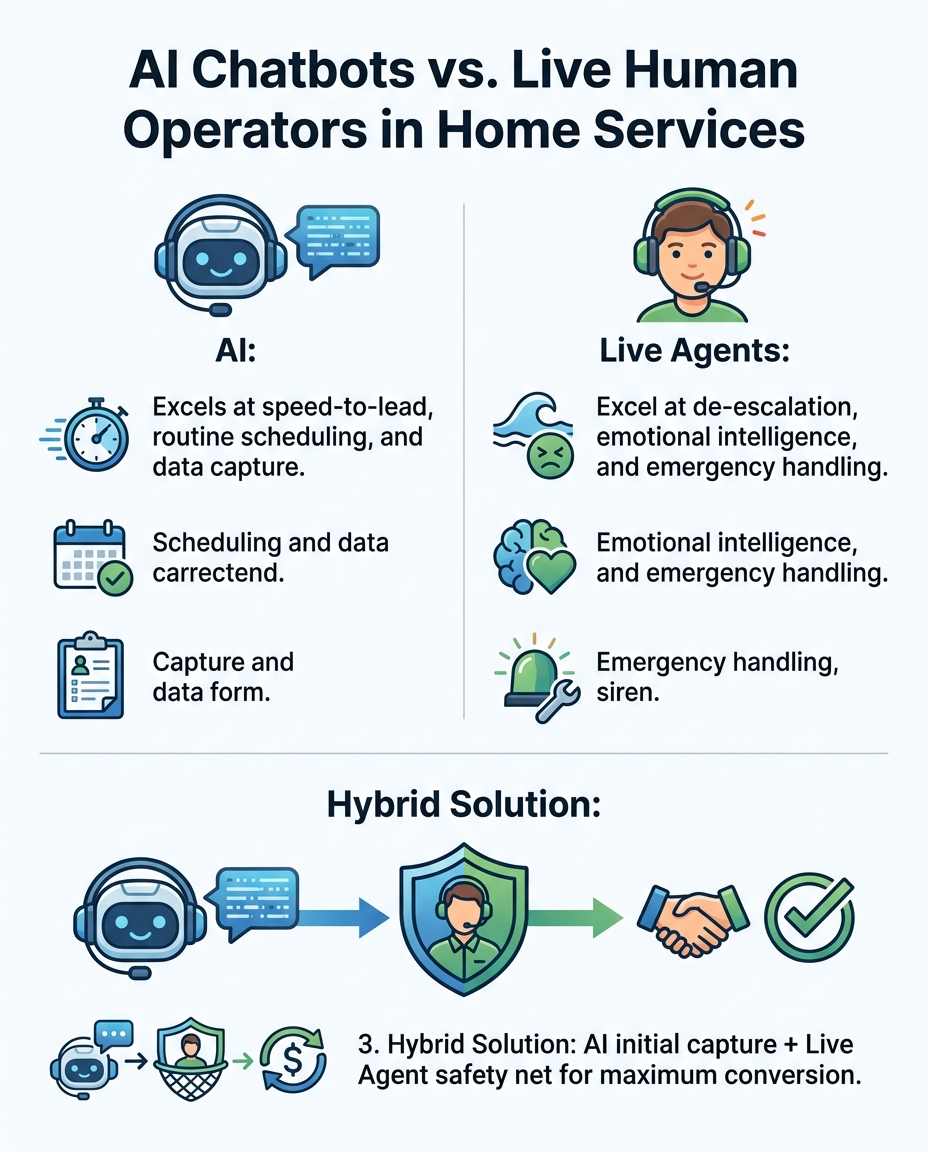
Side-by-Side: AI Chatbots vs. Live Human Operators
To maximize your conversion rates, we recommend using a clear, objective framework to evaluate which system to use for different call types. Both AI chatbots and live human operators have distinct strengths, and forcing one to do the job of the other is where contractors lose out on high-value bookings.
• Response Time — AI Chatbots & Automation: Instantaneous, zero wait time. — Live Human Operators: Fast, but subject to call volume and hold times.
• Empathy & De-escalation — AI Chatbots & Automation: Non-existent. Cannot read tone or panic. — Live Human Operators: High. Can calm a panicked homeowner immediately.
• Data Accuracy — AI Chatbots & Automation: Perfect. Directly inputs data into the CRM. — Live Human Operators: Good, but subject to occasional human error.
• Cost Effectiveness — AI Chatbots & Automation: Highly cost-effective for routine, high-volume tasks. — Live Human Operators: Higher cost, but provides massive ROI on high-ticket emergencies.
• Complex Diagnostics — AI Chatbots & Automation: Fails when the issue falls outside pre-programmed menus. — Live Human Operators: Excels at asking nuanced, follow-up questions to diagnose the real issue.
When to Deploy AI
Reserve your automated systems for interactions that do not carry emotional weight. AI is the perfect tool for routine maintenance scheduling for standard 80% AFUE furnaces, answering general frequently asked questions, and handling initial lead qualification during standard business hours. If the customer's property is safe and they are simply gathering information, automation provides the friction-free experience they want.
When Live Operators Are Strictly Necessary
You must route calls to a human being the moment property damage or safety is at risk. Live operators are strictly necessary for active property damage scenarios—like a burst pipe in a second-floor bathroom—extreme weather system failures, and complex diagnostic inquiries that require a nuanced response. When a homeowner is dealing with extreme winter or peak summer temperatures and their system fails, only a human voice can secure that high-value booking.

Implementing a Hybrid Approach for After-Hours Support
Contractors should never feel forced to choose entirely between automation and human connection. We see that the most profitable home service businesses implement a hybrid approach that blends the flawless efficiency of AI with the irreplaceable empathy of a live dispatcher. This model uses AI for the initial greeting and data capture but offers an immediate, frictionless escape hatch to a human operator the moment the system detects urgency.
By utilizing tools like OnePath AI CRM alongside a dedicated answering service, you create a comprehensive safety net for your high-value leads. For example, one plumbing and HVAC business reached out to us during a harsh mid-December cold snap needing a reliable extension for their customer service. By partnering with a team that provided an after-hours call center, agents like Danielle and Rianna offered the exact support required to keep operations running smoothly while the software handled the backend data. This seamless integration ensures that an after-hours emergency HVAC repair is escalated immediately, while a request for a spring tune-up is quietly scheduled in the background.
Contractor in Charge stands out by offering both advanced AI CRM solutions and professional 24/7 live agent call center services. This dual capability means you do not have to piece together incompatible software and third-party call centers. You get a unified, hybrid solution that scales effortlessly during peak demand without ever sacrificing the customer experience. Your routine calls are automated, and your emergencies are handled with care, ensuring no lead slips through the cracks.
Safeguarding Your Marketing ROI from Abandoned Calls
Your operational choices directly impact your bottom line. Home service contractors spend significant marketing budgets every month on pay-per-click advertising, local service ads, and SEO to generate leads. It is a massive waste to deploy those marketing efforts only to lose the customer at the final conversion stage because a chatbot frustrated them.
Properly routing urgent calls maximizes your chances of converting leads to revenue. When you safeguard your intake process, you protect your return on investment. Consider the following steps our team uses to audit systems:
• Track your drop-off points: Review your 30-day chat logs and phone tree analytics to see exactly where customers abandon the interaction. If they are hanging up after the second automated prompt, your menu is too long.
• Measure conversion by channel: Compare the booking rates of leads managed entirely by AI versus those handled by human operators during emergencies.
• Audit your after-hours response: Test your own systems during extreme winter or peak summer temperatures. Call your business at 2:00 AM and see how difficult it is to reach a person.
• Implement a zero-friction escape hatch: Ensure that at any point in an automated chat or phone menu, the customer can press "0" or type "Agent" to be immediately connected to a live dispatcher.
Frequently Asked Questions About AI in Home Services
Should home service companies use AI chatbots?
Yes, we always advise that home service companies should absolutely use AI chatbots, provided they are deployed strategically. Chatbots are highly effective for answering frequently asked questions, capturing basic customer information, and scheduling routine maintenance. However, they should always include a clear option to transfer to a live representative if the customer's request is urgent or complex.
When should HVAC companies use live operators instead of AI?
HVAC companies must use live operators whenever a call involves property damage, safety risks, or extreme weather emergencies. For instance, an after-hours emergency HVAC repair for a failing 14 SEER unit during a freezing night requires a live operator to de-escalate the homeowner's panic and provide immediate reassurance that a technician is on the way.
How does AI impact home service lead conversion?
AI positively impacts lead conversion by drastically improving speed-to-lead for non-urgent inquiries, ensuring no routine request goes unanswered. However, if AI is forced to handle urgent, high-stress calls, it can negatively impact conversion by frustrating panicked callers who will hang up and contact a competitor instead.
Can AI chatbots handle emergency plumbing and HVAC calls?
No, AI chatbots should not handle the entirety of an emergency plumbing or HVAC call. While they can be used to ask the initial qualifying question (e.g., "Is this an emergency?"), the system must immediately route the user to a live dispatcher the moment an emergency is confirmed. Bots lack the empathy required to secure a booking from a distressed homeowner.
What is the best way to manage emergency contractor calls?
The best way to manage emergency contractor calls is through a hybrid system that combines CRM software with a 24/7 live answering service. This ensures that caller data is accurately recorded in your system while a real human being speaks to the customer, validates their emergency, and secures the dispatch.
Design a Lead Management Framework That Actually Converts
At Contractor in Charge, our ultimate goal is to help you build a clear, objective framework that identifies which specific call types automation handles effectively and which require human empathy. The right technology, when paired with the right human touch, prevents lead abandonment and ensures your marketing efforts turn into booked jobs. An after-hours emergency HVAC repair requiring a rapid 30-minute dispatch window requires a different approach than a routine filter change, and your intake system must reflect that reality.
Do not let a rigid automated system cost you your highest-value jobs. Take the time to evaluate your current after-hours intake process and identify where your customers might be experiencing friction. By exploring a hybrid lead management and answering solution, you can enjoy the cost-saving efficiency of AI while maintaining the reassuring, human connection that panicked homeowners desperately need.