

Structuring Commission vs. Hourly Pay for Dedicated Outbound Schedulers

How Do You Motivate Schedulers Without Risking Customer Trust?
Is your outbound scheduling team actually driving growth, or just going through the motions? When deciding between commission and hourly pay for outbound schedulers, home service business owners face a difficult balancing act. At Contractor In Charge, we hear from local contractors every week who need their customer service representatives (CSRs) to hit aggressive call volume targets, especially when trying to fill the dispatch board with shoulder season tune-up campaigns. However, pushing too hard for numbers can inadvertently incentivize aggressive sales tactics, leading to burned-out employees and alienated homeowners.
This creates a critical decision point for any plumbing, electrical, or HVAC operation. Do you compensate your dedicated outbound schedulers using a stable hourly rate, a performance-based commission, or a hybrid model? The answer directly impacts your ability to maximize booked seasonal tune-ups while protecting your local reputation.
The core challenge of outbound scheduling:
• Call reluctance: Picking up the phone to make outbound calls requires persistent energy that naturally wanes throughout an eight-hour shift.
• Quality vs. Quantity: Rushing through a call list to hit a quota often means missing the subtle buying signals that lead to larger ticket sizes down the road.
• Brand protection: A pushy scheduler can permanently damage the trust you have spent years building in your community.
Ultimately, solving this dilemma requires a comprehensive approach to lead to revenue management. By aligning your compensation structure with your broader business goals, you can build an outbound team that consistently converts idle contact lists into profitable service appointments.
The Hourly Pay Model: Stability vs. Complacency
The most common approach to paying inside sales support and outbound schedulers is a straightforward hourly wage. This model is simple to administer, easy to forecast, and provides employees with a predictable paycheck regardless of how many shoulder season tune-up campaigns they successfully book in a given week.
In an industry where call center turnover rates are historically high, our team has found that providing income stability is a powerful retention tool. When CSRs know their basic living expenses are covered, they experience less financial anxiety. This often translates to better, more patient customer interactions. An hourly employee is far less likely to pressure a hesitant homeowner into a maintenance visit they do not want, thereby protecting your brand's reputation.
However, the purely hourly model carries significant drawbacks when applied to outbound scheduling.
Pros of the Hourly Pay Model:
• High income stability: Reduces financial stress for your team, which can lower turnover rates and reduce hiring costs.
• Protected brand reputation: Without the pressure of a commission-only quota, CSRs focus on providing helpful, friendly service rather than aggressive closing tactics.
• Predictable overhead: Business owners can easily calculate payroll expenses and manage seasonal budgets without unexpected commission spikes.
• Focus on call quality: Inside sales support teams operating on an hourly wage are more likely to follow scripts carefully and accurately update customer records.
Cons of the Hourly Pay Model:
• Lack of urgency: There is no financial incentive to make the extra ten calls at the end of a long shift or push through a high volume of voicemails.
• Performance plateaus: Top performers quickly realize they are paid the same as underperformers, which can breed resentment and lower overall team productivity.
• Missed booking targets: During critical periods, purely hourly pay often fails to motivate the persistence required for outbound seasonal scheduling, leaving your dispatch board empty.
• Cost inefficiency: You pay the same payroll amount whether the CSR books twenty tune-ups or zero, meaning your cost per acquisition can skyrocket during slow weeks.
The Commission Model: High Volume vs. Brand Risk
On the opposite end of the spectrum is the pure commission model. In this structure, outbound schedulers earn their income based entirely on their output—typically measured by the number of successful bookings they secure for shoulder season tune-up campaigns or the revenue generated from those appointments.
From a purely financial perspective, commission-only structures are highly appealing to business owners. Your payroll expenses scale directly with your revenue generation. If the phones are quiet and no appointments are booked, your labor costs remain low. Furthermore, this model naturally filters out employees who lack the drive for outbound sales, leaving you with a highly aggressive, volume-focused team.
Yet, based on the patterns we see often in the local area, relying on a pure commission model introduces severe operational and reputational risks for local home service businesses.
Pros of the Commission Model:
• Maximum raw output: Commissioned CSRs are highly motivated to dial faster, overcome objections, and push for the booking on every single call.
• Performance-based costs: Payroll expenses are directly tied to successful outcomes, ensuring you only pay for actual results.
• Attracts driven talent: Highly confident sales professionals often prefer commission structures because their earning potential is uncapped.
Cons of the Commission Model:
• Severe brand reputation risks: Desperate CSRs may resort to "slamming"—booking unqualified appointments, misleading homeowners about the service, or using high-pressure tactics that alienate your customer base.
• High burnout and turnover: Periods of low contact rates or seasonal slowdowns lead to sudden drops in income, causing top talent to quit abruptly.
• Operational friction: Technicians often arrive at homes to find confused or angry customers who felt tricked into the appointment by a pushy scheduler.
• Heavy management burden: This model requires rigorous quality assurance oversight and constant call monitoring to prevent customer alienation and ensure compliance with your company standards.
Side-by-Side Comparison: Evaluating Outbound Compensation Structures
Choosing the right compensation structure requires a careful analysis of how each model impacts your specific operational goals. A model that works perfectly for an inbound emergency dispatch team will likely fail when applied to an outbound team trying to secure maintenance agreements.
To help you weigh your options, our team has broken down the key differences across four critical metrics in the table below: Booking Volume, Customer Experience, Retention, and Financial Predictability. Understanding these trade-offs is essential when you need to manage high call volume during peak season transitions.
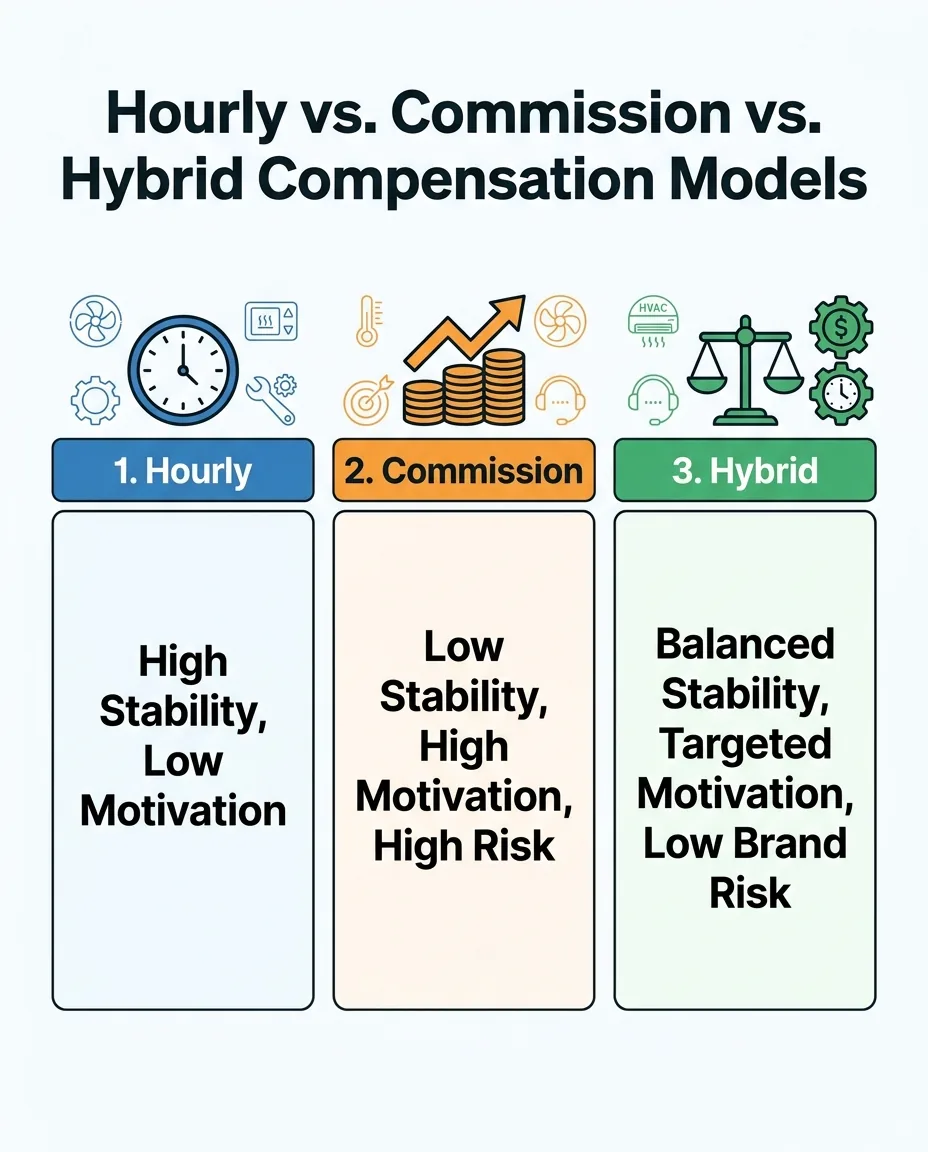
• Pure Hourly — Booking Volume: Low to Moderate — Customer Experience: High (Friendly, no pressure) — Employee Retention: High (Stable income) — Financial Predictability: High (Fixed payroll costs)
• Pure Commission — Booking Volume: Very High — Customer Experience: Low (Risk of pushy tactics) — Employee Retention: Low (High burnout rate) — Financial Predictability: Moderate (Tied to revenue)
• Hybrid (Base + Bonus) — Booking Volume: High — Customer Experience: High (Quality controlled) — Employee Retention: Very High (Best of both) — Financial Predictability: Moderate (Base is fixed, bonus scales)
Analyzing the data:
The comparison clearly illustrates why extremes rarely work in the home service industry. The pure hourly model protects your brand but starves your dispatch board. The pure commission model fills the board but risks burning your local reputation to the ground.
This is why the most successful home service contractors ultimately transition to a hybrid hourly-plus-performance compensation structure. By combining the stability of a base wage with the motivation of targeted bonuses, you create an environment where CSRs feel secure enough to provide excellent service, but hungry enough to push for the booking.

Why the Hybrid Model is the Ultimate Solution for Trades
Leveraging Contractor In Charge's deep expertise in home service administration, we consistently recommend a hybrid hourly-plus-performance compensation structure as the most effective way to drive trade-specific KPIs. This model provides a stable base wage to secure employee retention, paired with performance incentives (often called SPIFFs) that drive booking rates without encouraging pushy tactics.
When structured correctly, a hybrid model aligns the CSR's financial goals directly with the business owner's operational needs. One winter, a home service company lost its primary dispatcher and call taker, creating a critical operational gap right when heating calls were spiking. Contractor In Charge stepped in to take over full-time dispatch and call-taking responsibilities. By applying our proven compensation and management frameworks to our dedicated agents, the client was not only able to stabilize their operations but actually grow and operate more effectively than before.
Here is how to structure a successful hybrid model for your outbound team:
1. Set a competitive base wage: Establish an hourly rate that covers the local cost of living. This removes financial desperation from the equation, ensuring the CSR does not sound panicked or aggressive on the phone.
2. Define clear performance triggers: Bonuses should be tied to specific, measurable actions. For outbound schedulers, this typically means a flat bonus per booked and completed maintenance appointment, or a percentage bonus for selling a new annual membership.
3. Implement quality assurance multipliers: To prevent CSRs from booking bad appointments just to hit a quota, tie their bonus payout to a quality score. If an appointment is booked but the CSR failed to verify the customer's address or equipment age, the bonus is reduced or forfeited.
4. Create tiered goals: Encourage continuous effort by increasing the bonus payout once a certain volume threshold is reached. For example, the first twenty bookings in a week yield a standard bonus, but every booking after twenty yields a higher premium.
A professional answering service for contractors often utilizes variations of this exact hybrid model. It is the only reliable way to maintain both high call quality and high output over long periods of time.
Aligning CSR Compensation with Seasonal HVAC Goals
The home service industry is inherently cyclical. During the moderate shoulder seasons of spring and fall, HVAC companies urgently rely on outbound schedulers to fill the dispatch board with maintenance tune-ups before extreme weather hits. This is the time of year when your outbound scheduling strategy makes or breaks your quarterly revenue.
Our team typically sees that your compensation structure must reflect this seasonal urgency. A static pay model fails to account for the shifting priorities of your business. When you utilize a hybrid hourly-plus-performance compensation structure, you gain the flexibility to adjust incentives based on immediate operational needs.
Strategies for seasonal alignment:
• The Shoulder Season Push: During spring and fall, temporarily increase the SPIFF for booking shoulder season tune-up campaigns. This focuses your team's attention exactly where you need it—bridging the revenue valley between peak heating and cooling seasons.
• Targeting aging equipment: If your installation crews are sitting idle, create a specific bonus for outbound CSRs who successfully book a sales consultation for systems over ten years old.
• After-hours capture: Partnering with a dedicated service can expand your reach. In one instance, a plumbing and HVAC business needed reliable after-hours support to capture emergency calls without burning out their daytime staff. Our team took over the after-hours management, with specialized agents providing excellent customer service to callers in distress. Because the agents were supported by aligned compensation and management structures, the business received seamless support and positive customer interactions around the clock.
Scaling your outbound efforts becomes much easier when you have a 24/7 live agent call center backing up your internal team. By ensuring that every agent handling your account is motivated by a balanced, quality-focused compensation model, you guarantee that your dispatch board stays full without sacrificing the customer experience.
Frequently Asked Questions About CSR Compensation
Is it better to pay appointment setters hourly or commission?
In our experience working with home service businesses, a hybrid approach is generally best to balance quality and volume. A pure hourly rate often leads to complacency and low booking volumes, while pure commission can incentivize aggressive tactics that damage your local reputation. A hybrid hourly-plus-performance compensation structure provides the financial stability needed to retain good talent, along with the bonuses required to drive persistent outbound dialing.
How do you incentivize outbound CSRs?
The most effective way to incentivize outbound CSRs is through a combination of SPIFFs, tiered bonuses, and team-based goals. You can offer a flat bonus for every successful maintenance appointment booked, or provide a premium payout once a CSR exceeds their weekly quota. It is also highly effective to tie these incentives to quality assurance scores, ensuring that volume does not come at the expense of customer service.
What is a hybrid compensation model for call centers?
A hybrid compensation model defines a pay structure that combines a stable hourly base wage with performance-based bonuses for specific outcomes. In a home service call center, this usually means the CSR earns a reliable hourly paycheck to cover their living expenses, plus additional financial rewards for booking calls, selling memberships, or saving canceled appointments.
How should I structure pay for seasonal employees?
When hiring temporary staff to handle peak season overflow, it is often best to offer slightly higher base rates or aggressive short-term SPIFFs to attract talent quickly. Because seasonal employees know their tenure is limited, they require immediate, tangible financial motivation to perform at a high level. Clear, easy-to-understand bonus structures work best for short-duration staff.
Does pure commission increase call center turnover?
Yes, pure commission structures often lead to higher burnout and turnover due to extreme income instability. When contact rates drop or seasonal demand wanes, commission-only CSRs see their paychecks plummet, prompting them to leave for more stable opportunities. This constant churn forces business owners to spend excessive time and money recruiting and training replacements.
Optimize Your Call Center Performance with the Right Structure
Motivating your outbound scheduling team does not have to be a guessing game. The right compensation model directly aligns your employees' financial motivation with your business goals. While purely hourly pay provides stability and pure commission drives volume, only a hybrid hourly-plus-performance compensation structure offers the balanced approach necessary for long-term success in the trades.
By implementing a stable base wage paired with targeted, quality-controlled bonuses, you can maximize your seasonal tune-up bookings without ever putting your brand's reputation at risk. Take the time to evaluate your current pay structures and look for areas where incentives might be misaligned with your dispatch needs. If you are struggling to build a motivated, high-performing outbound team, our experts at Contractor In Charge are available to help you refine your call center operations and keep your dispatch board full all year round.