

Using AI for Digital Lead Management Without Losing the Human Touch in Customer Service

Myth vs. Reality: Does Lead Automation Mean Sacrificing Empathy?
In our years of managing dispatch operations at Contractor in Charge, the biggest misconception we encounter in the home service industry is that adopting artificial intelligence means replacing your human customer service team with a robot. Using AI to manage digital leads while keeping a human touch in customer service is not only achievable, but it is also rapidly becoming the operational standard for top-performing contractors. The concrete problem many HVAC and plumbing businesses face today is losing warm leads because their fully automated text sequences feel cold, robotic, and completely lack empathy. When a homeowner is dealing with a flooded basement during a torrential spring storm or a freezing house on a sub-zero January night, a canned text message often misinterprets their complex emergency request, leaving them frustrated and ready to call a competitor.
The critical decision point for your business is choosing between these fully automated SMS follow-ups and a much more nuanced approach. By implementing a hybrid AI-to-live-agent SMS handoff workflow, you can secure the lead instantly while ensuring a real person takes over the moment empathy and critical thinking are required. Upgrading to an AI CRM lead management system that prioritizes this seamless transition is the most effective way to protect your brand and capture more revenue.
The Speed-to-Lead Dilemma in Home Services
Our team constantly monitors conversion metrics, and in the highly competitive home services market, the window of opportunity to capture a new customer is incredibly small. A homeowner experiencing an equipment failure—like an older 80% AFUE furnace dying in mid-winter—will typically search online, click on three different websites, and fill out multiple contact forms. The company that responds first is almost always the one that wins the job.
The critical nature of response times:
Industry data clearly shows that reaching out to a prospect within the first five minutes drastically increases your chances of converting that inquiry into a booked appointment. This rapid response is the foundational pillar of any successful speed to lead for home service companies strategy. However, speed alone is not enough to secure a lifelong customer.
The human element of home emergencies:
While technology can acknowledge a form submission in milliseconds, it cannot provide the necessary reassurance a panicked homeowner requires. When a family is facing an unexpected home service emergency, they are stressed, uncomfortable, and looking for immediate guidance. They need to hear from someone who understands the gravity of their situation, not a generic auto-responder that asks them to pick a date on a calendar.
The bottleneck of manual dispatching:
Relying solely on manual dispatching to achieve this speed creates severe operational bottlenecks, especially after hours or during peak July heatwaves and deep winter emergency surges. Human dispatchers get overwhelmed by call volume, leading to missed calls, unread emails, and delayed text responses. Technology must step in to bridge this gap, enhancing your team's capabilities rather than replacing the human connection entirely.
Evaluating Fully Automated SMS Sequences
To understand the value of a balanced approach, we must first objectively evaluate fully automated AI models. When our team audits contractor workflows, we see many software platforms promising a completely hands-off solution where chatbots handle the entire booking process from start to finish. While this sounds appealing from an overhead perspective, it carries significant risks for home service contractors.
• The primary advantage: Unmatched speed. Fully automated systems excel at instant initial lead acknowledgment. The moment a lead enters your system, the bot replies. This guarantees that your speed-to-lead metric drops to mere fractions of a second, immediately stopping the homeowner from continuing their search.
• The failure point: Interpreting complex requests. HVAC and plumbing diagnostics are rarely straightforward. A homeowner might text, "My AC is making a loud grinding noise and the vents smell like burning plastic." An automated bot lacks the situational awareness to recognize this as an urgent safety hazard associated with a failing blower motor. Instead, it might reply with a generic, "Great! What day works best for your tune-up?" This lack of nuance infuriates stressed customers.
• The risk to brand reputation: When homeowners get stuck in automated loops—repeating their problem to a bot that cannot understand them—they feel ignored. This poor experience often leads to negative online reviews and a damaged local reputation.
Ultimately, while automation is a powerful tool for that very first point of contact, we find it is entirely insufficient as a standalone customer service strategy. A hybrid AI-to-live-agent SMS handoff workflow is necessary to catch the nuance of real-world problems and provide the level of care your customers expect.
Inside the Hybrid AI-to-Live-Agent SMS Handoff Workflow
How does this balanced approach actually function in a real-world dispatch environment? The middle ground between slow human response times and robotic automation is a highly structured, carefully timed transition. Based on the protocols we implement at Contractor in Charge, here is a breakdown of the exact mechanics behind a successful handoff.
1. Instant Lead Acknowledgment: When a prospective customer fills out a web form or sends a text message, the AI immediately detects the inquiry. Within seconds, it sends a conversational, personalized ping acknowledging the specific service requested.
2. Basic Context Gathering: The AI is programmed to ask one simple, non-intrusive qualifying question. For example, "I see you need help with your furnace. Are you currently without heat?" This prompts the customer to reply, keeping them engaged with your brand.
3. The Seamless Human Transition: The moment the customer replies with their specific details, the AI instantly halts its automated sequence—typically within a 60-second window. The conversation is immediately routed to a live virtual customer service representative. The agent can see the entire chat history, allowing them to pick up the conversation without asking the customer to repeat themselves.
4. De-escalation and Booking: The human agent reads the context, applies empathy to the situation, and takes control of the interaction. They reassure the homeowner, ask the necessary diagnostic questions, and secure the booked job on the schedule.
This specific workflow bridges the gap between the absolute necessity of speed-to-lead and the equally important requirement for human reassurance. By combining the best aspects of both worlds, contractors can maximize their booked jobs and deliver a superior customer experience.
Protecting Your Brand During Extreme Weather Surges
The true test of any dispatch operation happens when the weather turns extreme. Whether it is a brutal summer heatwave pushing temperatures past 100 degrees or a sudden, deep winter freeze, extreme weather events cause massive, unpredictable spikes in HVAC and plumbing call volumes. During these surges, standard operational protocols often collapse under the weight of the demand.
Managing the chaos of high-volume periods:
When hundreds of calls and web forms flood in simultaneously, human dispatchers cannot physically respond to everyone in a timely manner. This is where AI becomes an invaluable triage tool. The technology effectively manages the initial surge by instantly acknowledging every single incoming request, preventing warm leads from slipping through the cracks. It acts as a digital safety net for your operations.
The necessity of human intervention:
However, during these high-stress periods, human agents are more essential than ever. Panicked homeowners dealing with frozen pipes bursting or dangerous indoor temperatures need to feel heard and prioritized. Fully automated systems cannot de-escalate a frantic caller.
Real-world operational stability:
A pattern we see often is contractors reaching out during a particularly busy winter season, requiring immediate assistance with bookkeeping and dispatch services for their operations. Because they integrated our dedicated dispatch team alongside expert operational advice, the assigned professionals answered critical questions and provided the necessary support to stabilize their workflow. This is exactly how operations survive peak summer and deep winter emergency surges—by utilizing a hybrid model that leverages technology to handle the overwhelming volume, while relying on skilled humans to handle the complexity and maintain strong customer relationships.
The Role of Trade-Trained Agents in De-escalating Emergencies
The success of the hybrid model relies heavily on the quality of the human agent taking over the conversation. At Contractor in Charge, our team provides a hybrid solution tailored specifically for HVAC and plumbing, pairing rapid AI responses with live, trade-trained agents to deliver industry-specific empathy. This distinction is crucial for home service businesses.
Why generic call centers fall short:
Many generic answering services employ agents who handle calls for doctors, lawyers, and retail stores all in the same hour. When an HVAC emergency occurs, these agents lack the technical vocabulary to understand the severity of the issue. They can only take a message and promise a callback, which does little to comfort a homeowner standing in a puddle of water from a cracked 50-gallon water heater.
The value of industry-specific knowledge:
A specialized contractor answering service understands trade terminology. When a customer mentions a frozen evaporator coil or a backed-up 4-inch main sewer line, our trade-trained agents know exactly what that means. They can provide immediate, relevant reassurance and accurately prioritize the call on the dispatch board.
Elevating the customer experience:
Agents who understand the nuances of the trades can better guide customers through preliminary safety steps, such as locating their main water shut-off valve or turning off the 240-volt breaker to a smoking unit. Showing this level of competence immediately builds trust. By combining the instant speed of an AI ping with the specialized knowledge of a trade-trained professional within a hybrid AI-to-live-agent SMS handoff workflow, contractors create a vastly superior customer experience that generic solutions simply cannot match.
Side-by-Side Comparison: Automated vs. Hybrid Models
To make the best decision for your dispatch operations, we recommend looking at an objective, side-by-side comparison of how these two approaches handle the realities of home service customer management.
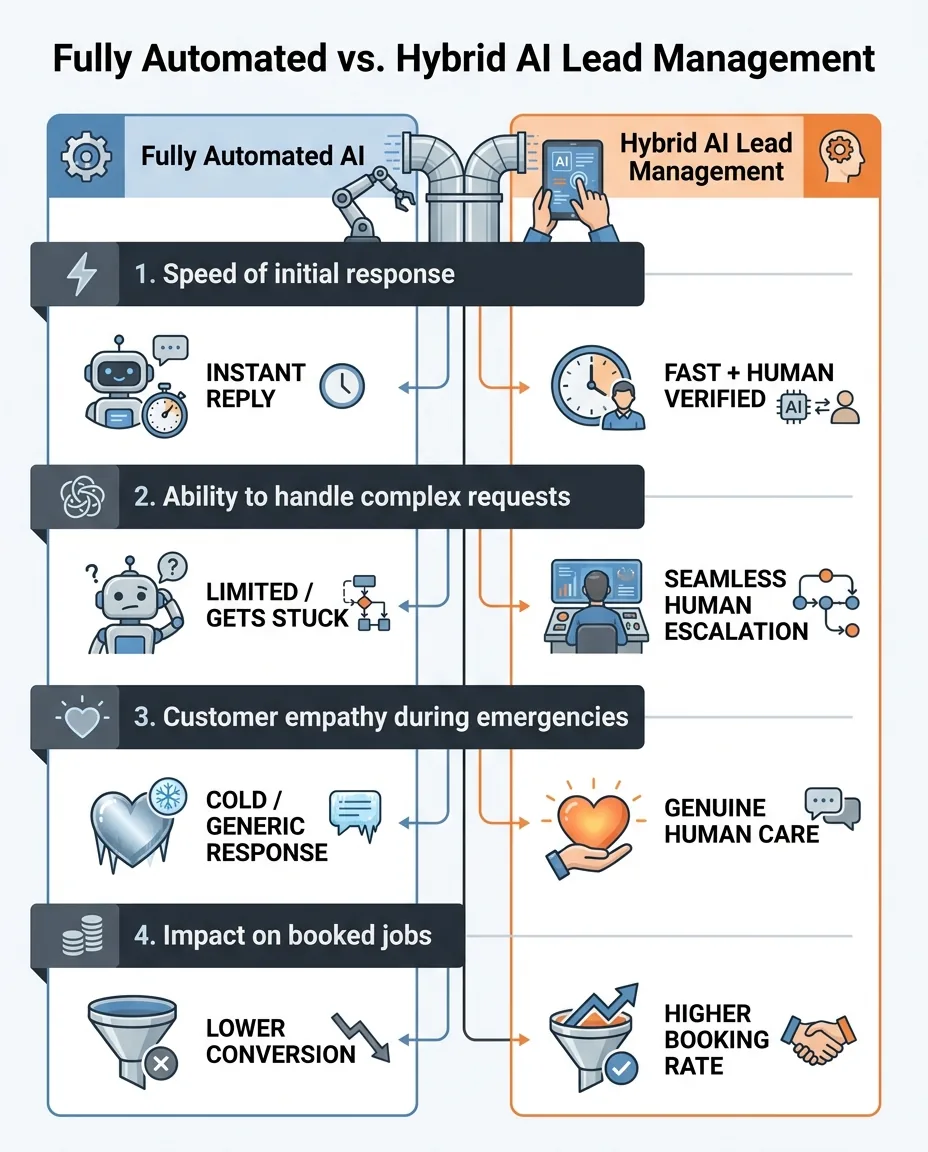
• Speed of Initial Response — Fully Automated SMS Sequences: Instant (Milliseconds) — Hybrid AI-to-Human Handoff: Instant (Milliseconds)
• Handling Complex Diagnostic Requests — Fully Automated SMS Sequences: Low (Frequently misinterprets symptoms and context) — Hybrid AI-to-Human Handoff: High (Human agents catch nuance and ask clarifying questions)
• Customer Empathy During Emergencies — Fully Automated SMS Sequences: Poor (Relies on canned, robotic responses) — Hybrid AI-to-Human Handoff: Excellent (Provides trade-trained reassurance and de-escalation)
• Impact on Maximizing Booked Jobs — Fully Automated SMS Sequences: Moderate (Captures simple inquiries but loses complex emergencies) — Hybrid AI-to-Human Handoff: High (Secures the lead instantly, then uses human skill to close the booking)
As the data shows, while both models solve the initial speed-to-lead problem, only the hybrid approach successfully manages the critical secondary phases of customer interaction.

Frequently Asked Questions About AI in HVAC Customer Service
How do you balance AI and human interaction in customer service?
The most effective way we have found to balance these elements is to assign specific roles to each based on their strengths. Use AI strictly for immediate administrative tasks, such as initial lead acknowledgment and basic data gathering. Once the customer engages, route the conversation to a human agent immediately to handle empathy, negotiation, and complex scheduling.
What is a hybrid AI customer service model?
A hybrid AI customer service model, like the one we deploy at Contractor in Charge, is a dispatch system that pairs automated technology with live, human agents. It ensures that no lead is missed by utilizing instant digital responses, while maintaining a personal connection by seamlessly transitioning the conversation to a real person for the actual booking process.
What are the disadvantages of fully automated AI chatbots?
In our experience, the primary disadvantage is their inability to read emotional cues from stressed customers experiencing a home emergency. Fully automated AI chatbots also have a tendency to trap users in frustrating automated loops when a diagnostic request falls outside of their programmed parameters, which can damage your brand's reputation.
How fast should a contractor respond to a lead?
Industry benchmarks and our own internal data suggest that contractors must respond to a new lead within the first five minutes of the inquiry. Speed significantly increases the likelihood of booking the job, as homeowners typically hire the first company that acknowledges their problem and offers a clear path to a solution.
Can AI accurately diagnose HVAC or plumbing issues?
While AI can gather preliminary symptoms based on a customer's initial text, it cannot replace a professional diagnostic. Our human agents are far better equipped to understand the nuances of a customer's description, ask the right follow-up questions, and schedule the appropriate technician for the job.
Finding the Perfect Balance for Your Dispatch Operations
An objective comparison of lead management strategies clearly favors the hybrid model for home service contractors. In our experience, relying entirely on manual dispatching leaves you vulnerable to missed leads during busy periods, while relying entirely on automation strips away the empathy your customers desperately need. Using AI merely for the initial response before instantly routing the conversation to a live agent combines the best of both worlds.
We encourage you to take the time to evaluate your current lead follow-up systems to ensure they are actually maximizing booked jobs without losing the human touch. If your current process is creating bottlenecks or alienating customers, it is time to upgrade your approach. Partnering with a dedicated 24/7 live agent call center that utilizes advanced hybrid handoff technology will ensure your business remains responsive, empathetic, and highly profitable year-round.