
The Real Reason Small Plumbing Shops Struggle with Owner Dependency During Vacations


The Vacation Illusion: Why Stepping Away Feels Impossible for Trade Owners
Your bags are packed, the out-of-office reply is active, but your phone is already ringing. The reason small plumbing shops can't let the owner fully unplug on vacation is rarely a lack of capable staff—it is the absence of documented Standard Operating Procedures (SOPs) for non-standard customer complaints. Many trade business owners find themselves trapped in a cycle of daily check-ins while technically away, unable to fully disconnect from the daily operations of their company. When every unique escalation routes directly back to the owner's smartphone, a true break becomes physically and mentally impossible.
To break this cycle, the critical decision point for growth is stopping the habit of acting as the sole escalation point. Establishing reliable back-office solutions and documented frameworks allows you to finally step away with confidence. Without these systems, the burden of decision-making remains squarely on your shoulders, regardless of your physical location.
The Psychological Toll of the "Quick Check-In"
Most owners believe that answering just one quick question from a dispatcher will save time and prevent disasters. However, this habit creates a profound operational bottleneck. Consider the typical interruptions that plague a supposed week off:
• The "unique" customer complaint: A homeowner is upset about a diagnostic fee they claim wasn't explained properly.
• The scheduling collision: A major job runs long, forcing the dispatcher to shuffle three other appointments, but they are afraid to make the call on who gets bumped.
• The parts delay: A supplier fails to deliver a critical component, and the technician needs approval to offer a temporary workaround.
• The seasonal surge: During the summer peak busy season, the sheer volume of calls overwhelms the front desk, leading to panicked requests for help.
None of these situations require the technical expertise of a master plumber. They require a business decision. When you are the only person authorized to make that decision, your staff has no choice but to interrupt your time off. Implementing structured virtual support systems and clear guidelines changes this dynamic entirely.
The Hidden Bottleneck: Non-Standard Customer Complaints
Standard dispatching and basic service calls are usually the first things a growing business delegates successfully. A trained call taker can easily book a routine drain cleaning or annual water heater inspection. However, the hidden bottleneck lies in non-standard customer complaints, which require nuanced decision-making and a deep understanding of customer relations.
When a complex issue arises—such as a disputed invoice, a multi-day project delay, or a warranty disagreement—informal communication chains immediately break down. Staff members who lack a documented framework will inevitably default to calling the owner. They do this not out of incompetence, but out of self-preservation; they want to avoid making a costly mistake or angering a valuable client. This dynamic creates an artificial ceiling on your business scalability, trapping you in the day-to-day operations and making vacations a stressful ordeal.
Relying on "tribal knowledge" rather than documented processes ensures that the owner remains the ultimate bottleneck. This was exactly the case for one home services company during a busy winter season. They lost their primary dispatcher and call taker right at the end of the year, leaving the owner entirely unable to handle the flood of calls while managing the business. By partnering with a full-time support team to take over dispatching, they bypassed the bottleneck entirely. The company is now able to grow and run better than ever before, proving that the right virtual customer service partner can stabilize operations even in a crisis.
Comparing Standard vs. Non-Standard Escalations
To understand why edge cases break operations, it helps to see how they differ from routine tasks. The table below illustrates where the breakdown typically occurs:
• Standard Booking — Customer Request: "My toilet is clogged and backing up." — Staff Action Without SOPs: Books the next available technician on the board. — Result for the Owner: Uninterrupted time off.
• Standard Inquiry — Customer Request: "Do you service my specific zip code?" — Staff Action Without SOPs: Checks the service area map and confirms. — Result for the Owner: Uninterrupted time off.
• Non-Standard Complaint — Customer Request: "The tech left mud on my carpet and the leak isn't fixed." — Staff Action Without SOPs: Panics, apologizes, and calls the owner for instructions. — Result for the Owner: Vacation interrupted.
• Complex Dispute — Customer Request: "I was quoted one price, but the final bill is much higher." — Staff Action Without SOPs: Refuses to alter the invoice, calls the owner to mediate. — Result for the Owner: Vacation interrupted.
As the table shows, routine tasks are easily handled by frontline staff. It is the emotionally charged, financially sensitive edge cases that demand a documented response strategy.
How Extreme Weather Breaks Fragile Operational Systems
Informal operational systems might survive during mild, predictable weather, but they shatter during seasonal extremes. If your business relies on verbal instructions and the owner's constant availability, you are highly vulnerable to environmental stressors.
Explicitly, extreme summer heatwaves and sudden winter freezes cause sudden, massive spikes in emergency HVAC and plumbing calls. When temperatures drop below freezing and pipes begin to burst across the region, or when an August heatwave causes air conditioning units to fail simultaneously, emergency call volumes spike dramatically. This surge in high-stress, urgent calls increases the likelihood of non-standard customer complaints and complex dispatch decisions. Customers are agitated, technicians are overworked, and the margin for error shrinks to zero.
If an owner attempts to take a vacation during these volatile periods—or even just step away for a long weekend—without SOPs in place, the sheer volume of escalations will force them back to work. A dispatcher who normally handles ten calls a day might suddenly face forty, including several angry homeowners demanding immediate service. Without a playbook for prioritizing emergencies, the informal communication chain breaks completely.
Documented frameworks act as a shock absorber against this seasonal unpredictability. When the summer peak busy season hits, a well-documented SOP tells your team exactly how to triage calls, what to say to customers who have to wait, and when a situation truly warrants an escalation. This preparation ensures that extreme weather tests your systems, rather than breaking your spirit.
Moving from Owner-Reliant to Process-Driven Escalation
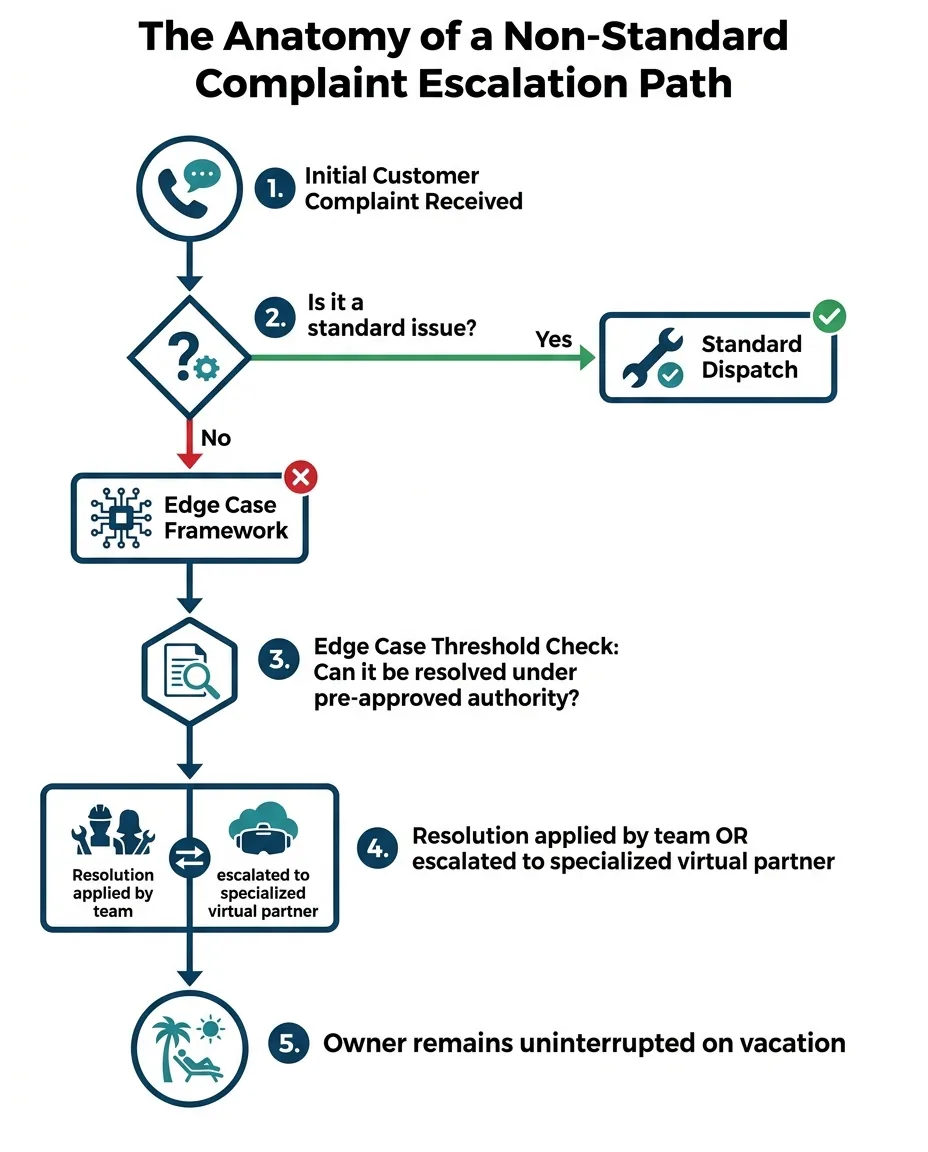
Transitioning away from owner dependency requires a fundamental shift in how your business handles problems. You must move from a reactive, owner-reliant model to a proactive, process-driven escalation system. This means building decision-making frameworks for edge cases so your team knows exactly what to do when things go wrong.
To build a comprehensive blueprint for owner dependency reduction, follow these critical steps:
1. Identify the pain points: Review the past year and list every scenario that required your direct intervention.
2. Build the decision trees: Create "if/then" escalation paths that empower staff to resolve issues up to a certain threshold without your approval.
3. Define true emergencies: Set clear, non-negotiable boundaries for what constitutes an emergency that actually warrants interrupting your vacation.
4. Centralize the documentation: Store these procedures in a centralized, easily accessible digital format rather than relying on verbal instructions or a dusty binder.
5. Conduct role-play training: Train the team on these specific edge-case scenarios before you attempt to step away, ensuring they feel confident executing the plan.
Categorizing Edge-Case Scenarios
The first step to building an SOP is understanding what you are trying to solve. Audit the last ten times your vacation, evening, or weekend was interrupted by the shop. Write down exactly what the caller needed. Next, group these interruptions by type. You will likely find they fall into a few predictable buckets: scheduling conflicts, pricing disputes, part delays, or property damage claims. Once categorized, you can build a single, unified policy for each bucket rather than solving every problem from scratch.
Establishing Authority Thresholds
Your staff cannot execute an SOP if they are terrified of financial repercussions. Give your customer service representatives the authority to offer specific remedies without asking permission. For example, you might authorize a dispatcher to waive a standard dispatch fee to appease an angry customer whose appointment was delayed. Set clear guidelines on when a manager or specialized partner must step in. When the team knows their exact boundaries, they will handle the majority of complaints autonomously.
The Execution Arm: Who Handles the Framework When You Leave?
Documenting SOPs is only half the battle; executing them flawlessly requires dedicated personnel. Having a beautifully written manual does no good if the person answering the phone lacks the confidence, training, or time to follow it during a crisis.
Generic advice often suggests hiring an expensive in-house operations manager to oversee the office while you are away. For many small plumbing shops, this simply isn't financially feasible. The overhead costs alone can negate the profitability of a growing business. Instead, a specialized virtual partner can seamlessly adopt these documented procedures and act as the front line for escalations.
Contractor In Charge specializes in virtual customer service solutions built specifically for trades, acting as the reliable execution arm for these SOPs. Utilizing a professional answering service trained specifically in the plumbing and HVAC industries ensures that complex dispatch decisions are handled according to your exact specifications. They understand the difference between a routine dripping faucet and a catastrophic main line backup, and they know how to apply your specific escalation rules to each scenario.
This level of specialized support was crucial for one business owner during a demanding winter season. They needed reliable dispatch and bookkeeping services coupled with solid operational advice. Their assigned virtual team provided timely answers and executed their daily processes flawlessly, resulting in excellent service delivery and allowing the business to run smoothly without the owner's constant oversight. This allows your business to extend its operations and maintain a top-notch client experience, even after hours or while you are finally enjoying a well-deserved vacation.
Frequently Asked Questions About Plumbing Business Delegation
How do you handle escalated customer complaints in home services?
Handling escalated complaints requires a documented "if/then" framework that removes emotion from the equation. First, empower frontline staff with a pre-approved authority threshold to offer immediate remedies, such as waiving a dispatch fee. If the issue exceeds that threshold, it should be routed to a designated manager or a specialized virtual partner who follows a strict, owner-approved resolution policy. This ensures consistency and protects the owner's time.
How to create SOPs for a plumbing business?
Creating effective SOPs starts with auditing the most common interruptions and bottlenecks in your daily operations. Categorize these issues—such as pricing disputes, scheduling conflicts, or warranty claims—and write clear, step-by-step instructions on how to resolve them. Store these documents in a centralized digital location and regularly train your team on them through role-playing scenarios.
How do I run a plumbing business without being there?
Running a trade business remotely requires shifting from an owner-reliant model to a process-driven model. You must establish strict operational frameworks and partner with a reliable execution team, such as a trade-specific virtual customer service provider. By delegating the execution of your SOPs to trained professionals, you can monitor high-level metrics from afar without getting dragged into daily dispatching.
Why do small business owners struggle to take vacations?
Small business owners struggle to step away because they act as the sole escalation point for every non-standard issue. While routine tasks are easily delegated, complex customer complaints and edge cases typically bypass informal communication chains and land directly on the owner's phone. Without documented procedures for these unique scenarios, the business cannot function autonomously.
What is the first step to reducing owner dependency in a trades business?
The very first step is acknowledging that owner dependency is an operational problem, not a staffing problem. Begin by tracking every single interruption you experience over a two-week period. Once you have this data, you can start building specific, documented protocols for your team to handle those exact situations without needing your input.
Reclaim Your Time Off with Reliable Operational Systems
The inability to take a vacation is fundamentally an SOP problem, not a staffing problem. When your team lacks a playbook for the unexpected, they will always rely on you for answers. By building and documenting frameworks for non-standard complaints, owners can finally break the cycle of constant availability and step away from the business.
The real reason small plumbing shops struggle with owner dependency during vacations is the fear of what happens when things go wrong. Once you define exactly how to handle those edge cases, that fear disappears. Explore how specialized virtual support can execute these frameworks, handle the difficult calls, and protect your hard-earned time off.