

Why Cross-Training Dispatchers on Basic Technical Troubleshooting Reduces Unnecessary Truck Rolls

The High Cost of the 'Simple Fix' Truck Roll
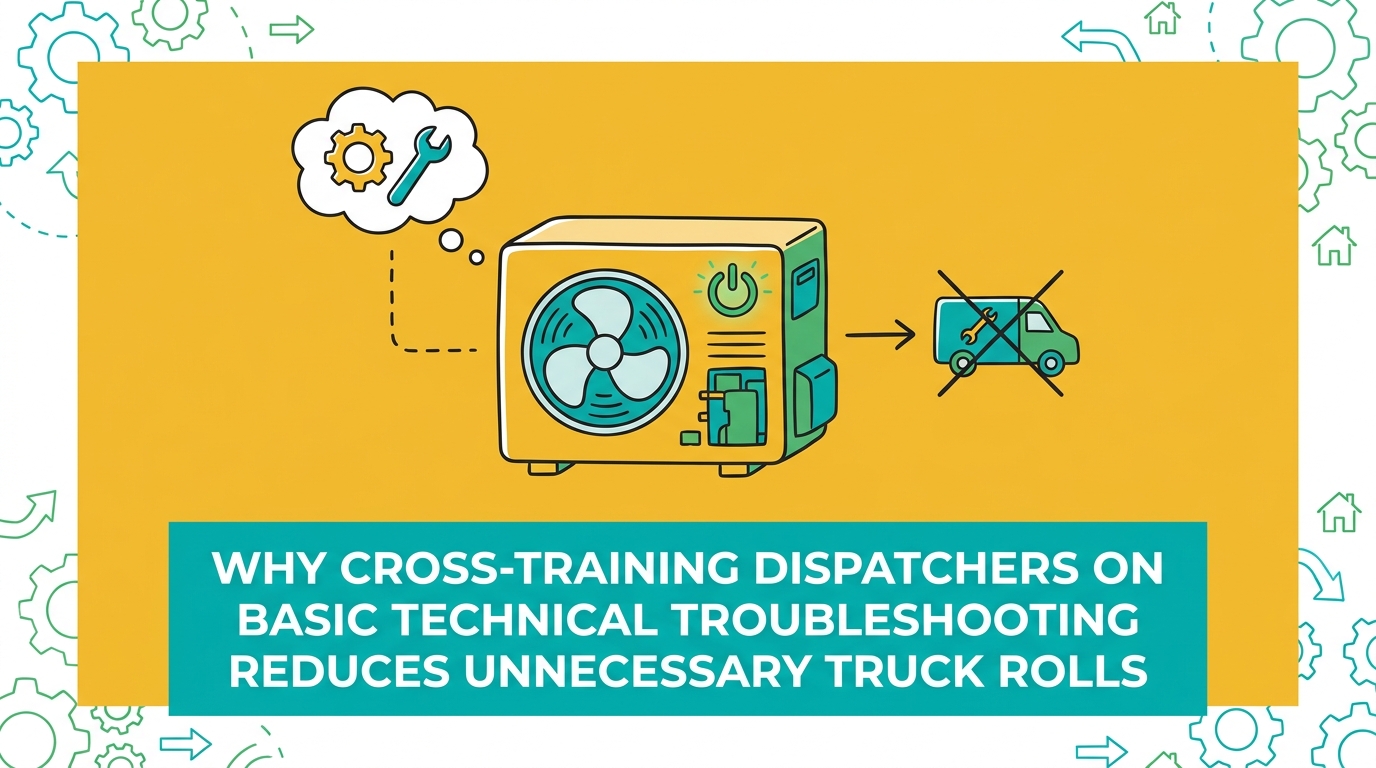
Your dispatch board is packed, your technicians are working overtime, but at the end of the day, you realize several of those highly valuable appointments were wasted on calls that only required flipping a breaker or changing a battery. Understanding exactly how teaching dispatchers basic troubleshooting cuts down on needless truck rolls is the first crucial step toward reclaiming those lost operational hours. Every time a licensed professional is sent to a home for a non-issue, the business absorbs a massive opportunity cost. Upgrading your initial point of contact from a simple order-taking function to an intelligent diagnostic filter changes the entire trajectory of your daily schedule.
The operational bottleneck is clear: dispatching highly trained, well-compensated technicians to zero-revenue nuisance calls drains capacity. During the peak summer cooling season, schedule density is at its absolute highest. Every single hour a technician spends driving to a home just to reset a safety switch is an hour they cannot spend performing a full emergency system replacement for a customer in distress. The mindset shift required here is treating the initial customer phone call as the actual first step in the diagnostic process, rather than just a logistical scheduling task. Modern dispatching demands more than just putting names into time slots; it requires a strategic approach to call management that protects your most valuable asset—technician time.
To implement this successfully, home service businesses often look toward integrated solutions. Establishing a strong foundation with virtual customer service protocols ensures that every incoming request is properly vetted. Furthermore, utilizing 24/7 live agent call center services guarantees that this critical triage process happens around the clock, preventing simple fixes from cluttering the board before the morning shift even begins.
Shifting from Schedule Coordinators to First-Line Diagnosticians
Transitioning your front office from traditional schedule coordinators to first-line diagnosticians fundamentally changes how your business operates. A schedule coordinator simply takes down a name, an address, and a generic complaint like "the air conditioner is broken," before assigning it to the next available technician. A first-line diagnostician, however, actively screens the call, asking targeted questions to determine the actual severity of the issue. This proactive approach prevents zero-revenue calls from ever reaching the dispatch board.
Intelligent overflow management relies heavily on this screening process. When a business experiences a sudden surge in service requests, the ability to filter out non-emergencies keeps the operation running smoothly. Consider the impact on technician morale: driving an hour through heavy traffic only to find a clogged air filter is frustrating and demoralizing for professionals who want to utilize their advanced skills. By providing accurate upfront information, technicians arrive on-site prepared for actual repairs, which drastically improves their windshield time efficiency.
One home service business owner found themselves needing a professional and timely partner during a busy winter season. By implementing a dedicated answering service that understood the nuances of the industry, they gained a partner that transformed their daily operations. The team handled call dispatching and re-routing efficiently, ensuring that only legitimate technical issues were forwarded to the field staff.
The Operational Benefits of First-Line Diagnostics:
1. Increased capacity: Filtering out nuisance calls frees up the schedule for high-priority replacements.
2. Improved morale: Technicians spend their days doing actual technical work rather than mundane resets.
3. Better customer experience: Homeowners appreciate having simple issues resolved quickly over the phone without waiting for an appointment.
4. Optimized routing: Dispatchers can group legitimate calls more effectively when the board isn't cluttered with false alarms.
During the peak summer cooling season, this shift in strategy is often the defining factor between a highly profitable week and a chaotic, inefficient schedule.
Navigating the Line Between Safe Triage and Unlicensed Advice
Empowering your dispatchers to ask technical questions introduces a critical industry challenge: maintaining the strict boundary between safe, observational triage and providing unlicensed technical advice. Crossing this line can expose the business to severe liability and potentially endanger the homeowner. The goal is never to have a dispatcher talk a customer through a repair; the goal is to gather accurate symptoms to determine if a repair is actually needed.
Defining the Boundary of Customer Service
Safe triage focuses entirely on gathering observational symptoms. Dispatchers should be trained to ask what the customer can see, hear, or smell, without ever instructing them to open a panel, touch a wire, or dismantle any equipment. Standardized scripts are essential here to keep agents within safe operational boundaries. For instance, asking a homeowner to check for a blank thermostat screen is a safe, visual check. Instructing them to remove the thermostat from the wall and check the voltage is crossing into unlicensed territory.
Providing professional call center etiquette and training ensures that dispatchers know how to guide these conversations smoothly. If a customer demands a quick fix over the phone for a complex issue, the dispatcher must know how to politely but firmly explain that a licensed technician is required for their safety and the integrity of the system.
Liability and Licensing Considerations
Protecting the business means ensuring that only licensed professionals handle technical repairs. Dispatchers must be trained to confidently explain why a technician must be dispatched when an issue goes beyond a simple user-error check. Safe phrasing is paramount.
Examples of Safe vs. Unsafe Phrasing:
• Safe: "What do you see on the equipment display screen right now?"
• Unsafe: "Go ahead and open the access panel to see if the control board is flashing."
• Safe: "Have you noticed any unusual noises coming from the vents?"
• Unsafe: "Try spinning the blower motor by hand to see if it's stuck."
Proper call center etiquette ensures that even when a dispatcher refuses to give repair instructions, the customer still feels heard, helped, and prioritized.
3 Basic Troubleshooting Questions Every Dispatcher Should Ask
Creating a standard operating procedure for every incoming service request ensures consistency and protects your schedule. By logging the answers to these specific questions in your field service management software, the technician arrives on-site with a clear picture of the problem. These simple questions save countless hours of unbillable time each week.
1. "Is the thermostat display active?"
This is the most common culprit for a "no heat" or "no cool" call that turns out to be a non-issue. Dispatchers should guide the homeowner to check for a blank thermostat screen. If the screen is completely dark, the issue might simply be dead batteries. Suggesting that the homeowner replace the batteries before rolling a truck can instantly resolve the problem. If the batteries are fresh and the screen remains blank, it indicates a broader power loss issue, validating the need for a service visit.
2. "Have any breakers tripped in the electrical panel?"
Power-loss issues often masquerade as equipment failures. Dispatchers should ask the customer to visually inspect the main breaker box or the equipment service switch located near the unit. A tripped breaker or a switch that was accidentally bumped to the "off" position does not require an HVAC or plumbing specialist to resolve. If the customer resets the breaker and the system turns on, the truck roll is saved. If the breaker immediately trips again, the dispatcher now knows there is an electrical short, and can brief the technician accordingly.
3. "When was the air filter last replaced?"
Severely clogged air filters restrict airflow, causing systems to freeze up in the summer or overheat and trip high-limit switches in the winter. Asking this question helps identify restricted airflow symptoms safely. If the customer admits the filter hasn't been changed in months, the dispatcher can advise them to replace it and wait an hour to see if normal operation resumes. Using this question safely eliminates basic maintenance oversights without requiring the customer to touch any internal components.


Protecting Technician Capacity During Extreme Weather Spikes
Understanding the massive opportunity cost of nuisance calls becomes absolutely critical when regional weather pushes your schedule to the breaking point. Extreme weather spikes, such as intense summer heatwaves or sudden deep freezes, completely max out HVAC schedules within hours. During these periods, the elimination of simple-fix truck rolls is critical for capturing high-revenue emergency replacements. When the board is overflowing with genuine "no heat" or "no cool" emergencies, sending a technician across town just to flip a breaker is a devastating loss of capacity.
Schedule density changes dramatically during severe weather events. In the shoulder seasons, a nuisance call might just be an annoyance; during the peak summer cooling season, it represents a missed opportunity to serve a customer who desperately needs a full system replacement. Triage acts as a protective barrier for the company's most valuable asset: technician time.
How Triage Protects the Schedule:
• Preserves energy: Technicians avoid burnout by focusing only on calls that require their specialized training.
• Maximizes revenue: Highly skilled labor is directed toward complex diagnostics and major installations.
• Improves response times: Customers with genuine emergencies receive faster service because the queue isn't clogged with false alarms.
Ethically and efficiently prioritizing high-revenue calls means ensuring that those who truly need a licensed professional get one immediately, while those with a dead thermostat battery are guided to a quick, self-serve resolution.
The In-House Training Challenge vs. Turnkey Solutions
Acknowledging the value of dispatch triage is one thing; implementing it is another. Building an internal technical dispatch manual from scratch requires a heavy lift of time, resources, and continuous management. Furthermore, relying on a single highly trained in-house dispatcher creates a massive vulnerability—if that individual leaves unexpectedly, the entire triage system collapses.
One home service company experienced this exact vulnerability when they suffered a sudden loss of dispatcher and call taker staff right at the end of the year, just as winter weather set in. Needing immediate administrative support, they had Contractor in Charge take over full-time dispatch and call-taking duties. Today, that company is growing and running better than ever before because they eliminated the single point of failure.
The turnkey alternative is partnering with an external team that already understands the home service industry. Contractor in Charge utilizes industry-trained virtual customer service agents who already understand HVAC, plumbing, and electrical basics, ensuring calls are properly triaged before a truck is ever rolled. This approach not only captures leads but streamlines daily operations without requiring a massive internal training phase.
• Implementation Time — Building In-House Training: Takes months to develop scripts, train staff, and refine processes. — Turnkey Industry-Trained Agents: Immediate deployment with pre-established industry protocols.
• Staffing Vulnerability — Building In-House Training: High risk. Losing a trained dispatcher halts the entire triage process. — Turnkey Industry-Trained Agents: Zero risk. A fully staffed team ensures continuous, uninterrupted coverage.
• Technical Knowledge — Building In-House Training: Requires pulling technicians off the field to train office staff. — Turnkey Industry-Trained Agents: Agents arrive with a baseline understanding of HVAC, plumbing, and electrical.
• Scalability — Building In-House Training: Difficult to scale quickly during sudden extreme weather spikes. — Turnkey Industry-Trained Agents: Easily handles call surges without dropping triage quality.
By integrating inside sales and lead capture with proper technical screening, businesses ensure that every call is handled with both revenue growth and operational efficiency in mind.
Frequently Asked Questions About Dispatch Triage
How do you reduce unnecessary truck rolls?
You reduce unnecessary truck rolls by implementing a standardized triage script to catch simple fixes like dead batteries or tripped breakers before dispatching. When dispatchers actively screen calls rather than just taking orders, they can identify user errors that do not require a licensed technician. This preserves the schedule for actual emergencies and complex repairs.
What questions should an HVAC dispatcher ask?
An HVAC dispatcher should ask about the thermostat display, breaker status, filter condition, and any unusual noises or smells. These observational questions help paint a clear picture of the symptom without asking the homeowner to perform any dangerous diagnostic work. For example, verifying a blank thermostat screen quickly rules out battery issues.
How do you train HVAC dispatchers to troubleshoot safely?
You train HVAC dispatchers to troubleshoot safely by focusing entirely on observation-based questions and strictly forbidding step-by-step repair instructions. Dispatchers must understand the legal and safety boundaries of their role. Training should emphasize gathering symptoms for the technician rather than attempting to solve the root cause over the phone.
What is considered unbillable windshield time?
Unbillable windshield time is the time spent driving to and from a location where no billable work can be performed, often due to nuisance calls. If a technician drives forty minutes to flip a service switch and then drives forty minutes back, that entire duration generates zero revenue. Minimizing this time is crucial for maintaining profitability.
Can an answering service perform technical triage?
Yes, an answering service can perform technical triage if they utilize industry-trained agents who understand the basics of home service trades. A generic answering service will just take messages, but a specialized service will ask the right questions about filters, breakers, and thermostats to prevent unnecessary dispatching.
Stop Wasting Windshield Time on Nuisance Calls
Treating the initial customer phone call as the first step in the diagnostic process is a fundamental requirement for modern home service operations. Every time a dispatcher successfully identifies a blank thermostat screen or a tripped breaker over the phone, they protect your technicians from unbillable windshield time. Especially during the peak summer cooling season, this protection is what allows your business to capture high-value installations instead of chasing false alarms. Upgrading your dispatch strategy to include basic, safe technical troubleshooting eliminates zero-revenue visits and provides a clear, actionable framework for maximizing your team's daily capacity.