

The Financial Risks of Mixing Personal and Business Expenses in a Growing HVAC Shop

When a Single Bank Account Threatens Your HVAC Business Growth
You are reviewing your recent bank statement after a long week of service calls, trying to figure out if a specific hardware store charge was for a customer's compressor replacement or a repair at your own home. As a growing HVAC shop owner, using a single bank account for personal and business expenses might have seemed like a convenient shortcut when you first launched. However, this ad-hoc bookkeeping approach creates a massive concrete problem: it destroys the accuracy of your financial reporting and severely complicates your tax strategy. You are now at a critical decision point where shifting from running operations out of a personal checking account to establishing dedicated business financial infrastructure is no longer optional—it is a requirement for survival.
If you are ready to untangle your finances and establish a solid foundation, partnering for professional bookkeeping and accounting can provide the clarity you need to scale safely.
The Hidden Dangers of Ad-Hoc Bookkeeping
Operating a trade business requires precise financial tracking. When you lump personal grocery runs together with wholesale HVAC parts purchases, you create a tangled web of transactions that blinds you to your company's actual profitability. This lack of visibility means you cannot confidently answer basic questions about your business health. Are you actually making a profit on your installations, or are you just moving money around?
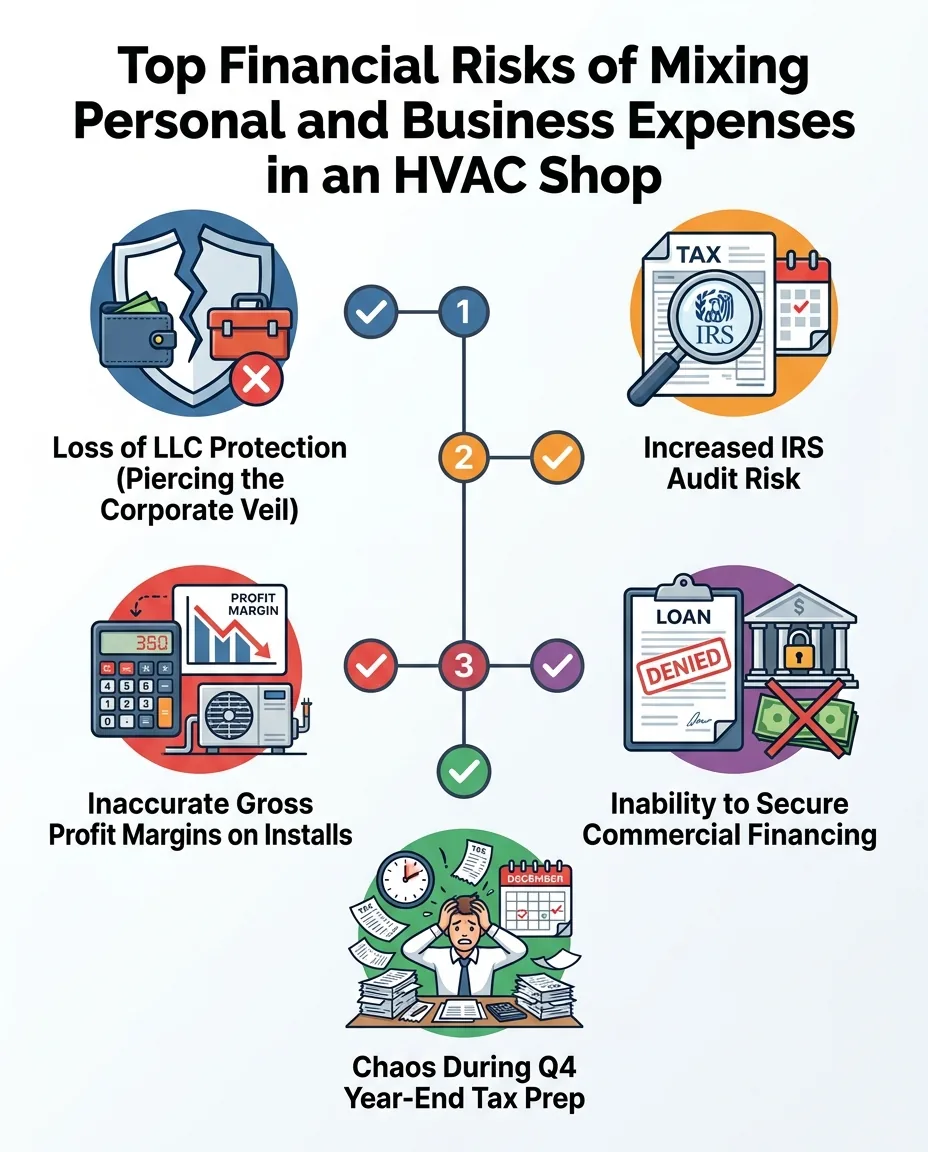
Furthermore, disorganized records make impending deadlines an absolute nightmare. When you lack a clear separation of funds, Q4 year-end tax preparation transforms from a standard administrative task into a frantic, stressful excavation of twelve months of receipts. You spend countless hours trying to justify business expenses to your CPA, often missing out on legitimate deductions simply because the documentation is too messy to untangle.
The Illusion of Cash Flow: Why Mixed Funds Hide the Truth
The Problem: Seeing a positive balance in your commingled bank account creates a false sense of financial security. You might look at the balance and assume your HVAC business is thriving, but having cash in the bank is vastly different from actually operating a profitable business.
The Cause: When you pay for personal expenses and business supplies from the same pool of funds, you distort your expense tracking entirely. This practice prevents you from setting accurate baseline metrics for your operations. One summer, an HVAC owner realized their previous accountants were disorganized and unreachable, leaving them completely in the dark about their true cash flow. They needed organized and reachable accounting services with accurate numbers and feedback to finally understand where their money was going. Once a specialized team stepped in to handle the accounting, they achieved accurate financial reporting and received the valuable feedback necessary to correct their course.
The Solution: You must establish organized, reachable financial data to provide accurate feedback on your business health. Without clean data, you will inevitably suffer from inaccurate gross profit margins on HVAC installs, making it impossible to know if you are hitting the right profit margin targets for home service companies.
Losing Sight of True Operational Costs
Personal withdrawals act as a smokescreen that masks business cash flow shortages. If your business is quietly losing money on labor inefficiencies, you might not notice because you are continually injecting personal funds or pulling cash out for daily living expenses. This constant ebb and flow makes accurate financial forecasting impossible.
• Operating Cash Flow — With Mixed Funds: Obscured by personal grocery runs and mortgage payments. — With Separated Funds: Clearly reflects money generated strictly from HVAC services.
• Expense Tracking — With Mixed Funds: Requires manual sorting of every individual receipt. — With Separated Funds: Automated categorization through business banking feeds.
• Forecasting — With Mixed Funds: Guesswork based on the total account balance. — With Separated Funds: Data-driven projections based on historical business performance.
Skewed Job Costing and Hidden Unprofitable Services
Job costing is the lifeblood of any successful trade business. It is the practice of tracking the specific material, labor, and overhead costs associated with a single project to determine its true profitability. To achieve accurate job costing, strict separation of expenses is an absolute requirement.
When you commingle your funds, allocating specific costs to individual jobs becomes impossible. You might know that you purchased a bulk order of sheet metal and refrigerant, but if those purchases are buried under personal travel expenses and family dining charges, you cannot accurately assign those material costs to the Smith family's ductwork replacement or the Jones family's AC installation.
The Danger of Subsidizing Losses:
• Blind spots in pricing: Without clear data, you suffer from inaccurate gross profit margins on HVAC installs.
• Subsidizing losing jobs: You may unknowingly use the profits from your highly lucrative maintenance contracts to cover the losses on underpriced commercial installations.
• Stagnant growth: You cannot scale a service line if you do not know whether it actually makes money.
To combat this, growing shops must utilize specialized financial oversight to track performance per service line. By implementing performance accounting, you gain the ability to isolate the profitability of your repair division versus your installation division, ensuring that every truck roll contributes positively to your bottom line.
Operational Chaos During Peak Climate Seasons
The HVAC industry is inherently seasonal, and extreme weather events push your business operations to their absolute limits. During intense summer heatwaves and brutal winter freezes, the rapid pace of an HVAC business causes operational costs and overtime pay to fluctuate wildly.
When your funds are mixed, tracking these massive fluctuations becomes an exercise in futility. Technicians are working double shifts, fuel costs are skyrocketing, and emergency parts are being purchased at a premium. If all of these elevated expenses are flowing through a personal checking account, you lose the ability to measure how much these peak seasons actually cost your business to operate.
This chaos inevitably leads to massive headaches during Q4 year-end tax preparation. When January arrives and you need to account for the frantic spending that occurred during a July heatwave, the lack of clean, separated financial records will leave you and your CPA scrambling for answers.
Managing Emergency Supply Runs
Consider the common scenario of technicians needing parts immediately during a sudden winter freeze. When a furnace goes down in freezing temperatures, your team cannot wait for a formal purchase order process. They head to the nearest supply house.
If you or your technicians use a personal credit card for these emergency business expenses, you instantly ruin your inventory tracking and job costing. The part gets installed, the customer gets billed, but the cost of the part remains hidden on a personal credit card statement. Clean financial records are the only way to accurately measure profitability during these wild, weather-driven revenue fluctuations.
Tax Liabilities, Audit Triggers, and Piercing the Corporate Veil
Treating your business account like a personal wallet carries severe legal and tax consequences that can threaten your livelihood. The risks extend far beyond simple bookkeeping headaches; they strike at the legal foundation of your company.
1. Piercing the Corporate Veil: When you form an LLC or a corporation, you create a legal shield that separates your personal assets from your business liabilities. However, if you commingle funds, a court can rule that your business is not a separate entity at all. This legal concept, known as "piercing the corporate veil," voids your LLC protections and leaves your personal assets—like your home and personal savings—vulnerable to business lawsuits and creditors.
2. Triggering IRS Audits: Commingling funds is a primary red flag for IRS auditors. When the IRS sees personal and business expenses intertwined, they assume your tax deductions are inaccurate. This scrutiny drastically increases your chances of facing a painful, time-consuming audit.
3. Skyrocketing Accounting Fees: Messy records complicate Q4 year-end tax preparation. Your CPA has to spend hours acting as a forensic accountant, untangling your personal and business lives. You pay for this extra time in the form of drastically increased accounting fees.
Having a dedicated accounting partner is essential to navigate these risks. Another business owner found themselves in a similar situation, requiring bookkeeping and accounting services with responsive and knowledgeable support to clean up their messy records. Their assigned accountant stepped in, answered their questions promptly, and provided sound financial advice that safeguarded the business from tax liabilities, leading to a highly successful partnership.

Financing Roadblocks for Trucks and Equipment Upgrades
Scaling an HVAC shop requires significant capital. As you grow, you need to purchase new service trucks, invest in advanced diagnostic tools, and make bulk equipment purchases to secure better pricing. Commingled funds stunt this business growth by preventing your access to commercial financing.
Commercial lenders require pristine financial statements before they will underwrite a loan or a line of credit. They need to see a clean Profit & Loss statement and a clear balance sheet. If your financial documents are riddled with personal expenses, lenders will immediately reject your applications because they cannot accurately assess the financial health of the business.
Furthermore, disorganized records can prevent you from achieving high valuations during potential business transactions. During a busy winter season, one group of business owners realized they needed their financial house in strict order as they prepared for high-end business transactions and sales. By bringing in professional oversight to serve in a fractional CFO capacity, they organized their financial records and ensured total readiness for the sale. Because their finances were perfectly separated and well-managed, the owners achieved the highest valuation range possible.
Separating your finances is the foundational step to treating your shop like a scalable entity. If you want to position your company for growth or an eventual exit, engaging fractional CFO services can provide the high-level financial strategy required to secure financing and maximize valuation, ensuring you never suffer from inaccurate gross profit margins on HVAC installs again.
Actionable Steps to Establish Dedicated Business Finances
Untangling your personal and business finances does not have to be an overwhelming process. By taking clear, judgment-free steps today, you can protect your margins and set your HVAC shop up for sustainable growth.
1. Open Dedicated Accounts Immediately: Go to your bank and open a dedicated business checking account and a separate business credit card. This is the absolute first step in establishing a financial firewall between you and your company.
2. Implement Strict Spending Policies: Create a hard rule for yourself and your team: business cards are strictly for business purchases, and personal cards are strictly for personal purchases. If an emergency forces a crossover, document it immediately with a formal reimbursement process.
3. Adopt Industry-Specific Software: Implement accounting software designed specifically for the trades. This allows you to track job costs properly, avoiding inaccurate gross profit margins on HVAC installs by tying every piece of sheet metal and every hour of labor directly to the correct customer invoice.
4. Partner with Specialized Support: Do not try to handle complex bookkeeping on your own. One summer, an HVAC contractor realized they needed to save money on bookkeeping operations while improving accuracy. By partnering with specialized administrative support, they received tailored bookkeeping services that resulted in significant cost savings and streamlined operations.
It is important to note that Contractor in Charge specializes exclusively in the home service trades, providing industry-specific financial insights that generic bookkeepers simply miss. By leveraging professional back office solutions, you can ensure your financial infrastructure is built to handle the unique demands of the HVAC industry.
Frequently Asked Questions About HVAC Business Accounting
What are the financial risks of commingling funds in an HVAC business?
Commingling funds obscures your true operational costs and creates a false sense of cash flow. It drastically increases your risk of IRS audits and can legally void your LLC protection, leaving your personal assets vulnerable. Ultimately, it prevents you from understanding if your business is actually profitable.
How does mixing expenses affect HVAC job costing?
Mixing expenses makes it impossible to accurately assign material and labor costs to specific jobs. When personal and business overhead are blended together, you cannot calculate the true cost of an installation. This leads directly to inaccurate pricing and hidden unprofitable services.
Why is a dedicated business bank account necessary for tax preparation?
A dedicated account provides a clean, single source of truth for all business transactions. Without it, Q4 year-end tax preparation becomes a chaotic process of manually separating personal and business receipts, which increases accounting fees and the likelihood of missing valuable tax deductions.
Can I use my business account for personal expenses?
No, you should never use your business account for personal expenses. Doing so is known as "piercing the corporate veil," which can destroy the legal separation between you and your business. Always pay yourself a formal salary or owner's draw, and use those personal funds for personal expenses.
How do you separate business and personal finances effectively?
The most effective method is to open a distinct business checking account and a dedicated business credit card. Route all business income into the business checking account, and pay all business expenses exclusively from these dedicated accounts, utilizing trade-specific accounting software to track every transaction.
Does mixing funds void my HVAC company's LLC protection?
Yes, mixing funds is one of the primary reasons courts decide to pierce the corporate veil. If you treat the business bank account like a personal wallet, the legal system may determine that the LLC is not a separate entity, thereby holding you personally liable for business debts and lawsuits.
Protect Your Margins and Scale Your HVAC Operations
Untangling your finances is essential for accurate job costing and stress-free Q4 year-end tax preparation. When you stop running your business out of a personal checking account, you gain the clear financial visibility necessary to make strategic growth decisions rather than relying on guesswork.
A clear, judgment-free explanation of exactly how mixed funds ruin financial reporting is just the first step; the true value comes from taking actionable steps to separate your accounts before the next tax season arrives. By exploring professional financial oversight, you can protect your margins, safeguard your legal status, and confidently scale your HVAC operations into the future.