
An Essential Guide to Benefits of Integrated Accounting


Why the Benefits of Integrated Accounting for Service Businesses Matter More Than Ever
The benefits of integrated accounting for service businesses are real, measurable, and within reach — even for small contracting shops. Here is a quick summary before we dive in:
Key benefits at a glance:
• Accuracy — Automated data entry eliminates costly manual errors
• Real-time visibility — See your cash flow and job profitability as it happens
• Time savings — Less manual reconciliation means more time on the tools
• Scalability — Your books grow with your business without adding headcount
• Compliance — Audit-ready records with less last-minute scrambling
• Faster close — Month-end processes that once took weeks can take days
• Better decisions — Live financial data replaces gut instinct with facts
If you run a plumbing, HVAC, or electrical business, you know the feeling. You are out in the field all day, your crew is booked solid, and somewhere in the back office, the numbers are a mess. Invoices are sitting unsent. Job costs are being tracked in a spreadsheet that nobody updates. Your bookkeeper is re-entered the same data into three different systems. And by the time you get a profit and loss statement, it reflects what happened six weeks ago — not what is happening right now.
That disconnect between field operations and financial reporting is not just frustrating. It is costing you money, slowing your growth, and making it nearly impossible to know whether your business is actually profitable.
The good news is that integrated accounting systems exist precisely to solve this problem. Instead of juggling separate tools for invoicing, payroll, job costing, and reporting, an integrated platform connects all of those functions into one streamlined system. Data flows automatically from the field to the office, your books stay current, and you spend less time on administrative work and more time running your business.
I am Anna Lynn Wise, CEO of Contractor In Charge and a former owner and general manager of a plumbing, HVAC, and remodeling company — which means I have seen how the benefits of integrated accounting for service businesses translate from theory into real dollars saved and real stress eliminated. In the sections below, I will walk you through everything you need to know to make integration work for your contracting business.
Defining Integrated Accounting vs. Traditional Methods
In the "old days" (which for some contractors, is still today), accounting was a series of disconnected islands. Your field service management (FSM) software handled the schedules, your bank account handled the cash, and your accounting software — usually a standalone version of QuickBooks — sat in the corner waiting for someone to manually type in data.
This traditional method relies on manual data entry, which is the natural enemy of accuracy. When a technician finishes a job, they might write the details on a paper invoice or save it in a field app. Then, an office admin has to read that data and type it into the accounting system. This creates "data silos" where the person looking at the schedule doesn't see the financial status of the client, and the person looking at the books doesn't see the actual job costs.
Integrated accounting flips this script. It functions like a smartphone, where various "apps" (payroll, invoicing, accounts payable) all talk to a centralized database. When a sale happens in the field, the general ledger is updated instantly. This real-time processing ensures that by May 2026 standards, your business isn't just surviving; it’s operating with total financial transparency.
• Data Entry — Traditional Accounting: Manual, repetitive re-keying — Integrated Accounting: Automated, "one-and-done" entry
• Data Sync — Traditional Accounting: Delayed (weekly/monthly) — Integrated Accounting: Real-time / Instant
• Accuracy — Traditional Accounting: High risk of human error — Integrated Accounting: High (system-validated data)
• Visibility — Traditional Accounting: Historical (looking backward) — Integrated Accounting: Live (current financial health)
• Reconciliation — Traditional Accounting: Hours of manual matching — Integrated Accounting: Automated "zero-touch" matching
To truly thrive, you need to know How to Keep Clean Financial Records as a Contractor, and integration is the most effective way to achieve that goal.
Top Benefits of Integrated Accounting for Service Businesses

For a service business, cash flow is the lifeblood of the company. If you aren't tracking your dollars in real-time, you are essentially flying blind. Integrated systems provide a holistic view of your financial health, allowing you to see exactly where every cent is going.
One of the most significant benefits of integrated accounting for service businesses is the massive reduction in administration costs. Research shows that businesses can eliminate over 16 hours of manual work every month just by automating receipt collection and matching. For a busy HVAC or plumbing company, those 16 hours are better spent booking jobs or training technicians.
Furthermore, specialized needs like Accounting for Plumbers or Financial Planning for HVAC Companies become much easier when your software understands the nuances of your trade, such as equipment depreciation and seasonal demand shifts. Unfortunately, Why Most Contractors Don't Know Their True Profitability often boils down to the fact that they are missing the "hidden" costs like unbilled travel time or forgotten materials — costs that integrated systems capture automatically.
Improving Accuracy with Benefits of Integrated Accounting for Service Businesses
Manual data entry is a notorious source of errors. A single typo in a decimal point can turn a profitable job into a loss on paper. Integrated systems use AI and machine learning to achieve "zero-touch" coding. For example, modern platforms like Ramp can learn your chart of accounts and categorize transactions with a 67% increase in accuracy compared to manual rules.
This level of precision is vital when you need to How to Calculate True Job Profitability for Contractors. When your FSM software and accounting software are integrated, every part used and every hour logged by a technician flows directly into the job cost report. This eliminates the "guessing game" and ensures that your automated reconciliations are always based on consistent, verified data.
Scaling Your Operations with Benefits of Integrated Accounting for Service Businesses
Growth is the goal, but growth without systems is a recipe for a breakdown. As you add more trucks, more technicians, and perhaps even more locations, your financial complexity explodes. Integrated accounting supports sustainable growth by allowing for multi-entity management within a single login.
By tracking the Financial KPIs Every Home Service Business Should Track, you can spot trends before they become problems. Are your "WIP" (Work in Progress) days getting too high? Is your "DSO" (Days Sales Outstanding) creeping up? Integrated Financial Dashboard Metrics for Contractor Business Owners give you the resource optimization tools to scale without needing to double your office staff every time you add a new service line.
Key Features That Drive Efficiency and Accuracy
What exactly should you look for in an integrated system? It isn't just about "connecting" two apps; it's about how the data flows. Here are the essential features:
• FSM Integration: Your Field Service Management tool (like ServiceTitan or Housecall Pro) must sync seamlessly with your accounting software (like QuickBooks or Sage Intacct).
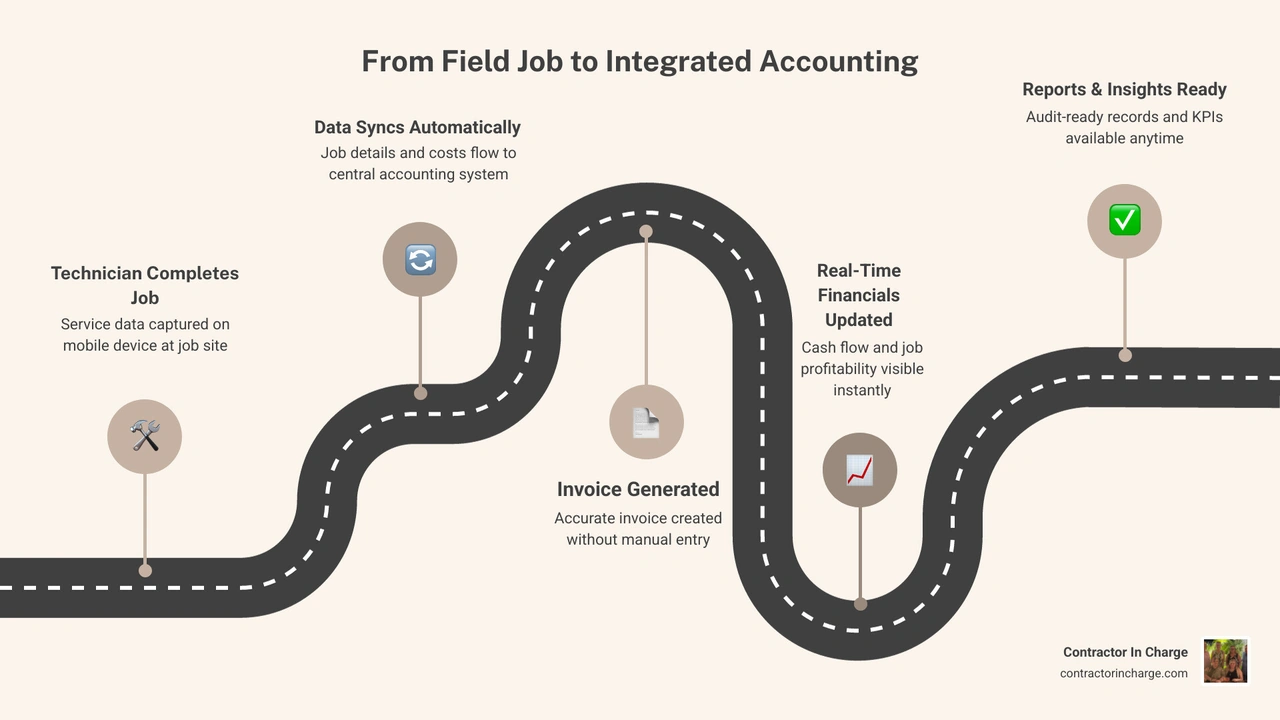
• Automated Invoicing: As soon as a job is marked "complete" in the field, an invoice should be generated and sent, with the transaction recorded in the ledger.
• Time Tracking and Payroll Sync: Technicians log their hours in the field app, which then calculates payroll and updates job costs simultaneously.
• Accounts Payable (AP) Automation: Digital workflows for approving vendor bills and matching receipts to credit card transactions.
• Tax Management: Built-in tools that track sales tax by jurisdiction, ensuring you stay compliant across different counties or states.
For many, the biggest win comes from Business Systems and Software Optimization: Accounting FSM Integration. When these two "brains" of your business talk to each other, you eliminate the need for six-drawer filing cabinets and endless stacks of paper.
Best Practices for System Implementation and Scalability
Switching to an integrated system can feel like trying to change the tires on a truck while it's moving down the highway. However, following a few best practices can make the transition smooth:
1. Clean Your Data First: Don't move "garbage" data into a new system. Take the time to standardize your chart of accounts and client names.
2. Phased Rollout: Don't try to change everything at once. Start with the most impactful integration, like connecting your field invoicing to your accounting ledger.
3. Invest in Training: Up to 25% of employees might consider leaving if they feel overwhelmed by subpar software. Ensure your team has hands-on workshops and clear "how-to" guides.
4. Cloud-Based is King: Legacy server-based systems are expensive to maintain. Cloud-based solutions offer better API connectivity and allow you to check your books from a job site on your phone.
We always recommend following Accounting and FSM Integration Best Practices for Contractors to avoid common pitfalls like duplicate data entry or broken API links. The goal of change management is to make your team's life easier, not harder.
Frequently Asked Questions
How does integrated accounting improve cash flow for contractors?
Integrated accounting improves cash flow by reducing the "time to invoice." When a technician completes a job, the invoice is generated and sent immediately. Many systems also include "Pay Now" buttons for credit cards or ACH. This reduces your Days Sales Outstanding (DSO) and gets money into your bank account days or even weeks faster than manual billing.
Can integrated systems help in booking more service jobs?
Yes! While accounting is a "back-office" function, the data it provides allows you to see which marketing channels are actually profitable. When you know which jobs have the highest gross margin, you can focus your lead generation on those services, effectively booking jobs that make you the most money rather than just staying busy.
What is the difference between standalone and integrated accounting?
Standalone accounting requires you to manually export data from one tool (like a spreadsheet or FSM) and import it into another. Integrated accounting uses APIs to allow two-way, real-time communication between software. In an integrated system, a change in one place (like a price update) updates everywhere automatically.
Conclusion
At Contractor In Charge, we have seen time and again how the benefits of integrated accounting for service businesses transform struggling shops into industry leaders. By moving away from the "shoebox" method of bookkeeping and embracing a centralized, automated system, you gain more than just clean books — you gain the freedom to focus on your craft.
Whether you are a solo plumber or a large HVAC firm with a fleet of 100 trucks, Outsourced Accountants Can Help You Find the Profit in Your Company. Our team combines the latest technology with the "old-fashioned" customer care that contractors deserve. We don't just "do the books"; we help you build a scalable foundation for strategic decision-making and more efficient booking jobs.
Ready to stop wrestling with spreadsheets and start growing your business? Let's talk about Accounting and FSM Integration and how we can help you take control of your financial future today.