

The Real Reason You're Missing Goals: Measuring HVAC and Plumbing Profit Margins


Why Most HVAC and Plumbing Contractors Are Flying Blind on Job Performance
How to calculate true job profitability for contractors is one of the most important business skills you can develop 1 and most contractors haven't fully figured it out yet. Here's the short answer:
To calculate true job profitability:
1. Track all direct job activity 1 labor hours, materials used, subcontractor involvement, and equipment assigned to the job
2. Account for business overhead 1 include the share of office, admin, insurance, software, and support functions tied to running the job
3. Compare job revenue to total job-related activity and overhead 1 this gives you a clear view of job performance
4. Measure gross profit margin percentage 1 divide gross profit by revenue and multiply by 100
5. Review net profit after G&A activity 1 this shows what the business actually retains
6. Use the result to improve operations 1 stronger scheduling, cleaner handoffs, and better follow-up help you secure more service appointments and improve overall performance
That's the foundation. But getting each of those numbers right is where most contractors stumble.
Here's a sobering reality: many trade businesses struggle not because the work is bad, but because the performance behind each job is misunderstood or ignored entirely. The gap between average operators and top-performing contractors almost always comes down to one thing: knowing exactly how each job supports the business and where operational improvements are needed.
If you're winning bids, staying busy, and still wondering why growth feels harder than it should, you're not alone. Many HVAC and plumbing contractors confuse activity with profitability, overlook operational inefficiencies, and fail to connect job performance with stronger scheduling and booking results. The result? You can run a full schedule and still feel like you're not building the business you want.
I'm Anna Lynn Wise, CEO of Contractor In Charge and a former owner and general manager of a plumbing, HVAC, and remodeling company 1 and my hands-on experience in the trades is exactly what shaped my approach to how to calculate true job profitability for contractors. In this guide, I'll walk you through the habits, reporting methods, and operational practices that help contractors run better businesses and create more consistent service opportunities.
The Critical Difference Between Markup and Profit Margin
One of the most common financial blind spots in the home services industry is the interchangeable use of the terms "markup" and "margin." If your team uses these loosely, it becomes much harder to evaluate job performance and make smart business decisions.
Markup is the amount added to job-related activity to arrive at a selling price.Profit Margin is the percentage of the final sale that remains after job-related activity is accounted for.
Why does this matter? Because using the wrong language creates confusion across the business. Estimators, office staff, and leadership need a shared understanding of performance metrics so they can support stronger scheduling, cleaner operations, and more consistent service appointments.
To avoid this disconnect, we recommend using Performance Accounting principles to look at your business through the lens of margin rather than markup.
Markup vs. Margin Comparison Table
• 10% — Required Markup: 1.11
• 20% — Required Markup: 1.25
• 25% — Required Markup: 1.33
• 30% — Required Markup: 1.43
• 35% — Required Markup: 1.54
• 40% — Required Markup: 1.67
• 50% — Required Markup: 2.00
When your team understands this distinction, it becomes easier to align reporting, improve decision-making, and build a business that supports healthy growth.
How to calculate true job profitability for contractors
Achieving financial transparency starts with a commitment to job costing. This isn't just "general bookkeeping"; it is the process of tracking everything associated with a specific project so you can evaluate performance clearly and run the business more effectively. Without this, you're essentially flying a plane without a fuel gauge.
True profitability is found in the "Net Income"1what stays in the company after the full business operation is accounted for. For many specialized trades, Accounting for Plumbers and HVAC pros requires a close look at how labor, overhead, and workflow all contribute to job performance.
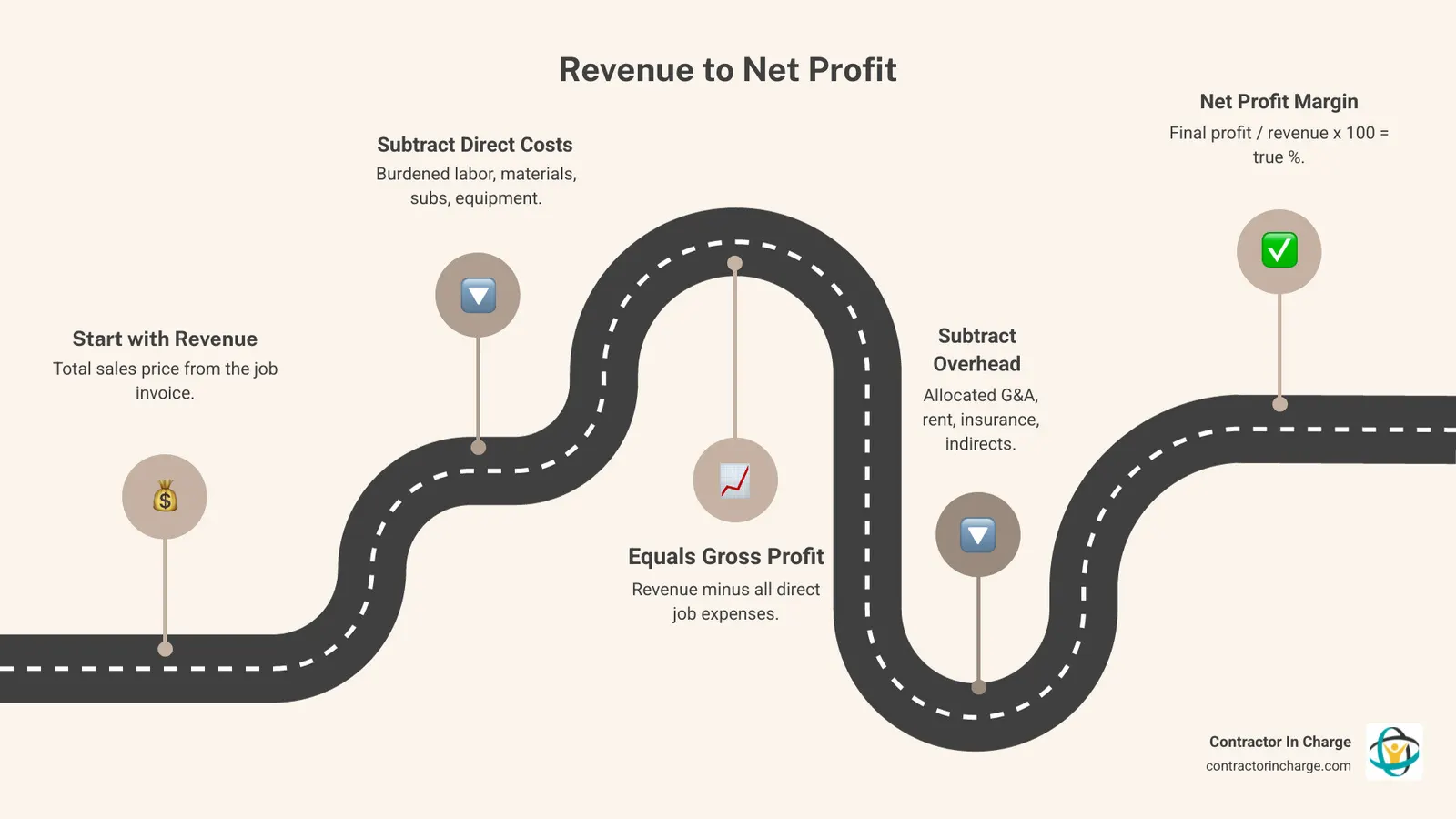
Step-by-step formula for how to calculate true job profitability for contractors
To get an accurate picture, you must move beyond "gut feelings" and use a standardized formula. Here is the step-by-step breakdown:
1. Identify Total Revenue: This is the final amount invoiced to the customer, including any change orders.
2. Track Total Direct Job Activity: These are the items directly tied to the job.
— Materials: Every fitting, wire, and piece of equipment used.
— Subcontractor Activity: Any trade partner involvement connected to the project.
— Equipment Usage: Specialized tools or lifts assigned specifically to the site.
3. Determine Labor Burden: Look beyond hourly pay and include the full business impact of field labor so job performance is measured accurately.
4. Allocate Indirect Costs (Overhead): Assign a reasonable share of your office and operational support to the job.
5. The Formula:
— Revenue - (Direct Materials + Burdened Labor + Subs + Allocated Overhead) = True Job Profit.
When you consistently track these elements, you create better visibility into which jobs support the business best and where operational improvements are needed.
Leveraging technology for how to calculate true job profitability for contractors
In the modern era of home services, using a pencil and a legal pad for job costing makes it harder to stay proactive. Real-time tracking helps you spot operational issues before they affect service capacity and booking momentum.
By using mobile data entry, your technicians can log their hours and material usage directly from the field. This dispatch synchronization ensures that the office sees job activity as it happens. We often see that Bookkeeping for HVAC Companies becomes significantly more useful when automated reporting replaces manual data entry.
When your field software talks to your accounting software, you can generate reports that show you exactly where you stand in real time. That visibility helps you improve scheduling, support your team more effectively, and create a smoother operation that can secure more service appointments.
Allocating G&A Overhead and Indirect Expenses
General and Administrative (G&A) overhead is the behind-the-scenes activity required to keep your business running. It includes your rent, utilities, insurance premiums, software subscriptions, and the salary of your office manager. Because these items don't appear directly on a single work order, many contractors forget to include them when figuring out how to calculate true job profitability for contractors.
There are three main ways to allocate these operational expenses to individual jobs:
• Percentage of Direct Job Activity: Apply a consistent share of overhead to each job based on direct activity.
• Labor Hour Method: Assign overhead based on the number of billable hours spent on a job.
• Revenue-Based Distribution: Allocate overhead based on the total contract value.
Understanding Key KPIs in Your Plumbing Business allows you to pick the method that fits your business model best. The goal is to ensure that every service call supports the business and contributes to stable operations, stronger scheduling, and long-term growth.
Monitoring Financial Health with WIP and Gain-Fade Analysis
For larger projects or commercial contracts, a Work-In-Progress (WIP) schedule is essential. A WIP report compares your estimated job activity to actual job activity at different stages of the project.
This leads to a critical metric: Gain-Fade Analysis.
• Profit Gain: When a project ends up performing better than originally expected.
• Profit Fade: When a project6s profit shrinks as it nears completion.
A recurring fade is a major red flag. It suggests that your estimating, scheduling, or field management needs attention. Consistent fade can also limit your ability to scale because it shows the business lacks full control over operations.
Outsourced Accountants Can Help You Find the Profit in Your Company by performing these analyses regularly. They identify patterns1like a specific type of install that consistently creates operational drag1so you can adjust internal processes, improve execution, and support a steadier flow of service appointments.
Frequently Asked Questions about Job Profitability
What is a healthy net profit margin for home service contractors?
A healthy home service business should aim for consistent, sustainable profitability that supports strong operations, dependable staffing, and long-term growth. More important than chasing a specific number is building the reporting discipline needed to understand which jobs, teams, and workflows are helping the business perform at a high level.
Why do contractors often confuse markup with margin?
It6s usually a matter of perspective. Estimators often think in terms of markup, while business owners and accountants think in terms of margin. This disconnect can create confusion in reporting and decision-making. To fix this, we recommend that everyone in the company speaks the "language of margin."
How does labor burden impact true project profitability?
Labor burden reflects the full business impact of an employee beyond wages alone. If you don6t account for that broader operational load, your job reporting will be incomplete. Accurately calculating burdened labor gives you a clearer picture of job performance, helps leadership make better staffing and scheduling decisions, and supports a healthier service operation overall.
Conclusion
Mastering how to calculate true job profitability for contractors is the difference between staying busy and building a business with intention. When you have financial clarity, you stop guessing and start improving. You can see which types of jobs support stronger operations, where your team performs best, and how to create a more reliable pipeline of service appointments.
At Contractor In Charge, we understand the unique pressures of the HVAC, plumbing, and electrical trades. We provide the specialized bookkeeping and accounting support you need to improve visibility, strengthen operations, and scale with confidence. Our focus is helping contractors build businesses that are organized, informed, and positioned for healthy growth.
Ready to see the true performance of your business? Get started with professional Bookkeeping and Accounting today and take control of your company's financial future.