

Getting Your Call Center Ready for Busy Season 101


Why Getting Your Call Center Ready for Busy Season Can Make or Break Your Year
Getting your call center ready for busy season is one of the highest-leverage moves a home services contractor can make — and most wait too long to start.
Here is a quick snapshot of what that preparation looks like in practice:
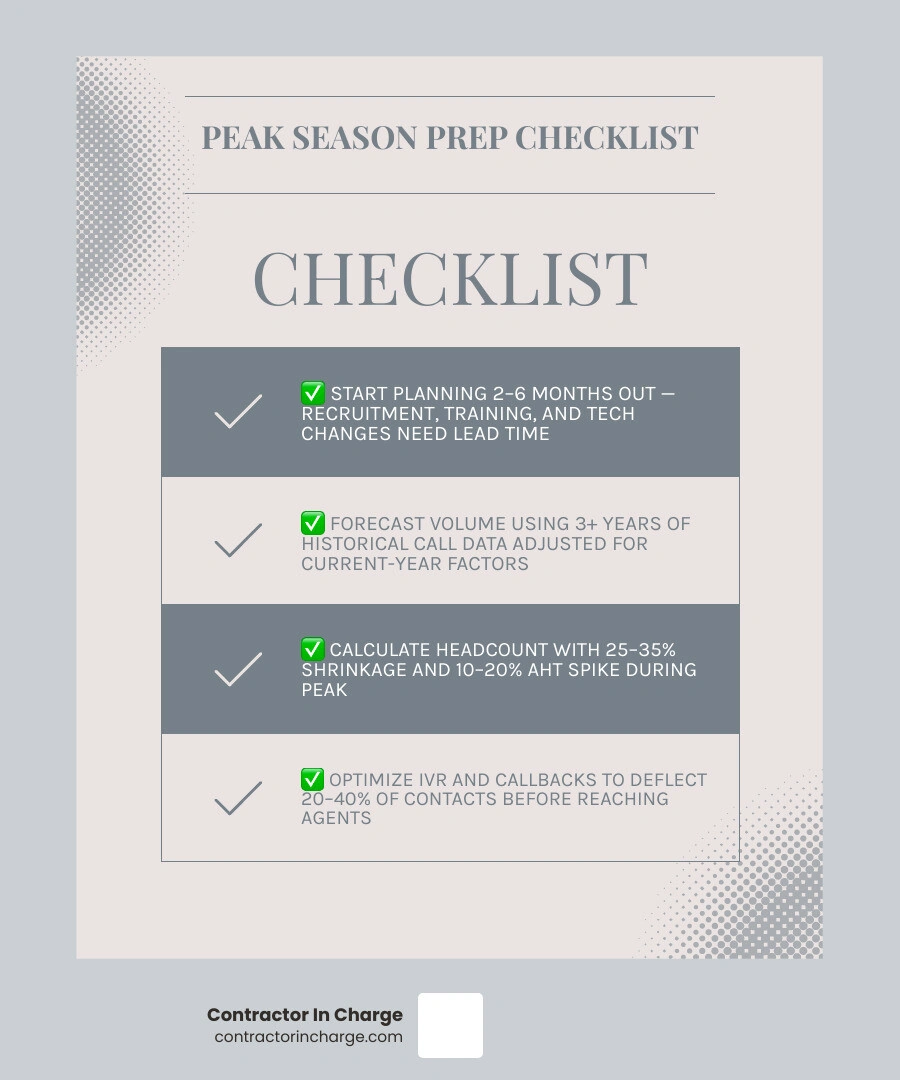
- Start planning 2–6 months out — recruitment, training, and technology changes all need lead time
- Forecast your volume using at least three years of historical call data, adjusted for current-year factors
- Calculate true headcount needs by accounting for a 25–35% shrinkage rate and a 10–20% spike in average handle time during peak periods
- Layer your staffing options — overtime, seasonal hires, and outsourced overflow each serve a different role
- Optimize self-service tools like IVR and automated callbacks, which can deflect 20–40% of contacts before they reach a live agent
- Train agents on peak-specific scenarios before the surge hits, not during it
- Monitor real-time metrics daily and make intraday adjustments to protect service levels
- Protect your agents — burnout-driven turnover costs far more than proactive staffing
- Debrief after the peak while details are fresh, so next season runs smoother
For HVAC companies, plumbers, and electricians, the stakes are especially high. Volume increases during peak season can range anywhere from 50% to 400%, and a 40% increase in call volume is not just more of the same — it shifts the nature of every interaction. Customers calling during a summer heatwave or a winter pipe freeze are stressed, time-sensitive, and far less forgiving of long hold times or missed calls. Research consistently shows that many customers will not return after a single negative service experience, and a significant portion will switch to a competitor without ever telling you why.
What makes this harder is that the busy season does not announce itself gradually. It tends to arrive all at once — and teams that are not already prepared find themselves scrambling to hire, train, and fix technology gaps in real time, which is exactly the wrong moment to do any of those things.
I'm Anna Lynn Wise, CEO of Contractor In Charge, and I started my career at eighteen as a dispatcher before spending fifteen years in ownership and general management of a plumbing, HVAC, and remodeling company — which means getting your call center ready for busy season is something I have lived through from both sides of the dispatch board. That hands-on experience shapes everything my team and I do to help service businesses answer more calls, book more jobs, and keep operations running smoothly when demand peaks.
Terms related to getting your call center ready for busy season:
The Timeline and Forecasting Math Behind Peak Season Prep

Preparing your customer service team for a massive influx of calls requires more than just telling everyone to "work faster." It is an exercise in precise forecasting, operational math, and proactive planning. To prevent your team from collapsing under the weight of sudden demand, you must understand both the calendar timeline and the staffing formulas that keep hold times low and booking rates high.
If you want to transition from a reactive "firefighting" mode to a calm, organized dispatch environment, you must start by laying down a solid foundation of data-driven planning. This is the first step in learning how to prepare your service business for peak season.
When to Start Getting Your Call Center Ready for Busy Season
The biggest operational trap home service contractors fall into is waiting for the weather to change before they start hiring and training. If you wait until a July heatwave hits Tampa, Florida, or a sudden freeze paralyzes Texas, you have already lost the battle.
To build a resilient operation, we must use a strategy called backwards scheduling. This means identifying your historical peak demand date and working backward to map out the exact milestones required to have fully productive agents on the phones on day one.
A realistic planning timeline spans two to six months before your busy season begins:
- 12 to 16 Weeks Out: Analyze historical data, establish your budget, and decide whether you will handle the surge in-house, authorize overtime, or partner with an outsourced provider.
- 8 to 12 Weeks Out: Begin the recruiting and screening process. The path from sourcing a candidate to full productivity can take anywhere from four to six weeks, and sometimes longer if your dispatching software or service area guidelines are highly complex.
- 4 to 8 Weeks Out: Conduct intensive classroom training and hands-on system onboarding.
- 2 Weeks Out: Run a live "dress rehearsal" to stress-test your phone lines, routing rules, and booking software under simulated high-volume conditions.
By mapping out these milestones early, you ensure that new hires are not trying to learn your dispatch procedures while a queue of fifty angry customers is waiting on hold. This proactive approach is the single best way how to stop losing calls during busy season.
Forecasting Surge Volumes and Calculating Required Headcount
To staff your call center accurately, you cannot rely on guesswork. You need to look at historical interval-level data—ideally broken down into 15- or 30-minute increments—and adjust those baselines for current-year factors like marketing campaigns, service area expansions, and regional weather patterns.
Once you have forecasted your expected call volume for a given interval, you must run the staffing math. This is where many home service business owners make a critical mistake: they assume that a 40% increase in calls simply requires 40% more working hours.
In reality, a 40% increase in call volume is not just "more of the same" — seasonal surges fundamentally change the nature of the work. During peak seasons, two primary variables shift:
- Average Handle Time (AHT) Increases: Because customer calls are more complex and carry a much higher emotional intensity (such as a homeowner with no air conditioning in 95-degree Florida humidity), AHT typically increases by 10% to 20% during spikes.
- Shrinkage Rises: Shrinkage represents the time agents are paid but are not available to answer calls (due to breaks, training, meetings, or absenteeism). While normal shrinkage runs between 25% and 35% in contact centers, you must plan for the higher end of this scale during peak periods because high-stress environments naturally drive up absenteeism.
To calculate the number of agents needed during a peak interval, you can use workforce management software utilizing Erlang C modeling, or apply this basic staffing math formula:
$$\text{Required Headcount} = \frac{\text{Forecasted Volume} \times \text{Average Handle Time}}{\text{Available Time per Agent}} \times (1 + \text{Shrinkage Factor})$$
By accounting for both the rise in AHT and the higher shrinkage rates, you can ensure you have a realistic buffer capacity. Tracking these metrics properly is essential for understanding how to measure call center performance for contractors.
Staffing and Technology Strategies for Getting Your Call Center Ready for Busy Season
| Staffing Strategy | Pros | Cons | Best Used For |
|---|---|---|---|
| In-House Overtime | Highly experienced staff; zero ramp-up time; excellent quality control. | High risk of burnout; expensive; limited total capacity. | Short, unpredictable weekend or evening weather spikes. |
| Seasonal Hires | Temporary capacity; does not burden core team; scalable. | Long recruiting/training cycles; high turnover; variable quality. | Predictable, multi-month surges (e.g., summer AC rush). |
| Outsourced Support | Instant scalability; 24/7 coverage; zero recruiting burden; pay-per-use. | Requires close integration with your CRM/dispatch tools. | Consistent overflow, after-hours, and holiday coverage. |
When getting your call center ready for busy season, you must strike a delicate balance between cost control and service level goals. The traditional contact center benchmark is the "80/20 rule"—answering 80% of calls within 20 seconds. However, during an extreme seasonal surge, maintaining this exact level solely with in-house staff can become incredibly expensive.
To find the right balance, you must compare the long-term viability of your team against the immediate needs of your callers. For a deep dive into how these models compare, read our analysis on in-house receptionist vs outsourced call center for contractors.
Balancing Overtime, Seasonal Hires, and Outsourced Support
Relying entirely on a single staffing strategy during peak season is a recipe for operational failure. If you try to cover a massive volume surge solely by pushing your existing team to work overtime, you will quickly run into the limits of human endurance.
While voluntary overtime is a great tool for short-term volume spikes, it must be managed carefully. Overtime should be strictly capped at 10 to 15 hours per week per agent. Exceeding this threshold leads to severe fatigue, critical data-entry errors in your dispatch software, and high attrition rates. The cost of replacing experienced agents after a burnout-driven resignation often far exceeds the cost of hiring strategically ahead of peak demand.
On the other hand, relying exclusively on temporary seasonal hires presents its own challenges. Recruiting, onboarding, and training temporary staff who may only work for three months is highly inefficient.
This is why successful home service brands deploy a hybrid model:
- Use your core, experienced in-house team to handle complex customer issues and VIP accounts.
- Authorize moderate, capped overtime to handle predictable daily peaks (such as the early morning rush).
- Partner with an outsourced, specialized contractor call center to absorb overflow, after-hours, and weekend emergency calls.
This hybrid approach allows you to scale your capacity up and down instantly without taking on the long-term overhead of year-round employees. You can learn more about managing these variables in our guide on the cost of a full-time receptionist vs call center service.
Deploying Smart Routing, IVR, and Callback Systems
Technology is the ultimate force multiplier when your phone lines are lighting up. Instead of letting every incoming call flood your primary queue, you can use smart call routing and interactive voice response (IVR) menus to organize the chaos.
A well-designed, peak-specific IVR menu can deflect 20% to 40% of contacts before they ever reach a live agent. During a busy season, you can optimize your phone menu by:
- Placing urgent options first: Keep your menu short (no more than 3 or 4 options) and put high-volume seasonal requests (like "Press 1 to schedule an air conditioning tune-up") at the very top.
- Setting up ring groups: Distribute incoming calls to multiple team members simultaneously rather than routing everything through a single receptionist. Set a minimum ring duration of 15 seconds to ensure calls have time to register on available devices.
- Implementing automated callbacks: Give customers the option to hang up and receive an automated callback when an agent becomes available, rather than waiting on hold. This simple feature drastically reduces abandonment rates and levels out sudden call spikes.
By routing simple inquiries to self-service paths or automated booking portals, you free up your live agents to focus on high-value scheduling interactions. This is a critical component of learning how to improve call answer rates for service businesses.
Agent Training, Well-Being, and Real-Time Intraday Management
When the busy season arrives, your call center agents are your first line of defense. They are the ones talking to stressed homeowners who are dealing with flooded basements or sweltering living rooms. To keep your team performing at their best, you must invest in their preparation, support their mental well-being, and monitor operations in real time to make agile adjustments.
Preparing Agents for High-Stress Inquiries and Changed Call Dynamics
Because seasonal surges change the emotional weight of customer interactions, standard onboarding is not enough. Your pre-peak training must focus on the specific scenarios agents will encounter during high-volume periods.
- Focus on the Top 5 to 10 Inquiry Types: During a surge, 70% to 80% of your call volume will consist of just a handful of request types (such as "no cooling" calls, emergency drain cleanouts, or scheduling seasonal maintenance). Train your agents extensively on these specific scripts and booking workflows.
- Empathy and De-escalation Training: Teach your staff how to handle highly emotional customers. Simple soft skills, like active listening and validating a customer's frustration, can quickly lower the tension on a call.
- Run a Live Dress Rehearsal: Two weeks before the busy season officially begins, conduct mock scenarios. Have your supervisors call in pretending to be frustrated homeowners, simulating a high-volume queue. This helps identify process bottlenecks and tech glitches before they impact real customers.
Providing this level of targeted preparation is the key to mastering how to handle high call volume during peak season. If you want to build a truly professional team, make sure to read our best practices on how to train staff to answer calls professionally.
Protecting Agent Well-Being and Monitoring Real-Time Metrics
Supervising a call center during peak season is a balancing act. While you must keep an eye on service level metrics, you must also monitor the human element. Burnout is the single biggest driver of employee turnover in our industry.
To protect your team and keep operations running smoothly, supervisors should monitor a few critical real-time KPIs:
- First Contact Resolution (FCR): This is your most critical peak-season metric. If an agent resolves a customer's issue on the first call, it prevents a follow-up callback. Unresolved issues compound inbound call volume exponentially.
- Abandonment Rate: If your abandonment rate is climbing, it means customers are hanging up out of frustration. This is a clear signal that you need to adjust your routing, activate callback features, or route overflow calls to an external partner.
- Break Compliance: When the queue is backed up, it is incredibly tempting to ask agents to skip their breaks. This is a massive mistake. Enforcing scheduled breaks is counterintuitively more important during high-volume periods because skipping them rapidly accelerates error rates and mental fatigue.
By supporting your team with clear escalation paths, daily huddles, and simple recognition programs, you can keep morale high when the pressure is on. To understand what a highly functional support environment looks like, read our guide on what to expect from a contractor call center.
Post-Peak Analysis and Off-Season Lead Nurturing
When the weather finally cools down and the phones stop ringing constantly, it is tempting to just take a deep breath and forget about the busy season. However, the work you do immediately after the peak is what will make next year's surge run even smoother. At the same time, you must pivot your strategy to keep your technicians busy and your pipeline full during the slower months.
To maintain a healthy business year-round, you must master both post-season analysis and off-season lead management. This is where understanding booking rate benchmarks for contractor call centers becomes incredibly valuable.
Conducting Post-Peak Debriefs for Continuous Improvement
The most valuable planning activity you can perform for next year's busy season must happen within two weeks of this year's surge ending. While the details are still fresh in everyone's minds, gather your leadership team and your agents for a comprehensive debrief.
During this post-peak analysis, focus on three key areas:
- Metrics Review: Analyze your actual call volumes, average handle times, abandonment rates, and booking rates against your initial forecasts. Where did the models hold up, and where did they fall short?
- Agent Feedback: Ask your front-line staff what worked and what didn't. Did they have the tools they needed? Were there specific scripts or dispatch procedures that caused confusion or slowed down call handling?
- Playbook Updates: Document every lesson learned. Update your standard operating procedures, training manuals, and IVR routing rules so you don't have to reinvent the wheel when the next busy season rolls around.
Consistently reviewing your performance is the only way to ensure continuous improvement. For a structured framework on how to analyze your operations, read our guide on how to evaluate your answering service performance.
Off-Season Marketing and Lead Nurturing to Fill the Pipeline
Once the emergency repair calls slow down, home service contractors face a different challenge: the dreaded "feast-or-famine" cycle. To keep your schedule full during the shoulder months, you must shift your focus from reactive call handling to proactive lead nurturing.
According to industry research, 50% of your leads aren't ready to buy immediately when they first make contact. If you ignore these cold or dormant leads, you are leaving an incredible amount of revenue on the table.
To fill your pipeline during the off-season, implement these proactive strategies:
- Segment Your Audience: Group your database into distinct categories, such as past customers who haven't had an annual maintenance visit, dormant leads from the summer, and new prospects.
- Deploy CRM Automation: Set up automated email and SMS drip campaigns to deliver helpful, value-first content (like a winterization checklist or an electrical safety audit guide) rather than aggressive sales pitches.
- Prioritize Speed to Lead: Even during the slow season, responsiveness is everything. When a homeowner reaches out for an estimate on an indoor remodeling project or a system replacement, you must respond instantly.
Understanding why speed to lead matters for home service companies is critical to outperforming competitors who go completely dark during the winter. By mastering how to follow up on leads effectively as a contractor, you can keep your technicians booked and build a highly resilient, year-round business.
Frequently Asked Questions about Busy Season Preparation
How far in advance should home service call centers start preparing for the busy season?
Most home service call centers should begin their operational planning and forecasting two to six months before their typical peak demand period. This extended timeline is necessary because recruiting, onboarding, and training new agents takes a minimum of four to six weeks. Additionally, implementing new technology, optimizing your IVR routing, and setting up backup support systems require several weeks of testing to ensure they run smoothly under pressure.
Starting early allows you to build a reliable "backwards schedule" that ensures your team is fully productive before the first heatwave or freeze hits. This level of preparation is closely tied to how fast contractors should respond to leads to secure jobs ahead of the competition.
What is the best way to handle sudden, weather-driven call spikes without burning out staff?
The most effective way to handle unpredictable, weather-driven call spikes is to implement a hybrid staffing model that combines smart technology with outsourced support. First, deploy an automated callback system to give customers the option to receive a call back when an agent is free, which helps smooth out sudden spikes in call volume. Second, strictly cap your in-house team's overtime at 10 to 15 hours per week to prevent fatigue and mistakes.
Finally, partner with a specialized, outsourced answering service that offers 24/7 live agent coverage. This allows you to route overflow calls seamlessly during extreme weather events, ensuring you never miss a lead while keeping your core team's workload manageable. For specialized emergency support, explore our 24/7 Live Agent Call Center Services: After Hours Emergency Call Handling.
How can self-service and IVR optimization help reduce agent workload during peak times?
Optimizing your interactive voice response (IVR) system and promoting self-service options can deflect 20% to 40% of incoming contacts before they ever reach a live agent. By designing a simple phone menu that places high-volume, seasonal requests at the very top, you allow callers with routine questions (like checking an appointment time or requesting a basic quote) to find answers or book online without speaking to a representative.
This keeps your phone lines open for complex, high-priority emergency calls that require human empathy and advanced dispatching skills. Implementing these automated routing paths is a highly effective strategy for learning how to convert more leads into booked jobs.
Conclusion
Getting your call center ready for busy season is not a project you can tackle at the last minute. It requires a strategic combination of accurate forecasting, structured training, smart technology, and a deep commitment to protecting your team from burnout.
When the phones start ringing off the hook, every missed call is a missed opportunity to help a homeowner and secure a valuable job. By laying down a solid operational foundation months in advance, you can turn seasonal pressure into an opportunity to showcase your professionalism, build long-term customer loyalty, and maximize your revenue.
At Contractor In Charge, we understand the unique challenges that plumbers, HVAC technicians, and electricians face when demand peaks. Founded by an industry veteran, we offer scalable, outsourced call answering, booking, dispatch, and bookkeeping services designed specifically for home service contractors. Our dedicated virtual receptionists combine modern technology with old-fashioned customer care to ensure your business never misses a call, even during the most hectic summer heatwaves or winter freezes.
Ready to take the stress out of your next peak season? Partner with Contractor In Charge for Peak Season Success and let us help you keep your schedule full, your customers happy, and your business growing.