

The Financial Risk of Relying on Cash Accounting During the August Busy Season


The Late-Summer Cash Surge: A Deceptive Peak for Home Service Businesses
Late summer heatwaves are notorious for pushing home service operations to their absolute limits, and with that demand comes a real risk for shops that rely on cash accounting during the August rush. When temperatures peak and emergency service calls flood your dispatch board, revenue naturally skyrockets. Your technicians are working overtime, trucks are rolling constantly, and customer payments are clearing your accounts at a record pace. For many business owners, logging into the banking portal during this period brings a profound sense of relief and accomplishment.
However, this massive cash influx often creates a dangerous and false sense of financial security. If your business relies solely on tracking cash as it enters and leaves the bank account, you are only seeing half of the financial picture. That high bank balance is an illusion because it completely masks the unrecorded liabilities that were generated alongside that revenue. You are looking at the gross receipts of your busiest month without accounting for the massive wave of bills, payroll taxes, and supplier invoices that are lagging just a few weeks behind.
The transition from the August peak to October shoulder season transition is one of the most vulnerable periods for any home service business. When the weather cools and the phone stops ringing, the incoming cash slows to a trickle. Yet, the expenses generated during the summer rush are just beginning to mature. Navigating this dangerous cycle requires more than just hoping for a mild autumn; it requires a fundamental shift in how you track your financial health. By transitioning your financial tracking methods and partnering with experts in bookkeeping and accounting services, you can recognize this illusion before the inevitable cash flow crunch hits.
How Cash Accounting Distorts Peak Season Profitability
To understand why the late-summer cash surge is so deceptive, you have to look at the mechanical differences between the Cash-basis vs. Accrual-basis accounting models. Under a cash accounting system, your business records revenue exactly when a customer payment is received and records an expense exactly when a bill is paid. On a slow Tuesday in March, this system might seem perfectly adequate. But during the chaotic peak of summer, this simplified method completely breaks down and distorts your true profitability.
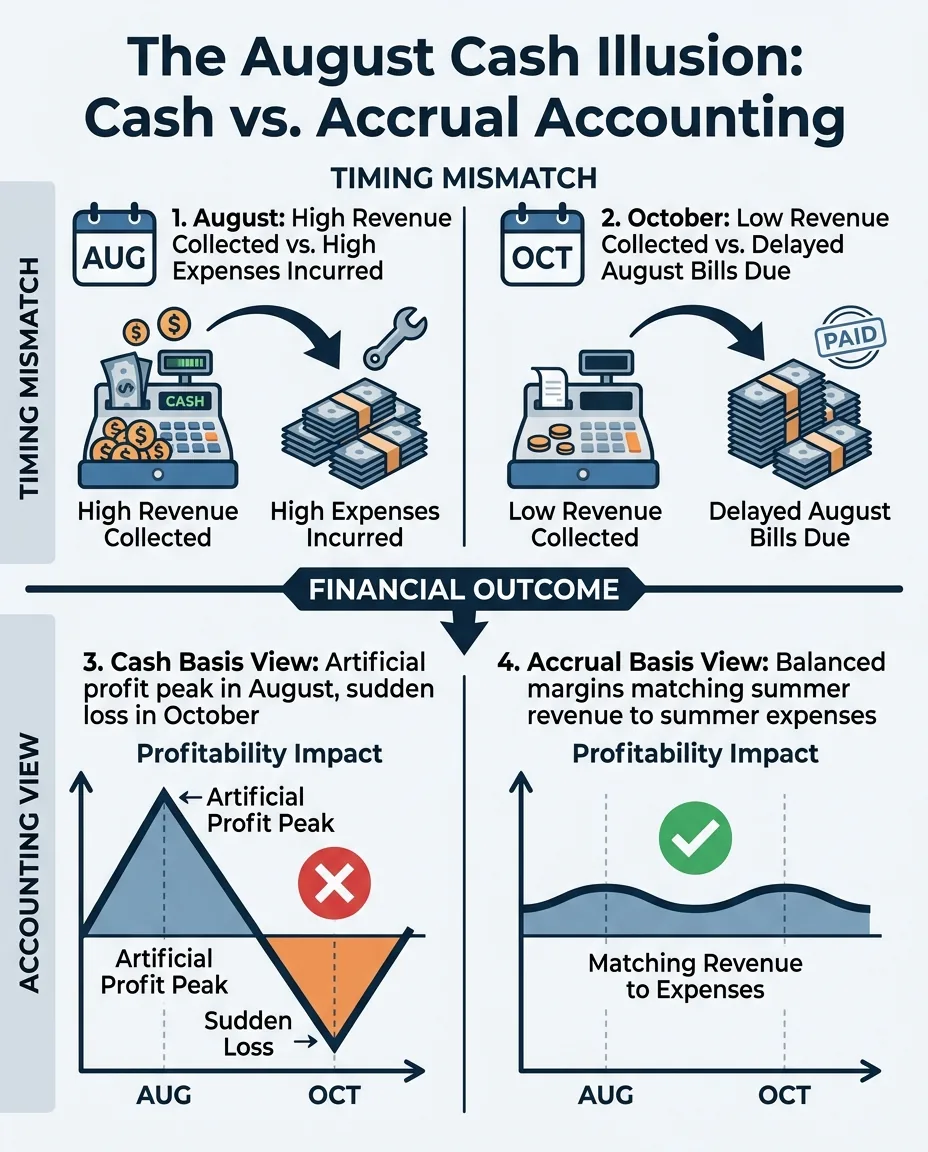
Consider the impact of regional climate patterns. Late summer heatwaves drive massive cash influxes from emergency A/C replacements. When an air conditioning system fails in triple-digit heat, homeowners authorize replacements quickly, and those large payments hit your bank account almost immediately. Under cash accounting, your August profit and loss statement looks incredibly strong. You see massive revenue spikes. However, the true cost of goods sold—the expensive condenser, the coil, the refrigerant, and the specialized labor—often remains entirely invisible on that same August report.
This creates a severe violation of the matching principle. The matching principle dictates that the expenses incurred to generate revenue must be recorded in the exact same period as the revenue itself. Because cash accounting ignores this rule, your peak season profit margins are artificially inflated. Business owners looking at these distorted metrics often make poor financial decisions, such as taking excessive owner draws, purchasing new fleet vehicles, or greenlighting expensive marketing campaigns, believing they have excess capital to burn.
The Danger of the Bank Balance Management Style
The banking app is not a financial report. Operating your business by checking your available bank balance is a risky management style that leaves you blind to upcoming obligations. The core issue is the lag time between collecting a customer's payment and actually paying the supplier invoices associated with that job.
When you rely on the bank balance, you are essentially spending money that belongs to your vendors, the government, or your insurance providers. Without accurate bookkeeping for HVAC companies to track these delayed obligations, you are essentially flying blind into the slowest part of the year. The cash in your account is not all profit; much of it is already spoken for by liabilities that simply haven't been invoiced yet.
Mounting Fall Liabilities Hidden in August Bank Balances
The illusion of the August cash peak shatters precisely when the delayed expenses finally come due. The danger lies in the fact that these bills arrive just as the August peak to October shoulder season transition takes hold. When service calls drop sharply in the fall, there is significantly less incoming cash available to cover these delayed peak-season bills.
Here are the primary liabilities that accumulate silently during the summer rush and strike during the fall shoulder season:
• Delayed Supplier Terms: Equipment purchases, parts, and heavy materials procured in August are frequently bought on Net-30 or Net-60 day supplier terms. The revenue was collected in August, but the massive vendor bills hit your desk in October.
• Overtime Payroll Taxes: While you pay your technicians their net wages weekly, the employer-side payroll taxes, matching contributions, and accrued benefits tied to those massive overtime hours often lag behind, draining cash reserves weeks after the revenue was generated.
• Workers' Compensation Adjustments: Higher payroll volume during the summer means higher workers' compensation liabilities. Premium audits or true-ups based on those peak hours frequently arrive just as the fall slowdown begins.
• Credit Card and Financing Fees: High-ticket replacements are often financed or paid via credit card. The merchant fees and financing buy-downs associated with peak-season volume can silently erode the cash you thought was safely tucked away.
Navigating this minefield requires precise visibility. During a particularly chaotic summer season, one home service business owner realized they needed highly organized and reachable support to get accurate numbers and proactive feedback. By bringing in a dedicated team to handle the accounting, they received spot-on numbers that illuminated these exact hidden liabilities before the fall slowdown hit. Accurate numbers and proactive feedback are the only ways to anticipate these liabilities before they completely drain your operating reserves.
Matching Revenue to Expenses: The Accrual Advantage
The only reliable way to eliminate the seasonal blind spot is to fundamentally change how you view your financial data. Shifting from the Cash-basis vs. Accrual-basis accounting models is not just a bookkeeping exercise; it is a critical survival strategy for cyclical businesses. Accrual accounting solves the shoulder-season cash flow crunch by matching your revenue with the exact expenses incurred to generate it, regardless of when the physical cash changes hands.
When you install a system in August, accrual accounting immediately records the revenue alongside the cost of the equipment, the labor, and the associated taxes—even if you won't pay that vendor bill until October. This provides a true, unvarnished picture of your profitability. By recording liabilities the moment they are incurred, you completely eliminate the shoulder-season surprises that plague cash-basis operators.
Comparing Cash vs. Accrual in Real Time
Understanding the difference requires looking at how a single peak-season transaction behaves under both systems. Shifting to this model requires adopting dedicated performance accounting solutions that track operations, not just bank deposits.
• August Revenue — Cash-Basis Accounting: Recorded immediately upon deposit, inflating perceived income. — Accrual-Basis Accounting: Recorded upon job completion, accurately reflecting earned income.
• Vendor Bills (Net-30) — Cash-Basis Accounting: Invisible in August. Strikes the P&L unexpectedly in October. — Accrual-Basis Accounting: Recorded in August. Matches the revenue generated by the parts.
• Profit Margin View — Cash-Basis Accounting: Wildly volatile. Artificial profit peak in August, sudden loss in October. — Accrual-Basis Accounting: Stable and accurate. Steady visibility into true margins year-round.
• Shoulder Season Impact — Cash-Basis Accounting: High panic. Scrambling for cash to pay delayed summer bills. — Accrual-Basis Accounting: Predictable. Funds are already allocated for upcoming obligations.

Strategic Preparation for the Shoulder Season Transition
Recognizing the flaws in your current tracking system is only the first step. To protect your business during the August peak to October shoulder season transition, you must take proactive steps while your cash reserves are still healthy. Waiting until the phone stops ringing in October to organize your finances is a recipe for disaster. Now is the time to leverage your peak-season momentum to build a sustainable, year-round financial strategy.
Industry-specific performance accounting and fractional CFO expertise helps contractors smoothly transition to accrual accounting without disrupting daily operations. When you have experts guiding the process, you can tie your operational dispatch metrics directly to your true financial reality.
Follow these strategic steps to prepare your business for the upcoming shoulder season:
1. Forecast Based on Liabilities, Not Historical Revenue: Begin forecasting your October and November cash flow based on the accrued summer liabilities sitting in your accounts payable. Do not base your fall budget on historical fall revenue alone, as that ignores the debt you owe from August.
2. Audit Open Purchase Orders: Work with your warehouse or inventory manager to identify all open purchase orders from the summer rush. Ensure every piece of equipment installed has a corresponding vendor bill entered into your accounting software, even if it is not due yet.
3. Reconcile Payroll and Benefit Accruals: Calculate the exact burden of your peak-season overtime. Ensure that employer taxes, workers' compensation premiums, and matching benefits are fully funded and set aside before owner distributions are taken.
4. Organize Financial Statements for Valuation: Clean, accrual-based financial statements are critical for long-term growth. One winter, a group of business owners realized they needed their financial house in perfect order to prepare for high-end transactions. By partnering with fractional CFOs to organize their financial records, the owners ultimately achieved the highest valuation range for their sold transactions. Messy, cash-basis books will derail any potential acquisition or financing effort.
5. Partner with Industry Financial Experts: Transitioning accounting models mid-year is complex. Partner with financial experts who understand the unique cyclical nature of home service businesses. Utilizing fractional CFO services ensures that your chart of accounts is optimized specifically for HVAC, plumbing, or electrical operations.
Frequently Asked Questions About Contractor Accounting Cycles
Why does cash-basis accounting create cash flow problems?
Cash-basis accounting creates problems because it records revenue immediately upon deposit while ignoring the delayed bills associated with that revenue. During the August peak to October shoulder season transition, this system artificially inflates your perceived profit. When the delayed supplier bills and payroll taxes finally arrive weeks later, the business often lacks the incoming cash to cover them, resulting in a severe cash flow crunch.
How should HVAC companies prepare for the shoulder season?
HVAC companies should prepare by shifting to an accrual-based tracking system while summer cash reserves are still high. This involves auditing all open purchase orders, reconciling peak-season payroll liabilities, and setting aside specific funds for delayed vendor bills. By forecasting fall cash flow based on known liabilities rather than hoping for high service call volume, businesses can navigate the slowdown safely.
What is the difference between cash and accrual accounting for contractors?
The primary difference between the Cash-basis vs. Accrual-basis accounting models is timing. Cash accounting logs transactions only when money physically enters or leaves the bank account, which is dangerous for cyclical businesses. Accrual accounting matches revenue with the exact expenses incurred to generate that revenue, providing a highly accurate picture of true profitability regardless of payment terms.
Why is a high bank balance in August potentially dangerous?
A high bank balance in August is dangerous because it creates a false sense of financial security that encourages overspending. Much of that cash is already spoken for by Net-30 or Net-60 vendor terms, overtime payroll taxes, and workers' compensation adjustments that simply haven't been invoiced yet. Treating that gross cash as pure profit leaves the business vulnerable to upcoming liabilities.
How do seasonal businesses accurately budget for slower months?
Seasonal businesses budget accurately by using performance accounting to track their true margins and accrued liabilities year-round. Instead of relying on a bank balance, they rely on a balance sheet that clearly outlines accounts payable and upcoming tax burdens. This ensures that the profits generated during the summer peak are properly preserved to sustain operations through the slower fall and winter months.
Secure Your Shoulder Season Cash Flow Today
Don't let the August cash illusion lead your business directly into an October cash crunch. The transition from the August peak to October shoulder season transition is unforgiving for businesses operating blindly on bank balances. Achieve true financial visibility and protect your hard-earned summer profits by shifting to an accrual-based tracking system now. Reach out to an expert financial team today to safeguard your seasonal transitions and gain the clear, accurate reporting you need to confidently run your business year-round.