

Choosing the Best HVAC Answering Service for Peak Season Call Triage

Is Your Current Call Center Dropping the Ball When Temperatures Rise?
During peak summer cooling season, your phone lines light up the moment the temperature spikes. Having common homeowner questions answered quickly and accurately is critical to keeping your schedule manageable and your customers calm. Here at Contractor In Charge, we frequently ask our partners: are you confident that your current call handling solution can actually differentiate between a simple tripped breaker and a major sealed-system failure? When a panicked homeowner calls because their standard residential split-system AC is blowing warm air or running continuously without cooling the home, how that call is handled dictates the rest of your day.
The critical decision point for any front-line dispatcher is identifying whether the lack of cooling is due to a homeowner-serviceable issue or if it requires immediate professional dispatch. Misdiagnosing a simple user error as an emergency wastes your technicians' time, while downplaying a real mechanical failure leaves your customers suffering in the heat. By upgrading to a specialized answering service, you ensure that expert triage takes place on every single call, saving your business valuable time and sparing the homeowner unnecessary emergency dispatch fees.
Comparing Generic Message Takers vs. Specialized HVAC Dispatchers
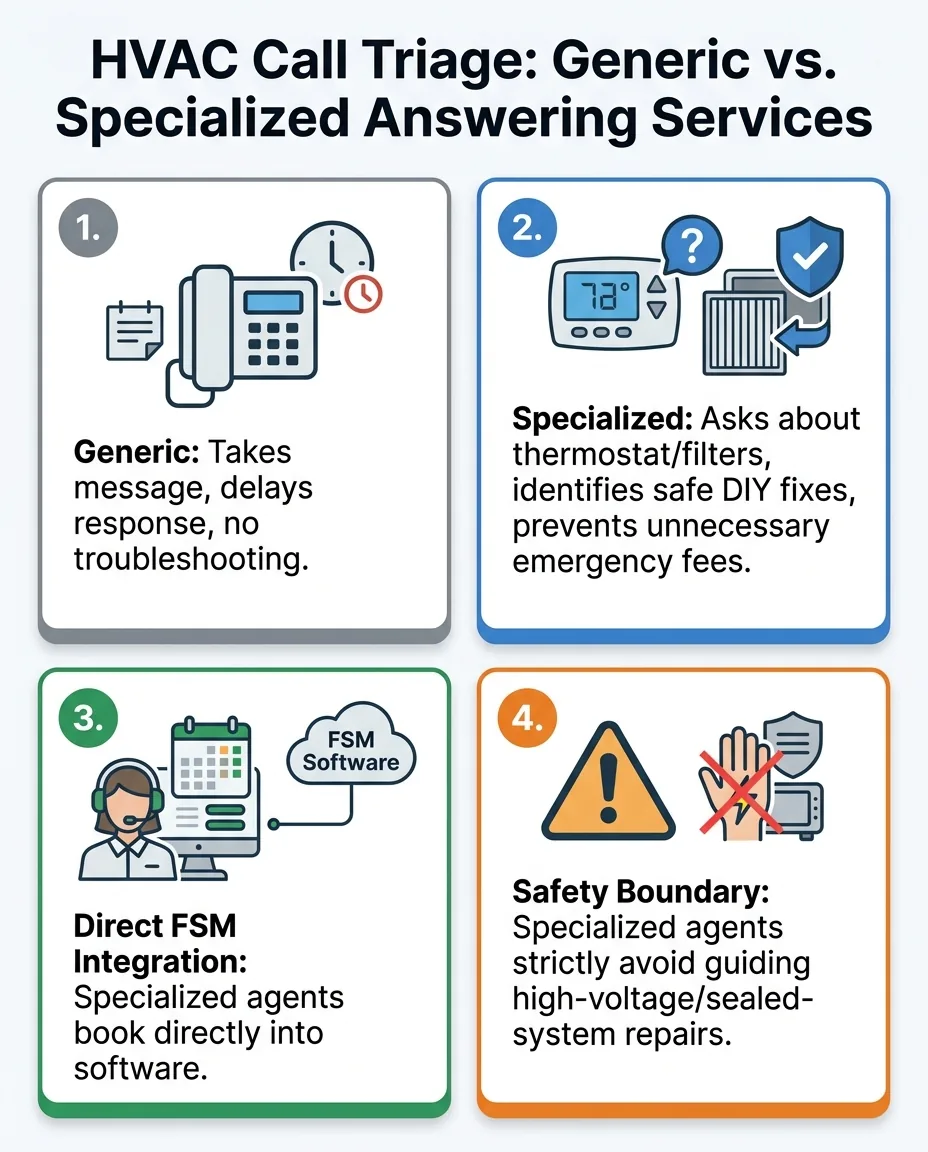
Not all call centers are created equal, and in our experience managing dispatch for home service businesses across the local area, the differences become glaringly obvious when extreme weather hits. Generic answering services operate on a simple premise: they take a name, a phone number, and a brief message, leaving the business owner or on-call technician to dial the customer back and figure out what is actually wrong. This creates a frustrating bottleneck. The homeowner is left waiting in a hot house, feeling ignored, while your technicians are forced to play phone tag instead of turning wrenches.
Specialized HVAC dispatchers, on the other hand, actively triage the call the moment they pick up the phone. Because they understand the nuances of a standard residential split-system AC, they ask targeted questions about thermostat settings, airflow, and air filters. They guide homeowners through safe, basic checks over the phone, immediately de-escalating the situation. The customer experience transforms from a frustrated homeowner waiting for a callback into a reassured homeowner who feels their problem is already being actively solved.
Consider the real-world impact of having trade-trained professionals on the line. We see this scenario play out often: one plumbing and HVAC business came to our team needing after-hours call center support to handle their overnight emergencies. By partnering with our specialized providers, dedicated agents handled the after-hours calls seamlessly, while the support team provided excellent customer service. The outcome was a reliable partner extending the business's services around the clock without sacrificing quality or technical accuracy.
A Clear Look at Call Handling Capabilities:
• Initial Response — Generic Message Takers: Records name, number, and basic message. — Specialized HVAC Dispatchers: Actively troubleshoots and triages the specific HVAC issue.
• Customer Experience — Generic Message Takers: Homeowner waits anxiously for a callback from a technician. — Specialized HVAC Dispatchers: Homeowner feels supported and guided through immediate, safe checks.
• Technical Knowledge — Generic Message Takers: Cannot differentiate between a dead thermostat and a bad compressor. — Specialized HVAC Dispatchers: Understands split-systems, airflow dynamics, and electrical basics.
• Impact on Technicians — Generic Message Takers: High rate of false alarms and unnecessary emergency truck rolls. — Specialized HVAC Dispatchers: Technicians arrive at real emergencies with preliminary diagnostic data.
When you utilize 24/7 live agent call center services, you bridge the gap between a ringing phone and a highly qualified, accurately booked appointment.

Triaging the Most Common Call: 'My AC is Blowing Warm Air'
When a homeowner calls in a panic because their AC is blowing warm air, a generic operator simply logs a "broken AC" ticket. A specialized agent, like those on our team at Contractor In Charge, however, initiates a structured troubleshooting protocol. This level of virtual customer service is designed to rule out simple user errors and environmental factors before ever rolling a truck.
Step 1: Verifying Thermostat Integrity
The Problem: The system is running, but the air feels tepid or the system isn't kicking on at all.
The Cause: Often, the issue is at the wall, not the unit. Thermostats get bumped, batteries die, and settings get accidentally changed to "heat" or "fan only."
The Solution: The agent calmly guides the caller to check the digital display. They ensure the system is set to "cool," the fan is on "auto" rather than "on," and the set point is actually lower than the current room temperature. If the screen is blank, they advise the homeowner to change the batteries.
Step 2: Assessing the Air Filter
The Problem: The system is running constantly, but airflow is weak and the air isn't cold.
The Cause: A severely clogged air filter restricts airflow over the evaporator coil. Without sufficient warm air blowing across it, the coil can literally freeze into a block of ice, stopping the cooling process entirely.
The Solution: The agent asks the homeowner when they last changed their filter. According to the U.S. Department of Energy, replacing a dirty, clogged filter with a clean one can lower an air conditioner's energy consumption by 5% to 15%. If the filter is filthy, the agent advises the homeowner to turn the system off to let it thaw, replace the filter, and test it again in a few hours.
Step 3: Checking Electrical Breakers Safely
The Problem: The indoor fan is blowing, but the outdoor unit is completely silent.
The Cause: A power surge or a temporary overload may have tripped the dedicated circuit breaker for the outdoor condenser.
The Solution: The agent instructs the homeowner to check their main electrical panel for a tripped breaker. They explain how to firmly push the breaker to the "off" position and then back to "on." Most importantly, they do this without ever instructing the homeowner to touch dangerous wiring or open the equipment panels.
By walking through these steps, trade-trained agents prevent unnecessary truck rolls for simple user errors, reserving your highly skilled technicians for true mechanical failures.
Establishing the Safety Boundary: When to Dispatch a Licensed Pro
While virtual troubleshooting is incredibly valuable, we know it must be governed by strict safety protocols. A professional answering service knows exactly where the "do not cross" line is for homeowners. HVAC systems involve high-voltage electricity, pressurized refrigerants, and complex moving parts. Encouraging a homeowner to poke around inside the cabinet of a standard residential split-system AC is a massive liability.
The absolute boundaries for homeowner troubleshooting include:
• High-Voltage Electrical Diagnostics: Homeowners should only operate the main breaker panel. They must never be instructed to open the outdoor disconnect box, test capacitors, or inspect contactors.
• Sealed-System Inspections: Refrigerant handling is strictly regulated by the EPA. Homeowners cannot check refrigerant pressures, add Freon, or attempt to braze leaking copper lines.
• Motor and Compressor Checks: If the outdoor fan is not spinning, homeowners should never use a stick to "jump start" the blades, as this can result in severe injury or further motor damage.
At Contractor In Charge, our agents clearly communicate to the homeowner why a licensed professional is legally and safely required for these issues. Agents listen carefully for specific red flags during the call. If a homeowner reports a loud screeching noise from the compressor, a hissing sound near the indoor coil, or a burning electrical smell, the agent instantly stops the troubleshooting process and moves to emergency dispatch.
Reinforcing this safety-first boundary builds immense trust. It positions your HVAC company as a responsible, authoritative expert that prioritizes the customer's physical safety over a quick fix, ensuring that when a technician does arrive, the homeowner is ready to authorize the necessary professional repairs.
The Impact of Extreme Heat on Call Volume and System Performance
When extreme summer heatwaves settle over the region, HVAC emergency calls surge to unmanageable levels. In-house staff can quickly become overwhelmed, leading to dropped calls, stressed dispatchers, and frustrated customers. But beyond the sheer volume of calls, extreme heat also creates a unique diagnostic challenge that generic call centers simply do not understand.
A pattern we see often during peak summer cooling season is that standard residential systems may run continuously for hours to maintain the indoor temperature. If it is 105 degrees outside, an AC designed for a 95-degree peak day will struggle to cool the house down to 70 degrees. The system is not necessarily broken; it is simply operating at its maximum thermal capacity against extreme environmental conditions.
Our experienced, specialized agents know how to calm panicked homeowners by explaining this climate-driven performance limitation. Instead of blindly dispatching a technician to a house where the AC is actually functioning normally, the agent asks for the indoor and outdoor temperatures. They educate the homeowner on design temperatures and advise them to monitor the system as the sun goes down. This saves your technicians from arriving at a home only to tell the customer, "It's just really hot outside."
Having a scalable answering service ensures no call goes unanswered during these critical weather events. We've guided many partners through these exact spikes. During a particularly brutal summer, one business came to us needing organized and reachable accounting and dispatch services to handle the overwhelming volume. A dedicated team stepped in to manage calls, dispatching, and accounting with incredible organization and responsiveness. Because the team understood the nuances of the industry, the customer's numbers were spot on, and the feedback from the field was wonderful. Partnering with HVAC contractors requires this exact level of industry-specific adaptability.
Direct FSM Integration: Turning Urgent Calls into Booked Appointments
The primary differentiator of a specialized, trade-focused answering service is the ability to operate seamlessly within your existing software ecosystem. Live agents specifically trained for the trades don't just take messages—they book appointments directly into your Field Service Management (FSM) software. This transforms a third-party service into a true extension of your in-house team.
The Direct Integration Workflow:
1. Call Reception and Triage: The agent answers the call using your company's branded greeting, triages the issue, and determines that a licensed professional is required.
2. Live Schedule Access: Instead of sending an email that your in-house team has to read and manually enter later, the agent logs directly into your FSM platform (like ServiceTitan, Housecall Pro, or FieldEdge).
3. Direct Booking: The agent views your real-time availability, selects the appropriate time window, and inputs all the triaged diagnostic notes directly into the customer's profile.
4. Technician Routing: Your on-call technician receives an immediate push notification on their tablet with the complete customer history, the specific symptoms (e.g., "compressor making grinding noise"), and the exact location.
Contrast this with the inefficiency of a generic call center. A generic service sends a text or email with a name and number. Your on-call technician has to pull over, call the customer, ask all the same questions the answering service should have asked, and then manually create the job in the software. Direct FSM integration eliminates double data entry, dramatically improves response times, and optimizes technician routing during high-volume periods.
Evaluating the True Cost of Missed Calls
In our conversations with contractors throughout the local area, many business owners hesitate to invest in a specialized 24/7 answering service, viewing it as an added expense rather than a revenue-generating asset. However, evaluating the true cost of missed calls reveals a very different financial reality. When a homeowner's AC dies on a Friday night in July, they are not going to leave a voicemail and wait until Monday morning. They are going to hang up and call the next contractor on Google until a live human being answers the phone.
The Hidden Financial Impacts:
• Lost Revenue Opportunities: Capturing just one high-value emergency replacement call—a system changeout that would have otherwise gone to a competitor—can often pay for the answering service's monthly retainer entirely.
• Wasted Technician Time: Without smart triage, you pay your technicians overtime to drive across town just to flip a breaker or change a thermostat battery.
• Brand Damage: Customers who are sent to voicemail during an emergency rarely leave positive reviews, and they are unlikely to refer your business to their neighbors.
The dual ROI of a specialized service is clear: you save money on unnecessary truck rolls through intelligent, over-the-phone triage, while simultaneously capturing every legitimate revenue opportunity that comes in after hours. When you review the missed call statistics for home service companies, it becomes obvious that a live, knowledgeable voice is one of the most powerful conversion tools in your arsenal.
Frequently Asked Questions About HVAC Call Handling and Diagnostics
Why is my AC running but not cooling?
This is often caused by restricted airflow from a dirty filter, improper thermostat settings, or a tripped outdoor unit breaker. If the indoor fan is blowing but the air is warm, the outdoor compressor may not be receiving power. If these basic homeowner checks pass, it may indicate a refrigerant leak or a failing compressor, both of which require professional diagnosis.
What should I check before calling an HVAC technician?
Always verify that the thermostat is set to "cool" and the temperature is set below the current room temperature. Next, check and replace dirty air filters, as severe clogs will freeze the system. Finally, ensure all related circuit breakers in your main electrical panel are in the "on" position before requesting a dispatch.
Can a dirty filter stop an AC from cooling?
Yes, a severely clogged filter restricts airflow over the indoor evaporator coil. Without enough warm air passing over it, the coil drops below freezing, causing condensation to turn into solid ice. This ice block stops the cooling process entirely and can eventually damage the compressor if left running.
How do I know if my AC compressor is bad?
Signs of a failing compressor include the system blowing warm air, strange grinding or screeching noises coming from the outdoor unit, or the outdoor circuit breaker repeatedly tripping. Because the compressor deals with high-voltage electricity and pressurized refrigerant, all compressor diagnostics require a licensed professional due to the inherent safety risks.
Why do generic answering services struggle with HVAC calls?
As we've seen time and time again, generic answering services lack the technical vocabulary to ask the right triage questions. As a result, they frequently dispatch technicians for simple issues like a dead thermostat battery, or they fail to identify true emergencies, leaving homeowners frustrated and contractors dealing with inefficient scheduling.
Partner with Experts Who Understand Your HVAC Business
Satisfying the modern homeowner requires more than just showing up on time; it requires providing immediate, knowledgeable support the moment they experience an issue. By offering a definitive, safe checklist of what they can check themselves, and clear guidance on when a licensed pro is required, you build authority and trust.
Having the right team answering your phones protects your contractor reputation, keeps your technicians focused on profitable work, and safeguards your bottom line. You don't have to manage the peak season surge alone. Partner with our dedicated team at Contractor In Charge—a solution that understands the mechanical realities of the HVAC industry, and ensure that every urgent call is handled with the expertise your business deserves.