

Dispatching for Profit: Navigating Akron's Sprawling Service Routes for HVAC Efficiency

The Hidden Cost of Windshield Time Across Akron's Infrastructure
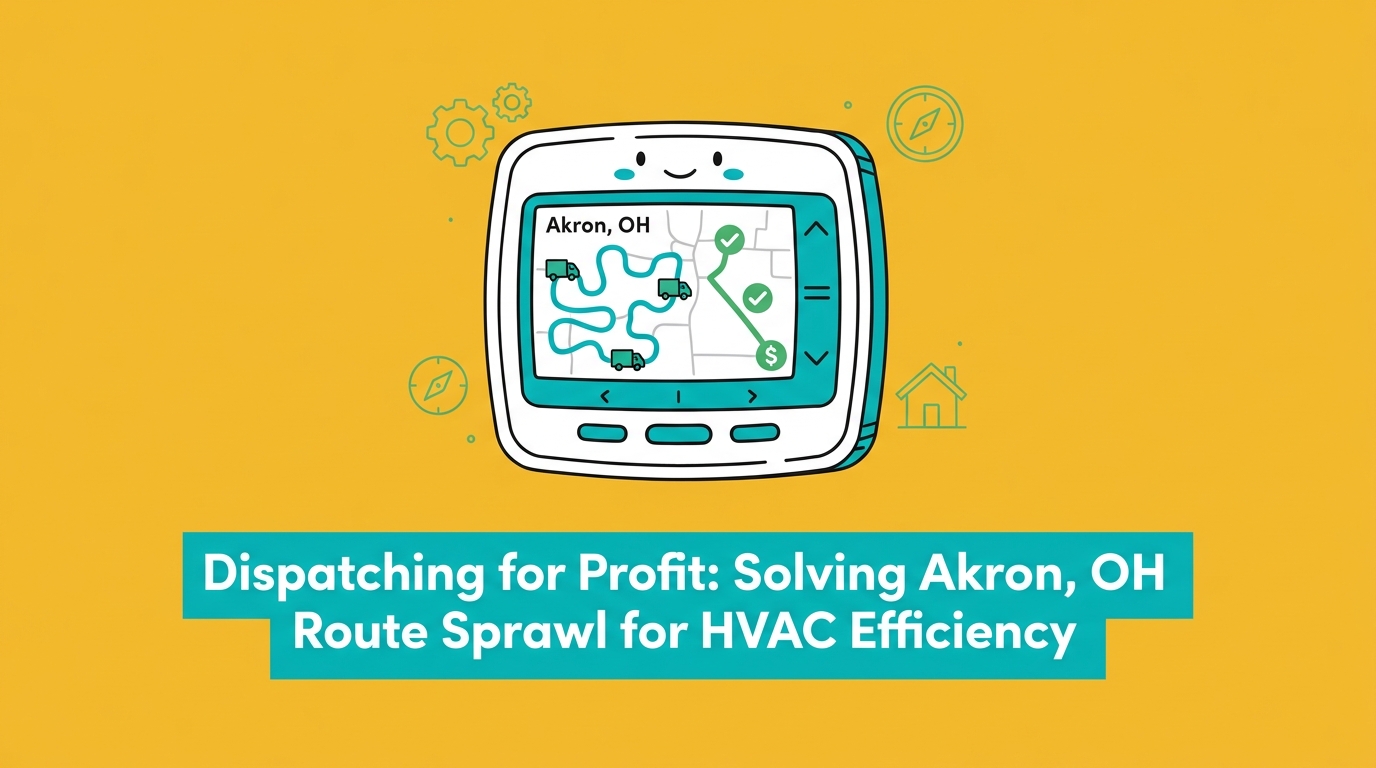
Your technicians are out in the field all day, but a massive portion of their shift is spent staring at tail lights on Route 8 rather than repairing furnaces. Mastering profitable dispatch across Akron's sprawling HVAC service routes is the only way to stop losing daily capacity to inefficient scheduling. Akron's diverse neighborhoods and sprawling service routes make it incredibly easy for a technician to burn an hour just driving from Cuyahoga Falls down to Coventry Township for consecutive calls. If your dispatch board operates strictly on a first-come, first-served basis, you are actively bleeding billable hours into the local highway system.
To reclaim that lost time and maximize your existing fleet, our team at Contractor in Charge often helps local owners utilize back-office support for HVAC contractors to implement localized, geographically grouped dispatching. Traditional time-based scheduling often ignores geographic realities. A customer calls at 8:00 AM and gets the 9:00 AM slot; another calls at 8:15 AM and gets the 11:00 AM slot. If those two customers live on opposite ends of Summit County, your technician is forced to crisscross the city, wasting fuel, increasing vehicle wear-and-tear, and sacrificing the time needed to fit in one more job.
The underlying issue: Time-based scheduling treats every address as if it exists in a vacuum. It fails to account for the reality of Akron's infrastructure, where a ten-mile drive can take fifteen minutes or forty-five minutes depending on the route and the time of day. Shifting to localized dispatching—where jobs are grouped by neighborhood clusters—is a critical decision point for any growing HVAC business. It transforms your dispatch board from a simple calendar into a dynamic geographic profitability lever. By executing this shift, you immediately reclaim lost capacity without having to hire a single additional technician.
Mapping the Geographic Toll on Daily Capacity
The Akron metropolitan area presents specific topographical and infrastructural challenges that directly impact field service operations. The sprawling suburban layouts combined with the natural barriers of the Cuyahoga Valley mean that secondary roads are rarely a straight shot. More importantly, the region's major highway interchanges dictate the flow of your entire fleet.
The Central Interchange bottleneck: The convergence of I-76, I-77, and Route 8 is a notorious choke point. If your dispatching strategy routinely sends technicians back and forth through this interchange during peak traffic hours, you are guaranteeing unpredictable delays. A delay of just twenty minutes on a morning call cascades through the rest of the day, forcing dispatchers to push afternoon appointments back and frustrating customers who are waiting in uncomfortable homes.
The mathematical reality of route sprawl is staggering. If you can save just 15 to 20 minutes of transit time between consecutive service calls, you recover enough time to add one additional service call per technician, per day. Across a fleet of five technicians, that equals five extra completed jobs daily—driving revenue straight to the bottom line without increasing your overhead.
• Time-Based (Traditional) — Average Transit Time: 35-50 minutes — Daily Jobs per Tech: 3-4 calls — Fleet Fuel Consumption: High (frequent cross-town trips) — Geographic Focus: None (first-come, first-served)
• Zone-Based (Optimized) — Average Transit Time: 15-20 minutes — Daily Jobs per Tech: 4-5 calls — Fleet Fuel Consumption: Low (clustered neighborhood routes) — Geographic Focus: High (technicians stay within assigned boundaries)
Topography vs. Technician Availability
Mileage-based routing is not the same as true time-based geographic routing. Two addresses might only be five miles apart on a map, but if those five miles require navigating steep elevation changes in the valley or crossing congested bridges, the travel time will reflect a much longer journey. True geographic routing factors in the topography and the realistic travel speed of secondary roads, ensuring that technician availability aligns with the actual logistics of the service area.
Navigating Extreme Weather and Seasonal Route Disruptions
Akron's climate adds a severe layer of complexity to fleet logistics. With freezing, snowy winters averaging over 40 inches of annual snowfall, and hot, humid summers driving sudden AC failures, extreme weather spikes create urgent dispatching bottlenecks. During peak HVAC service seasons, cross-town travel times don't just increase—they multiply.
The liability of winter routing: Dispatching a technician from a morning call in Norton to an afternoon call in Tallmadge during a January whiteout is an operational liability. Compromised roads drastically slow down transit, increase the risk of fleet accidents, and make it impossible to guarantee arrival windows. To protect technician safety and maintain reliable response times, businesses must tighten their geographic service zones when severe weather hits. A technician assigned to the northern suburbs should stay in the northern suburbs until the roads are clear.
Sudden operational crises during these weather extremes can cripple an unprepared business. We see this pattern often; in fact, our team recently stepped in to help a local company facing a critical operational gap during a harsh winter when they suddenly lost their primary dispatcher and call taker. The urgent need for dispatch support threatened to halt their entire operation. By bringing in our external team to take over full-time dispatch and call-taking responsibilities, the company experienced a significant improvement in route management, enabling them to handle the winter surge and maintain better business operations.
Handling these seasonal disruptions requires more than just a map; it requires professional back-office solutions that can adapt routing rules on the fly. When a blizzard hits, your dispatch team must instantly pivot from standard routing to hyper-localized emergency triage, ensuring that the closest available technician is routed to no-heat calls without forcing them across treacherous highway interchanges.
Transitioning to Zone-Based Dispatching Mechanics
Shifting your operations from a reactive, time-based model to a proactive, location-based model requires a fundamental change in how your back office operates. You are no longer just filling empty slots on a calendar; you are strategically grouping daily jobs by neighborhood clusters. This transition requires discipline, clear communication, and a structured approach to mapping Akron's diverse neighborhoods and sprawling service routes.
1. Segment the service area into distinct zones: Start by dividing your total coverage area into manageable geographic quadrants. Use natural dividers like I-77, Route 8, and the Cuyahoga River to establish hard boundaries. Label these zones clearly (e.g., Northwest Akron, Summit South, Valley East).
2. Assign primary and secondary technicians: Once your zones are established, assign specific technicians to them based on their starting locations and skill sets. A senior technician might be the primary responder for Zone A, with a junior technician acting as the secondary overflow.
3. Implement forced clustering for routine calls: Train your dispatchers to group non-emergency calls tightly. If a maintenance customer in Stow calls for a tune-up, the dispatcher should schedule that call for the specific day of the week when a technician is already assigned to the Stow zone.
4. Configure software preferences: Utilize business systems and software optimizations to hardcode these geographic preferences into your dispatch board, preventing call takers from accidentally booking a tech across town.
Balancing Urgency with Logistics
The biggest challenge in zone-based dispatching is handling emergency calls without breaking the entire routing structure. If a commercial client has a catastrophic system failure outside of a technician's assigned zone, the dispatcher must triage the situation carefully. Establishing clear overflow protocols allows dispatchers to pull a technician from an adjacent zone or reroute a secondary tech, ensuring that high-volume days don't devolve into chaotic, cross-town scrambling.
Optimizing FSM Software for True Geographic Routing
Our experts typically see HVAC owners invest heavily in Field Service Management (FSM) software, assuming the platform will automatically fix their routing woes. However, out-of-the-box software configurations frequently fail to account for localized traffic patterns and specific geographic barriers. Owning the software is only the first step; configuring it for true geographic efficiency is where the actual profit is made.
Common software pitfalls: A standard FSM setup might calculate the distance between two jobs using a straight line (as the crow flies). In Akron, a straight line might cross a ravine with no direct road access, turning a "five-minute drive" into a twenty-five-minute detour. To prevent this, your back-office team must configure custom service zones, draw specific geofences, and input realistic transit times based on historical local data.
Intelligent route optimization features rely on accurate GPS tracking and real-time data. By setting up proper tags and zone restrictions, the software can actively prevent a call taker from scheduling a technician outside their designated area. Furthermore, integrating the best FSM software for HVAC and plumbing companies with advanced predictive tools allows the dispatch board to adjust dynamically. If a technician is delayed at a complicated repair, the system can automatically suggest reassigning their next localized call to another tech already working in that same neighborhood.
Ultimately, software is only as effective as the back-office team managing its daily parameters. If your dispatchers are overriding the system's geographic recommendations because they are overwhelmed by call volume, the technology cannot save your daily capacity.
Bridging the Execution Gap with Specialized Support
The logistical strain on in-house dispatchers is immense. Trying to manage high call volumes, calm frustrated customers, match technician skill sets, and simultaneously optimize complex geographic routes is a recipe for burnout. When an in-house team is stretched too thin, they revert to the easiest scheduling method: first-in, first-out. This immediately breaks the zone-based strategy and introduces massive inefficiencies back into the fleet.
The execution gap: There is a vast difference between understanding route efficiency in theory and executing it flawlessly during a 95-degree summer heatwave. Utilizing a specialized, outsourced team allows for dedicated focus on route efficiency and software management. At Contractor in Charge, our expertise in back-office solutions and FSM software optimization serves as the bridge that makes theoretical route efficiency a daily reality, ensuring that your dispatch board remains tightly clustered even when call volume spikes.
During a recent busy summer stretch, we partnered with a growing home service company that realized they needed immediate help managing their call handling and dispatching services alongside their accounting needs. They relied on our external team to handle customer calls and dispatching, allowing the service to adjust dynamically as volume fluctuated. The outcome was top-notch, organized, and responsive dispatch support that kept their technicians localized and highly productive during the peak season.
Refined lead management and strict geographic dispatching directly impact the bottom line. By leveraging tools like AI CRM lead management, a specialized team can prioritize high-value calls and slot them perfectly into the existing geographic puzzle, lowering fleet fuel consumption, reducing vehicle wear, and maximizing the revenue generated per technician shift.
Frequently Asked Questions About HVAC Route Optimization
How do you optimize HVAC dispatch routes in sprawling service areas?
Optimizing routes requires shifting from time-based scheduling to geographic clustering. You divide the sprawling service area into distinct zones and assign specific technicians to those areas based on the day. By forcing routine calls into these established clusters, you drastically reduce the windshield time spent driving between distant neighborhoods.
What is zone dispatching in field service management?
Zone dispatching is a logistical strategy where a larger service territory is broken down into smaller, manageable geographic quadrants. Technicians are assigned to specific zones, and dispatchers prioritize booking jobs within those boundaries. This method prevents technicians from crisscrossing the city and maximizes the number of jobs they can complete in a single shift.
How can HVAC companies reduce technician windshield time?
Reducing windshield time starts with strict back-office discipline and optimized FSM software. Dispatchers must group calls by neighborhood, utilize GPS tracking to monitor real-time locations, and avoid scheduling consecutive calls on opposite sides of major highway bottlenecks. Every minute saved on the road translates directly into recovered billable capacity.
Why is time-based scheduling less efficient than geographic grouping?
Time-based scheduling focuses solely on filling the calendar in the order calls are received, completely ignoring the physical distance between jobs. This results in erratic, inefficient driving routes that waste fuel and time. Geographic grouping prioritizes location, ensuring that a technician handles all available work in one neighborhood before moving to the next.
How does FSM software improve daily job completion rates?
Properly configured FSM software automates the complex math of route optimization. It uses custom geofencing, real-time traffic data, and skill-matching algorithms to suggest the most efficient daily route for each technician. When the back office follows these optimized routes, technicians spend less time driving and can easily fit an extra service call into their day.
What role does a specialized back-office team play in route optimization?
A specialized back-office team provides the dedicated focus required to maintain strict routing rules during high-volume periods. While in-house staff might become overwhelmed by ringing phones and revert to inefficient scheduling, an outsourced team expertly manages the FSM software, triages emergencies, and keeps the dispatch board tightly clustered for maximum profitability.
Reclaim Your Fleet's Lost Capacity Today
The logistical benefits of localized dispatching are undeniable. By minimizing windshield time and strategically routing your technicians through Akron's complex infrastructure, you instantly increase your daily job completion rates. Stop letting inefficient, time-based scheduling drain your fleet's potential during peak HVAC service seasons. The quick fix: Take a hard look at your current routing strategies and evaluate whether your FSM software is truly configured for geographic efficiency.
If your dispatch board is chaotic and your technicians are spending too much time on the highway, it is time to seek professional support. Streamlining your operations with expert back-office solutions will provide the clear, logistical framework you need to group jobs geographically and drive true profitability across your entire service area.