

How Integrated Admin Services Solve Seasonal Dispatch Bottlenecks for Contractors

The Hidden Cost of Weather Spikes on Your Dispatch Board
When homeowners start ticking items off their seasonal home maintenance checklist, plumbing and HVAC contractors know exactly what is coming next: the first major seasonal weather spike. Sudden extreme weather—whether it is a blistering summer heatwave across the Sun Belt or an unexpected winter freeze in the Midwest—creates an immediate influx of frantic callers. Your dispatch board lights up, and standard in-house administrative capacity is quickly overwhelmed. In our years of supporting home service professionals at Contractor In Charge, the most critical vulnerability we see during these surges is the after-hours dispatch bottleneck.
When emergency call volume surges unexpectedly, a significant majority of callers will hang up and call another company rather than leave a voicemail during a home service emergency. The homeowner is panicked, their property is at risk, and they need a human voice to assure them that a technician is on the way. If your office cannot provide that immediate reassurance, your marketing dollars are essentially funding your competitors' growth. Navigating this chaos requires a strategic upgrade to your back office solutions.
Contractors face a crucial decision: stick with standard message-taking that leaves revenue on the table, or upgrade to real-time, integrated administrative support. Making the right choice determines whether a weather spike becomes a highly profitable operational period or a chaotic week of missed opportunities and burned-out staff.
Why Traditional Message Taking Fails During High-Volume Emergencies
Basic answering services operate on a fundamentally flawed premise for the home service industry. They simply hand the contractor a monthly invoice and a list of missed calls. During peak demand, receiving a list of messages an hour later means those leads have already booked a repair with another company. The modern homeowner expects instant gratification, especially when water is leaking through their ceiling or their furnace has failed on the coldest night of the year.
Without direct access to the dispatch board, third-party operators cannot give customers the immediate reassurance of a confirmed appointment window. They can only promise that "someone will call you back." This reactive approach forces business owners to spend their mornings playing catch-up instead of managing field operations. One plumbing and HVAC business our team partnered with found themselves struggling during a busy winter season. They required expert bookkeeping and financial advice, alongside better call handling, to keep up with the rush. By assigning a dedicated professional to answer questions and provide guidance, they achieved consistent bookkeeping and helpful financial advice—a level of support generic answering services simply cannot provide.
To fix this operational gap, businesses must transition to true virtual customer service that operates as a seamless extension of the in-house team.
The True Cost of a Missed Emergency Call
Industry benchmarks show high call abandonment rates for unconfirmed emergency requests. Losing a single high-value plumbing or HVAC replacement job negates the perceived savings of a cheap answering service. The true cost extends far beyond the lost revenue of a single ticket.
• Wasted marketing spend: You paid to acquire the lead, but failed to capture the conversion.
• Reputation damage: Frustrated callers often leave negative reviews when they cannot reach a live person during an emergency.
• Lost lifetime value: A customer who uses a competitor for an emergency repair will likely use them for future maintenance and replacements.
• Operational drag: Your internal team wastes valuable morning hours calling back leads who have already solved their problem.
• Call Handling — Standard Answering Service: Takes messages and sends emails — Integrated Admin Support: Books directly into the live dispatch board
• Customer Experience — Standard Answering Service: "Someone will call you back" — Integrated Admin Support: "I have a technician available between 2 and 4 PM"
• Software Access — Standard Answering Service: No access to your systems — Integrated Admin Support: Works inside ServiceTitan, Housecall Pro, etc.
• Morning Routine — Standard Answering Service: Owner spends hours returning calls — Integrated Admin Support: Technicians arrive to a fully booked schedule
Direct FSM Integration: Booking Emergency Calls in Real Time
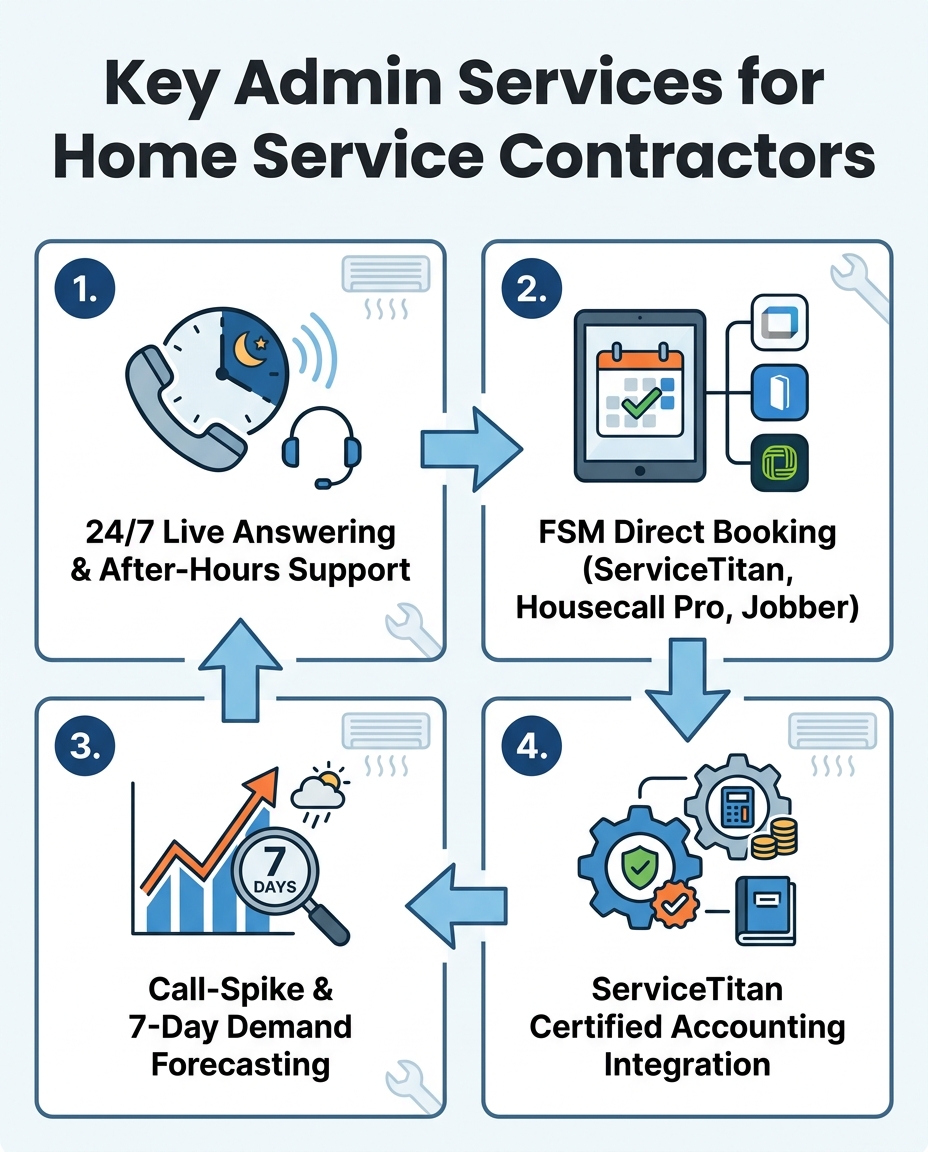
Modern admin services operate directly inside the contractor's existing field service management (FSM) software, such as ServiceTitan, Housecall Pro, or Jobber. Because Contractor In Charge specializes exclusively in the home service trades, our teams offer seamless integration with these industry-standard platforms. Utilizing 24/7 live agent call center services means live operators handle emergency and after-hours calls by booking directly into your live dispatch board.
Properly integrated admin services reduce dispatch errors and improve technician routing efficiency. The process is designed to be entirely transparent to the caller. This seamless integration ensures the customer feels they are speaking directly to your local office.
1. Immediate capture: The live agent answers promptly, greeting the caller exactly as your in-house team would, using your specific company scripts.
2. Customer profiling: The agent searches your FSM to see if the caller is an existing customer, checking their equipment history and membership status.
3. Real-time scheduling: The agent accesses your live availability to find an open time slot that makes geographical sense for the on-call technician.
4. Direct dispatching: The emergency call is placed onto the live dispatch board, triggering automated notifications for your field staff.
5. Customer reassurance: The homeowner receives immediate confirmation that help is on the way, stopping them from calling the next company on Google.

Moving from Reactive to Proactive: 7-Day Demand Forecasting
Advanced admin services provide more than just operators; they provide deep data visibility. While many competitors only provide a phone number and a monthly invoice, CIC's proprietary Client Portal allows contractors to monitor live calls and receive Call-Spike alerting in real time. This level of insight changes how a business operates during a weather event.
Consider a pattern our dispatch experts see often during the winter season. A contractor is suddenly left without a dispatcher unexpectedly, forcing them to transition from after-hours coverage to full-time support on the fly. By taking over full-time CSR duties and call management through a fully integrated platform, the business is able to grow and run smoothly despite the sudden internal staffing gap. Access to 7-day and 180-day forecasting allows plumbing and HVAC owners to staff field techs proactively. This visibility transforms a chaotic weather event into a managed, highly profitable operational period.
How Call-Spike Alerting Optimizes Technician Schedules
Real-time alerts notify management when inbound volume exceeds standard thresholds. This enables rapid deployment of on-call technicians before the dispatch board becomes unmanageable. Instead of waiting until the end of the day to realize you missed dozens of calls, you receive immediate notifications when demand spikes.
The proactive advantage includes:
• Adjusting on-call rotations: Call in backup technicians before the primary on-call tech is overwhelmed.
• Pausing marketing spend: Temporarily shut off paid search campaigns if your capacity is fully booked, saving valuable advertising budget.
• Prioritizing high-value calls: Ensure your team focuses on high-ticket replacements and emergency repairs rather than routine tune-ups during a surge.
• Monitoring operator performance: Track how quickly calls are answered and converted into booked jobs in real time.
Aligning Dispatch Efficiency with Financial Visibility
When seasonal call volume spikes, bookkeeping and accounting tasks are often the first to fall behind. The entire office is focused on getting technicians to the next job, leaving invoices uncollected and expenses untracked. Integrated admin services ensure that rapid job booking translates smoothly into accurate invoicing and accounting.
During a hectic summer surge, one contractor realized they needed reliable call dispatching combined with organized accounting support. By handling incoming calls, dispatching technicians, and managing accounting operations simultaneously, they secured organized bookkeeping and reliable communication across the board. Rapid job booking is excellent for top-line revenue, but if those jobs do not translate smoothly into accurate invoicing, cash flow suffers.
Utilizing trade-specific accounting expertise prevents revenue leakage during high-velocity operational weeks. Holding a credential like ServiceTitan Certified — Accounting means the team understands the specific nuances of home service financials, from inventory tracking to membership deferrals. Keeping financials up to date with professional bookkeeping and accounting services ensures the business owner understands their true profitability during a seasonal rush.
Scaling Operations for Growing Plumbing and HVAC Teams
Growing contractors—specifically those managing rapidly expanding operations and increasing fleet sizes—often hesitate to hire full-time, round-the-clock internal staff due to fluctuating seasonal demand. The overhead of an internal call center can drain profits during slower shoulder months, but lacking that staff during a heatwave costs the business massive amounts of revenue.
Outsourced, industry-trained admin services provide elastic capacity that scales up during a rush and scales down during shoulder seasons. This elastic capacity is perfectly suited for the unpredictable nature of extreme weather events. You only utilize the administrative power you actually need, when you need it.
This model allows ownership to focus on field execution and business development rather than managing an internal call center. A well-structured back office is the foundation for capturing market share when competitors are sending calls to voicemail. For a deeper dive into building this scalable foundation, review our strategies for overcoming unpredictable call volume bottlenecks.
Frequently Asked Questions About Contractor Admin Services
What are admin services for contractors?
In our experience managing back-office operations, admin services for contractors encompass specialized back-office support tailored specifically to the trades. This includes 24/7 live call answering, direct dispatch booking, and trade-specific bookkeeping. Unlike generic virtual assistants, these services operate inside industry-standard software to keep field operations moving smoothly.
How do virtual answering services integrate with dispatch software?
Virtual answering services integrate by having trained agents log directly into your field service management (FSM) platform. When a customer calls, the agent views your live dispatch board, schedules the appointment in real time, and assigns it to the appropriate technician. This eliminates the delay of relaying messages back and forth via email or text.
How can admin services help manage seasonal call spikes?
Admin services provide elastic staffing capacity that absorbs sudden surges in call volume without overwhelming your in-house team. By utilizing live demand forecasting and call-spike alerts, you can proactively adjust technician schedules. This ensures every emergency call is answered and booked, maximizing revenue during extreme weather events.
What is the difference between an answering service and FSM-integrated admin support?
A standard answering service merely takes messages and sends you a list of missed calls, often resulting in lost leads. FSM-integrated admin support acts as an extension of your office, booking appointments directly onto your live dispatch board. This provides immediate reassurance to the customer and keeps your operations proactive rather than reactive.
How does call-spike forecasting work for plumbing and HVAC businesses?
Call-spike forecasting uses historical data and real-time call tracking to predict inbound volume over a 7-day or 180-day window. Through a dedicated client portal, contractors receive alerts when call volume is trending upward. This allows ownership to deploy backup technicians and adjust on-call schedules before the dispatch board becomes unmanageable.
Take Control of Your Dispatch Board Before the Next Rush
The difference between losing revenue and maximizing a seasonal rush comes down to your administrative infrastructure. Integrating an industry-trained live-agent call center captures missed revenue without increasing the owner's workload. Explore how a tailored back-office solution can stabilize operations and support sustainable growth, ensuring you have a clear understanding of how integrating an industry-trained team captures missed revenue during seasonal rushes.