

Beyond Native FSM Reports: Building a Custom Contractor Financial Dashboard for Common Homeowner Questions Answered

The High Cost of Blind Spots in After-Hours Dispatching
When your after-hours dispatchers are overwhelmed with getting common homeowner questions answered, tracking the true cost of those late-night calls often falls through the cracks. Your phone rings at 2:00 a.m. with a frantic customer dealing with a burst pipe or a failed AC compressor. If you are relying on a standard answering service, that critical interaction usually ends up as a simple email notification sitting in an inbox. The call happened, but your financial software remains completely blind to it. Many growing home service businesses struggle to track the true cost of these missed after-hours emergency calls, leading to a massive gap between operational reality and back-office data.
To bridge this gap and gain true operational clarity, you need more than just a standard reporting tool. For more information on aligning your operations with your financial goals, explore our Performance Accounting solutions.
Relying on generic answering services leaves owners in the dark because messages are merely passed along without integrating into your financial data stream. You cannot measure what you cannot see. When inbound call spikes happen, the lack of real-time visibility means you are guessing about staffing needs, marketing ROI, and lost revenue. Contractors face a critical decision as they grow: take on the heavy overhead of hiring internal night staff, or partner with an FSM-integrated 24/7 live-agent service that actually connects to the business's core software.
Gaining real-time visibility into these dispatching gaps is the first step toward accurate financial management. Without it, you are managing your business based on incomplete information. Consider the hidden costs of blind spots in your current after-hours setup:
• Undocumented revenue leaks: Calls that are never booked into your system never show up on your financial reports.
• Wasted marketing spend: If you are paying for premium after-hours leads but failing to capture the data, your cost-per-acquisition metrics are artificially inflated.
• Inefficient labor costs: Without knowing exactly when call spikes occur, you cannot optimize your on-call technician schedules effectively.
• Delayed follow-ups: Standard email messages often get buried, leading to lost jobs that a competitor captures the next morning.
Why Native FSM Reporting Falls Short for Growing Trades
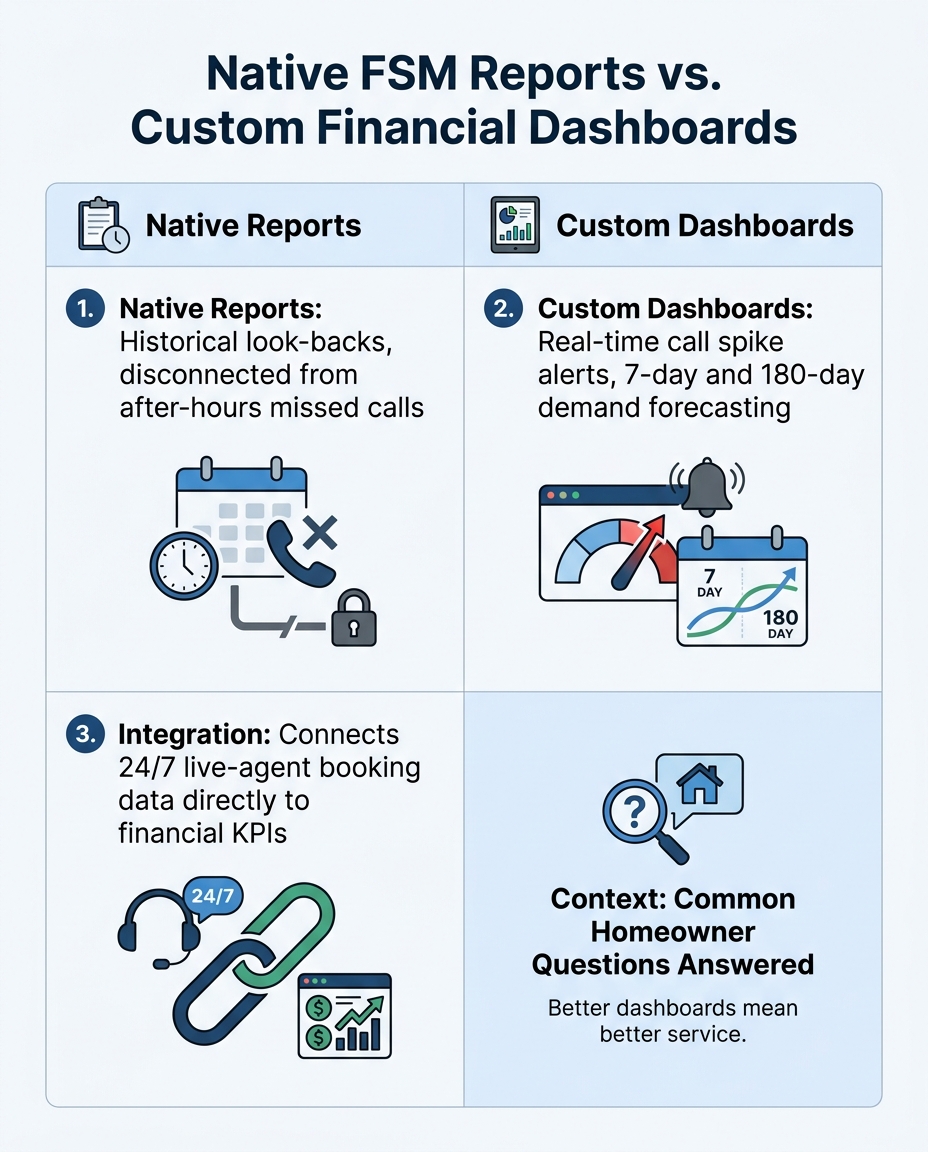
Native reports from platforms like ServiceTitan or QuickBooks are excellent for historical look-backs, but they often fail as real-time demand forecasting tools. Out-of-the-box reporting is designed to show you what happened last month or last quarter. However, when you are running a fast-paced plumbing or HVAC business, you need to know what is happening right now and what will happen next week. Standard dashboards frequently lack visibility into undocumented revenue leaks, specifically unbooked calls that never make it into the system.
Without customized data workflows, your back-office financial data remains disconnected from field operations. A specialized dashboard bridges this gap, acting as a single source of truth for both operational demand and cash flow. To see how specialized financial oversight can transform your reporting, learn more about our Fractional CFO Services.
The Gap Between Dispatching and Accounting
Data silos occur when answering services operate entirely outside your primary Field Service Management (FSM) software. If an agent takes a call but does not have the ability to book the job directly into your system, that data must be manually entered later. Manual data entry delays financial visibility and significantly increases the risk of undocumented revenue.
The quick fix: Stop relying on disconnected systems. When your dispatching and accounting platforms talk to each other in real time, you eliminate the manual entry bottleneck and ensure every lead is tracked financially.
• Data Timing — Native FSM Reports: Historical look-backs and end-of-month summaries. — Custom Financial Dashboards: Real-time syncing with active dispatch boards.
• Missed Call Tracking — Native FSM Reports: Often invisible if the call wasn't manually logged. — Custom Financial Dashboards: Captures every inbound lead and unbooked opportunity.
• Forecasting — Native FSM Reports: Limited to past performance averages. — Custom Financial Dashboards: Predictive demand planning based on live call volumes.
• KPI Customization — Native FSM Reports: Standard retail or generic service metrics. — Custom Financial Dashboards: Trade-specific metrics tailored for HVAC and plumbing.

Integrating 24/7 Live-Agent Sync for Accurate Forecasting
Connecting live-agent booking data directly to a financial dashboard creates highly actionable forecasting insights that native tools simply cannot match. A specialized B2B partner does not just take messages and send emails; they book directly into the FSM. This creates a seamless flow of data from the very first customer interaction straight through to your accounting software.
This real-time sync ensures that every inbound lead, booked job, and missed opportunity is immediately reflected in the financial dashboard. Owners can finally shift from reactive management—putting out fires and scrambling to cover shifts—to proactive planning based on actual call volume trends. This integration empowers highly accurate short-term and long-term demand planning.
Here is how the integration process actively improves your financial visibility:
1. Direct FSM Booking: When a call comes in, industry-trained agents enter the customer's information directly into your existing software, ensuring the lead is captured instantly.
2. Real-Time Data Sync: The moment the job is booked, the data flows into your custom dashboard, updating your daily revenue projections without any manual data entry.
3. Call-Spike Alerting: The CIC Client Portal provides real-time alerting when inbound call volumes surge, allowing you to adjust dispatching strategies on the fly.
4. Predictive Demand Planning: By analyzing this integrated data, you can rely on accurate 7-day & 180-day Forecasts via CIC Client Portal to plan inventory, labor, and marketing spend with confidence.
When your call center and your financial dashboard speak the same language, you stop losing money in the margins and start capturing the full value of every lead.
How Seasonal Extremes Mask Poor Profit Margins
Rapid cash flow movement during peak seasons can easily create a false sense of financial health. When summer heatwaves hit the region or sudden winter freezes cause pipes to burst, your phone lines light up. The sheer volume of inbound calls brings a massive influx of cash, making the bank account look incredibly healthy. However, this high cash flow often hides underlying profitability issues if your dashboard data isn't properly structured.
High call volumes during these seasonal extremes routinely overwhelm native FSM reporting. It becomes incredibly difficult to track labor and material costs accurately when dispatchers are just trying to keep their heads above water. You might be paying massive amounts of unbudgeted overtime, or technicians might be rushing through jobs and missing valuable upsell opportunities. If you want to benchmark your performance during these chaotic times, it helps to understand the average profit margins for HVAC and plumbing businesses.
Without a custom dashboard, owners may not realize they are losing margin on overtime and inefficient dispatching until the season ends. By the time October rolls around and you review the summer's native reports, the cash is already spent, and the opportunity to fix the inefficiencies is gone. Real-time visibility allows for immediate course correction during high-demand periods. When a summer heatwave triggers massive inbound call spikes that strain operations, a custom dashboard shows you exactly where your labor costs are creeping up, allowing you to adjust dispatch fees or reroute technicians before the margin evaporates.
Unifying Operational and Financial Truths
A custom contractor financial dashboard requires deep specialization in home service workflows. You cannot simply plug a retail accounting template into an HVAC or plumbing business and expect accurate results. The way a trades business handles inventory, deferred revenue, membership agreements, and dispatch fees is entirely unique. Proper setup ensures that field workflows translate perfectly into back-office data.
Working with industry-certified professionals ensures that your Key Performance Indicators (KPIs) are tailored to the trades rather than generic retail models. This unified approach eliminates data duplication and provides a clear, unvarnished picture of your business health. Partnering with a team that deeply understands how HVAC and plumbing workflows translate into accounting data is essential for long-term success. For specialized help aligning your software tools, look into Business Systems Optimization.
In our experience supporting growing home service contractors, we find that generic bookkeepers often miscategorize essential trade metrics. This is why having a partner who is ServiceTitan Certified — Accounting makes a massive difference. They understand the exact mapping required to ensure that a technician's closed ticket in the field accurately hits the right ledger account in the back office, without requiring three hours of manual reconciliation at the end of the week. Unifying your operational and financial truths means you can trust your numbers implicitly.
Preparing Your Business for Scalable Growth or Valuation
Disorganized financials and unorganized accountants are major roadblocks to scaling a home service business. If you cannot produce clean, accurate, and real-time financial reports, securing a line of credit for new trucks or opening a new branch becomes incredibly difficult. A custom dashboard, supported by professional bookkeeping, provides the clarity needed for strategic investments.
For owners considering an exit or a merger, pristine, real-time financial records are absolutely non-negotiable for securing top valuations. Private equity firms and independent buyers will scrutinize every line item. If your native FSM reports do not match your bank statements, or if your after-hours revenue is poorly documented, buyers will lower their offers to account for the risk. Organized financial management transforms a stressful, unpredictable operation into a highly attractive, valuable asset. To get your books in order for the next stage of your business, explore professional Bookkeeping & Accounting for Contractors.
In our experience supporting growing home service contractors, we see this pattern often. For example, during a recent winter season, business owners of a growing home service company needed professional financial preparation for a high-end sales transaction. By acting as a fractional CFO to organize their finances and prepare for the sale, the owners successfully secured the highest end of their valuation range. Clean data and custom dashboards prove to buyers that the business is predictable, profitable, and ready to scale.
Frequently Asked Questions About Contractor Financial Dashboards and Common Homeowner Questions Answered
What is a financial dashboard for contractors?
A financial dashboard for contractors is a specialized reporting tool that connects field service operations with back-office accounting. It goes beyond basic profit and loss statements by pulling real-time data directly from your FSM software. This allows owners to monitor trade-specific KPIs, track labor costs, and visualize cash flow instantly. Unlike generic tools, a custom dashboard is built specifically for the workflows of HVAC, plumbing, and electrical businesses.
How do I track missed revenue from after-hours HVAC calls?
Tracking missed revenue requires integrating your after-hours call center directly with your FSM and financial dashboard. When live agents book calls directly into the system, your dashboard can track both captured revenue and unbooked opportunities. By comparing total inbound call volume against booked jobs during after-hours shifts, you can pinpoint exactly how much revenue is slipping through the cracks. This visibility helps you justify staffing changes or marketing adjustments.
What KPIs should a plumbing or HVAC business track?
Home service businesses should track metrics that directly impact daily profitability and operational efficiency. Essential KPIs include average ticket size, fully burdened labor rate, unapplied labor time, and lead conversion rates. A custom dashboard will also track membership conversion rates and callback percentages. Monitoring these specific metrics allows you to adjust pricing and training in real time rather than waiting for end-of-month summaries.
How do you forecast revenue for a home service business?
Accurate revenue forecasting relies on combining historical seasonal data with real-time inbound lead volume. By utilizing a custom dashboard that tracks current call spikes and booking rates, you can project short-term cash flow with high accuracy. Advanced tools, like the CIC Client Portal, offer 7-day and 180-day forecasting models based on actual operational data. This allows you to plan inventory purchases and staffing levels proactively.
How does an FSM-integrated answering service improve financial reporting?
An FSM-integrated answering service eliminates the manual data entry gap between taking a message and recording a lead. Because agents book directly into your software, the financial dashboard updates immediately with new potential revenue and customer acquisition data. This ensures your marketing ROI and daily revenue reports are always accurate and up-to-date. It completely removes the blind spots caused by standard email-based answering services.
Why are native FSM reports often insufficient for real-time profitability tracking?
Native FSM reports are primarily designed to log historical data rather than provide forward-looking business intelligence. They often struggle to account for complex, real-time variables like unbooked after-hours calls or sudden spikes in unapplied labor during seasonal extremes. Without custom configuration, these standard reports can mask true profit margins behind rapid cash flow. A custom financial dashboard bridges this gap by aligning operational realities with strict accounting standards.
Take Control of Your Financial Visibility Today
Stop relying on incomplete native reports that leave you guessing about your true profitability. When you cannot see the full picture, you leave money on the table every single night. A clear explanation of how an industry-trained 24/7 call center seamlessly integrates with existing FSMs can completely transform your business visibility. You deserve to know exactly where your business stands, even when getting common homeowner questions answered after hours.
Talk to an expert today about implementing a custom financial dashboard and fractional CFO support tailored specifically to your trade. With weekly billing with no long-term contracts, you can secure the financial clarity you need to scale confidently and capture every dollar your business earns.