

Preventing Revenue Leakage: Why You Need a Custom Contractor Financial Dashboard for Common Homeowner Questions Answered

The Hidden Cost of Relying on Basic Message-Taking
When high-intent emergency leads call your business after hours, tracking how those common homeowner questions answered translate into booked jobs is the first step in stopping revenue leakage. Your marketing campaigns work hard to make your phone ring, but if those calls hit a basic answering service, the financial chain breaks. A homeowner staring at a flooded basement or a freezing house does not want to leave a message. They want immediate reassurance and a confirmed appointment.
To fix this disconnect, smart home service businesses rely on Bookkeeping and Accounting integrations alongside strategic Fractional CFO Services to build a seamless data pipeline from the first ring to the final invoice.
Traditional answering services that only take messages often result in lost opportunities. When a high-intent customer immediately calls a competitor because they couldn't get on your schedule, you lose more than just a single service fee. The financial impact of missing an emergency plumbing or HVAC call extends to lost lifetime customer value, lost recurring maintenance agreements, and wasted marketing spend. The decision to upgrade to a 24/7 live-agent team that books directly into your scheduling software is a critical turning point for any scaling home service business.
A true financial dashboard begins with capturing accurate front-end data at the very moment of dispatch. If your reporting relies on data that is manually entered the next morning, your metrics are already outdated. Tracking the exact volume of after-hours tech dispatch requests and mapping them directly to booked revenue is the only way to measure the true return on investment for your off-hours availability.
• Basic Message-Taking — Customer Experience: Caller leaves a voicemail or speaks to an unspecialized operator. No appointment is secured. — Financial Impact: High revenue leakage. Wasted customer acquisition cost as callers move to competitors.
• Integrated Live-Agent Booking — Customer Experience: Industry-trained agent answers, addresses the issue, and books directly into the FSM. — Financial Impact: Maximized ROI. Immediate capture of emergency revenue and accurate tracking data.
The bottom line: If your front-end call handling is disconnected from your back-end financial tracking, you are operating with a massive blind spot. Upgrading your intake process is the foundational step to building a reliable, actionable financial dashboard.
Why Native FSM Reporting Leaves Financial Blind Spots
Standard field service management reporting often fails to capture the true cost of lost after-hours calls or administrative double-entry. While native FSM tools are excellent for dispatching technicians and managing daily workflows, they are not dedicated accounting platforms. Relying solely on out-of-the-box reports means you are likely missing the nuanced financial details that drive long-term profitability.
Basic QuickBooks integrations can lead to deeply fragmented data if front-end operations aren't perfectly synced with back-end accounting. When your answering service operates in a silo, office staff are forced to manually copy caller information into the FSM the next day. This manual transfer creates duplicate customer records, misclassified revenue streams, and skewed profit margins. Home service businesses require specialized accounting methodologies to ensure accurate revenue classification across different trades, service types, and equipment installations. For instance, leaning on a team with ServiceTitan Certified — Accounting credentials ensures that every transaction is mapped correctly from the moment the call is booked.
During a busy summer season, one plumbing and HVAC contractor struggled to find organized, responsive accounting support while simultaneously managing heavy dispatch operations. By partnering with a dedicated accounting team that integrated directly with their operational software, they received spot-on numbers and reliable support that outperformed their past accountants. This level of clarity simply isn't possible when relying on disconnected systems.
To eliminate these blind spots, contractors must prioritize Business Systems Optimization. This connects the dots between what happens in the field and what appears on the balance sheet.
The Danger of Fragmented Data Entry
Manual entry between dispatch and accounting systems creates costly errors that ripple through your entire financial ecosystem. Live booking data must flow seamlessly into financial platforms for reliable tracking. When data is fragmented, several critical issues arise:
• Misaligned marketing metrics: If an after-hours call isn't properly tagged in the FSM, you cannot accurately calculate your customer acquisition cost for emergency campaigns.
• Delayed financial visibility: Relying solely on end-of-month reports prevents owners from making agile, real-time operational pivots during busy seasons.
• Administrative bloat: Paying internal staff to double-enter data wastes payroll hours that should be spent on proactive customer service and outbound follow-ups.
• Inaccurate profit margins: When material costs and labor hours are manually re-entered, the risk of typos leads to a false understanding of which jobs are actually profitable.

Bridging Front-End Dispatch with Back-End Financial Intelligence
Integrating a live-agent team directly into your FSM eliminates the revenue leakage caused by delayed follow-ups. When an emergency call comes in at 2:00 AM, the interaction shouldn't end with a sticky note on a dispatcher's desk. It must immediately become a trackable data point within your financial ecosystem. Real-time booking data provides immediate visibility into daily acquisition costs and campaign performance, allowing you to see exactly which marketing channels drive profitable emergency calls.
Connecting dispatch operations to financial tracking forms the foundation of a reliable contractor financial dashboard. This seamless data flow requires a specialized approach to Performance Accounting, where every operational action is measured against its financial outcome. When a live agent books a job directly into your software, the customer record, the lead source, and the initial service fee are all instantly categorized.
Here is how a fully integrated system bridges the gap between a late-night phone call and your financial dashboard:
1. Immediate Capture: An industry-trained live agent answers the call, addressing the homeowner's urgent issue and booking the appointment directly into your FSM.
2. Automated Classification: The FSM automatically tags the lead source, the job type, and the required trade, ensuring the data is categorized correctly from minute one.
3. Seamless Syncing: The booked job syncs natively with your accounting software, preventing the need for manual double-entry the following morning.
4. Real-Time Reporting: The financial dashboard updates immediately, reflecting the new potential revenue, the marketing cost associated with the lead, and the current dispatch capacity.
5. Actionable Insights: Ownership reviews the dashboard to assess the profitability of after-hours operations and adjust marketing spend or staffing levels accordingly.
This automated workflow ensures that no detail is lost in translation. It empowers home service business owners to trust their numbers, knowing that the data on their screen perfectly matches the reality of their field operations.
Managing Weather Extremes with Advanced Demand Forecasting
Unpredictable weather events drive massive fluctuations in emergency dispatch volume. For home service contractors, sudden seasonal weather fluctuations—such as intense summer heatwaves or deep winter freezes—cause immediate revenue spikes and operational strain. Without a predictive dashboard, contractors risk being severely understaffed during peak demand, leading to long hold times and abandoned calls, or overstaffed during lulls, which drains payroll resources.
Real-time financial visibility is crucial when extreme weather hits. You cannot wait until the end of the month to realize you missed out on dozens of high-margin emergency replacements because your intake team was overwhelmed. Proprietary tools like the CIC Client Portal allow businesses to track call spikes in real time. This proprietary dashboard goes far beyond basic bookkeeping, combining call-spike alerting with advanced demand forecasting to give contractors total control over their operational capacity.
By leveraging 7-day & 180-day Forecasts via CIC Client Portal, owners gain the operational visibility needed to capture maximum revenue during extreme weather events. Instead of reacting to a sudden flood of calls, you can proactively adjust your dispatch schedules, route technicians more efficiently, and ensure your live-agent support is scaled to meet the exact demand of your local climate.
The Value of Predictive Call-Spike Alerting
Predictive call-spike alerting is a game-changer for managing sudden weather shifts. When a heatwave is forecasted, historical data can predict exactly how much your call volume will increase.
Preventing missed opportunities: Real-time alerts notify your management team the moment inbound call volume exceeds standard thresholds. This allows you to quickly shift resources, prioritize emergency replacements over routine maintenance, and ensure high-intent callers are handled immediately.
Optimizing seasonal staffing: Using historical data to staff appropriately for upcoming seasonal changes protects your profit margins. If the 180-day forecast indicates a mild fall season, you can adjust your marketing spend and technician schedules well in advance, rather than burning cash on unnecessary overhead.
Elevating Strategy with Fractional CFO Perspectives
A custom dashboard is only as valuable as the strategic insights drawn from its data. Having beautifully organized charts and graphs means nothing if you don't know how to interpret the numbers to drive growth. This is where moving beyond basic bookkeeping becomes essential. Fractional financial leadership helps contractors interpret complex metrics like contract leakage, true profitability by service line, and unapplied labor costs.
Contractor In Charge offers a specialized focus on home service financials, providing fractional CFO insights that go far beyond standard data entry. Expert guidance ensures that back-end financial health aligns perfectly with front-end operational growth. Organized, accurate financials are absolutely essential for long-term business valuation, securing lines of credit, and preparing for high-end transactions.
During a recent winter season, owners preparing for high-end business transactions needed expert financial preparation to ensure their books were flawless. A fractional CFO stepped in to organize their finances across several high-end transactions, ultimately helping the owners achieve the highest end of their valuation range. This level of financial rigor requires a deep understanding of the unique revenue models, inventory challenges, and cash flow cycles inherent to the home service industry.
To truly understand how your business stacks up against industry benchmarks, you must analyze the average profit margins for HVAC and plumbing companies. A fractional CFO uses these benchmarks to identify areas where your business is overspending on materials, underpricing maintenance agreements, or losing margin to inefficient routing. They turn raw dashboard data into a step-by-step roadmap for sustainable, profitable scaling.
Frequently Asked Questions About Contractor Financial Management and Common Homeowner Questions Answered
What should a contractor financial dashboard include?
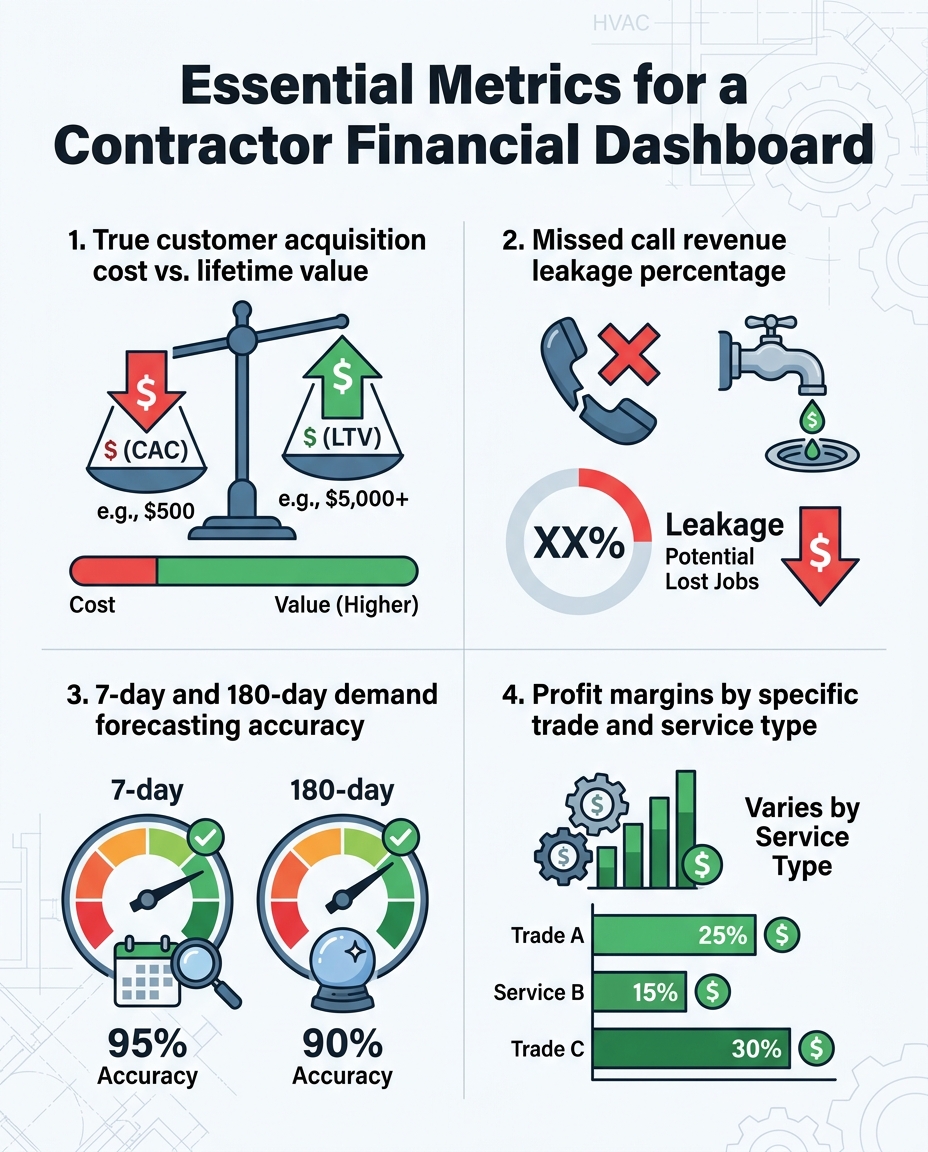
A comprehensive contractor financial dashboard should include real-time metrics that connect field operations to accounting. Essential components include customer acquisition costs, live call-booking rates, unapplied labor tracking, and profit margins broken down by specific trades. It must also feature demand forecasting and call-spike alerting to help owners manage seasonal volume proactively.
How do HVAC and plumbing companies track profitability accurately?
Accurate profitability tracking requires a seamless integration between the field service management software and the accounting platform. When a job is booked, all associated material costs, labor hours, and dispatch fees must sync automatically without manual double-entry. This ensures that every invoice reflects the true cost of goods sold, allowing owners to see exactly which service lines generate the best margins.
How can contractors forecast seasonal demand during weather extremes?
Contractors can forecast seasonal demand by utilizing historical call data and predictive alerting tools within a specialized client portal. By analyzing past dispatch volumes during specific weather events like heatwaves or freezes, businesses can project 7-day and 180-day demand. This allows for precise adjustments to technician schedules and live-agent staffing before the weather actually hits.
How do answering services integrate with field service management software?
Advanced answering services integrate by utilizing an industry-trained live-agent team that works directly inside the contractor's FSM, such as ServiceTitan or Housecall Pro. Instead of taking a message and sending an email, the agent captures the customer's information, classifies the job type, and secures the appointment on the live dispatch board. This immediate action prevents revenue leakage and ensures accurate data flow.
What is the true cost of using a basic message-taking service?
The true cost of a basic message-taking service extends far beyond the monthly subscription fee. When high-intent emergency callers are sent to voicemail or told they will receive a callback, a significant percentage will immediately hang up and call a competitor. This results in wasted marketing spend, lost immediate service revenue, and the forfeiture of that customer's lifetime value.
How does a fractional CFO differ from a standard bookkeeper for home services?
A standard bookkeeper focuses on recording historical data, reconciling accounts, and ensuring compliance. A fractional CFO takes that accurate data and uses it to shape future business strategy. They analyze complex metrics, prepare businesses for high-end valuations, identify operational inefficiencies, and provide high-level financial guidance that helps home service contractors scale profitably.
Gain Complete Visibility Over Your Operational Health
Transitioning from basic message-taking to fully integrated financial visibility is the most effective way to protect your profit margins. An advanced dashboard prevents revenue leakage, optimizes staffing during extreme weather, and ensures that your front-end dispatch operations are perfectly aligned with your back-end accounting. When your systems communicate seamlessly, you eliminate the blind spots that hold scaling businesses back.
Do not let disconnected data drain your resources. Explore specialized financial leadership solutions to streamline your operations, so you can guarantee that every late-night call and all common homeowner questions answered are captured, tracked, and converted into measurable revenue.