

Moving Beyond Basic FSM Reports: Why Contractors Need a Predictive Financial Dashboard

The Hidden Cost of Seasonal Extremes: Why Gut-Feeling Dispatch Fails
While your customers are busy crossing items off their seasonal home maintenance checklist, your plumbing or HVAC business is likely bracing for the sudden influx of emergency calls that come when that maintenance is ignored. In our years of experience supporting home service contractors nationwide, our team typically sees that the most critical operational failure during busy seasons—such as the peak summer cooling rush from mid-June through August—isn't a lack of technical skill in the field. It is an overwhelmed dispatch board in the office. Plumbing and HVAC contractors frequently lose high-ticket emergency jobs during these seasonal rushes simply because their in-house dispatch team cannot answer the phones fast enough. When a homeowner is standing in an inch of water or sweating in a ninety-degree house because their aging 12 SEER AC unit just failed, they do not leave voicemails. The majority of prospective customers will hang up and immediately call a competitor rather than wait on hold during a home service emergency.
For years, business owners have relied on gut-feeling to staff the office, leading to a frustrating decision point: blindly hiring more seasonal office staff who sit idle during shoulder months, or running lean and risking massive revenue leakage when the weather turns. Neither approach is sustainable for a growing service business. True operational health requires moving away from guesswork and implementing a combination of robust performance accounting and streamlined contractor bookkeeping and accounting. When your financial data and your operational capacity are aligned, you stop reacting to the weather and start predicting your revenue.
Why Native FSM Reports Are Insufficient for True Visibility
The problem with reactive data: Our data analysts have found that most contractors rely entirely on their Field Service Management (FSM) software to tell them how the business is performing. While native FSM reports are incredibly useful, they are inherently reactive. They show owners what happened only after the fact. They effectively track booked jobs, dispatched technicians, and closed invoices, but they possess a massive blind spot when it comes to the jobs you never actually booked.
The cause of revenue leakage: Standard dispatch software cannot track the invisible revenue leakage from abandoned calls. If a frantic homeowner calls your main line, waits on hold for two minutes, and hangs up, your FSM records nothing. Your conversion rate might look fantastic on paper because your dispatchers are booking ninety percent of the people they actually speak to, but that metric completely ignores the dozens of callers who couldn't get through. Without tracking these missed opportunities, contractors cannot accurately calculate the true impact on the average profit margins for HVAC and plumbing companies, especially during the chaotic transition weeks of early November when heating systems fire up for the first time.
The solution for operational readiness: True visibility requires moving beyond basic reporting to understand the real-time operational capacity of the business. You need a system that tracks not just what was won, but what was left on the table.
The Blind Spot in Standard Dispatch Metrics
To understand the difference between basic financial reporting and true operational readiness, consider how dropped calls distort your daily metrics. We frequently see this pattern play out in standard reporting:
• Call Volume — What Native FSMs Show: Total inbound calls answered by staff. — What Actually Happens (The Blind Spot): Ignores abandoned calls and peak-hour hangups.
• Conversion Rate — What Native FSMs Show: High percentage of answered calls booked. — What Actually Happens (The Blind Spot): Artificially inflated because un-answered leads are excluded.
• Staffing Efficiency — What Native FSMs Show: CSRs are fully utilized and busy. — What Actually Happens (The Blind Spot): CSRs are overwhelmed, leading to rushed calls and poor customer experience.
• Lost Revenue — What Native FSMs Show: Only tracks canceled or un-sold estimates. — What Actually Happens (The Blind Spot): Completely misses the high-ticket emergency jobs lost to competitors.
Predicting Demand: The Power of a Custom Contractor Dashboard
Transitioning from reactive reporting to proactive planning requires a custom dashboard designed specifically for the unique demands of the home service industry. Standard accounting software and basic dispatch tools tell you where you have been; a predictive dashboard tells you where you are going. This shift is what separates stagnant businesses from those that scale predictably year after year.
The CIC Client Portal advantage: Unlike competitors who only provide a generic phone number and a monthly invoice, at Contractor In Charge, we designed the CIC Client Portal to operate as a premier tool that gives owners a direct window into their own demand. A robust client portal provides visibility into upcoming call volume, rather than just historical data. By utilizing specialized tools to anticipate staffing needs before the phones start ringing, contractors can ensure they have the exact capacity required to capture every lead.
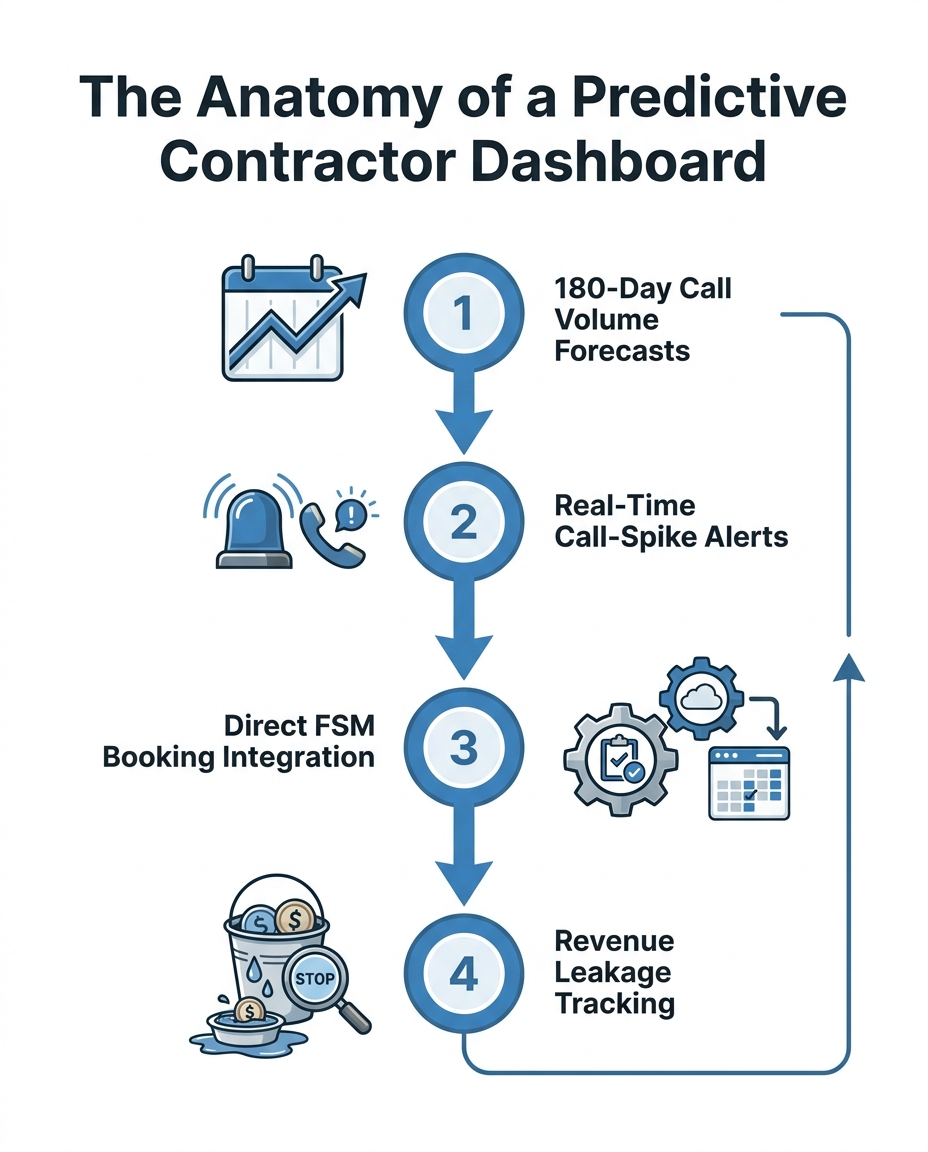
Eliminating seasonal guesswork: The most powerful feature of a predictive dashboard is access to accurate 7-day and 180-day call volume forecasts. By analyzing over 5 years of historical trends, marketing spend, and upcoming seasonal shifts, these forecasts completely eliminate the need for guesswork in seasonal staffing. You know exactly when your call volume is projected to spike, allowing you to seamlessly route excess calls to an integrated overflow team without carrying the overhead of permanent, full-time office staff during your slower shoulder months.

Managing Weather Extremes with Real-Time Call-Spike Alerting
The problem with sudden weather shifts: Even the most accurate long-term forecasts cannot perfectly predict the exact day a severe weather system will stall over your service area. Sudden weather extremes can cause inbound call volumes to triple overnight, instantly overwhelming even the most well-staffed in-house dispatch teams. When a major front moves through, the influx of panicked homeowners creates a bottleneck that standard phone systems simply cannot handle.
The cause of emergency bottlenecks: Our team sees this clearly during winter months. Events like sudden winter deep freezes causing burst pipes—similar to the historic February 2021 freeze—often trigger unmanageable emergency call spikes for plumbing contractors. The pattern is always the same: the temperature plummets, pipes freeze solid, and then, as the thaw begins, the pipes burst simultaneously across the region. Within hours, your dispatch board is entirely saturated, and your in-house team is forced to place high-value emergency leads on extended hold.
The solution through real-time alerting: Our team highly recommends real-time call-spike alerting because it becomes critical to protecting your bottom line. A predictive dashboard monitors your inbound call velocity in real time and notifies owners instantly when demand surges beyond normal parameters. This real-time data allows businesses to pivot resources immediately. Instead of finding out at the end of the day that fifty callers hung up, you receive an automated alert the moment your queue backs up, triggering your overflow protocols and ensuring high-ticket emergency jobs are captured rather than lost to competitors.
Bridging the Gap: FSM Integration and Live-Agent Overflow
Predictive insights and real-time alerts are entirely useless without the operational capacity to actually capture the incoming leads. Knowing that your phones are ringing off the hook does not help if there is no one available to answer them. We frequently advise contractors that there is a critical difference between hiring a generic answering service and partnering with an FSM-integrated live-agent overflow team—especially when regional heatwaves push call volumes past 300 calls an hour. Generic services simply take messages, which still forces your team to call the customer back—often finding that the customer has already booked with someone else.
Why Direct FSM Booking Matters
Booking overflow calls directly into the FSM prevents double data entry, maintains clean customer records, and streamlines the dispatch process. Optimizing these workflows often requires professional business systems and software optimizations. Here is exactly how an integrated workflow functions during a seasonal rush:
1. The Alert Triggers: Your predictive dashboard detects a sudden spike in call volume that exceeds your in-house capacity.
2. Seamless Routing: Overflow calls are instantly routed to industry-trained live agents who understand plumbing and HVAC terminology.
3. Direct FSM Entry: The live agent accesses your specific dispatch software and books the appointment directly onto your board, completely eliminating manual data transfer errors.
4. Technician Dispatch: Your field technicians receive the job details instantly on their mobile devices, keeping them on schedule during peak rushes without waiting for the office to catch up.
Partnering with a team that is ServiceTitan Certified — Accounting ensures that these operational workflows align perfectly with your financial tracking. Deep integrations between FSM software and accounting platforms mean that every emergency call captured by the overflow team is accurately tracked from the initial ring all the way to the finalized invoice.
Protecting Profitability with Accurate Financials
Capturing demand must translate to bottom-line growth: Answering every call and booking every emergency job is only half the battle. Capturing seasonal demand must ultimately translate into organized financial records and protected profit margins. If your back-office accounting is a mess, the extra revenue generated during a summer heatwave or a winter freeze will quickly be eaten up by operational inefficiencies, missing inventory, and inaccurate job costing.
The danger of disorganized accounting: One home service business owner reached out to our financial team last summer after struggling to find organized, reachable accounting professionals. After cycling through over four previous accountants who couldn't keep up with the fast-paced nature of the trades, their books were a disaster—relying on outdated 2015-era ledger practices. By transitioning to a highly organized accounting team that understood the nuances of the home service industry, they finally received spot-on numbers and wonderful feedback, allowing them to manage their cash flow effectively during their busiest season.
Leveraging true financial visibility: True financial visibility allows owners to track KPIs accurately and identify areas of revenue leakage before they become catastrophic. For businesses scaling rapidly or preparing for a future transition, leveraging fractional CFO services ensures that both operational metrics and overall financial health are optimized for maximum valuation. When your dispatch metrics, FSM data, and accounting records all speak the same language, you build a business that is resilient, predictable, and highly profitable.
Frequently Asked Questions About Contractor Dashboards and Call Management
How do HVAC and plumbing companies handle seasonal call volume?
The most successful contractors handle seasonal volume by moving away from gut-feeling staffing and adopting predictive forecasting. Instead of blindly hiring temporary office staff, they utilize dashboards to anticipate spikes and rely on integrated live-agent overflow to manage the excess calls. This ensures every lead is answered without carrying unnecessary payroll during slow months.
What is an overflow answering service for contractors?
An overflow answering service acts as an extension of your in-house office team, automatically taking calls only when your primary lines are busy or after hours. For home service contractors, the best overflow services utilize industry-trained agents who can book appointments directly into dispatch software. This prevents emergency leads from going to voicemail and being lost to competitors.
Why is it important for an answering service to integrate with my FSM?
Integration is vital because it eliminates the need for double data entry and delayed callbacks. When an answering service integrates with your FSM, agents book jobs directly onto your live dispatch board, allowing your technicians to see the new appointments instantly. This seamless workflow keeps your operations moving efficiently during extreme weather events.
How to integrate a call center with ServiceTitan?
Integrating a call center with ServiceTitan requires partnering with a service provider that has deep technical expertise and certified credentials. The process involves setting up secure API connections, mapping call classifications, and establishing strict operational workflows. Working with a team that holds specialized certifications ensures the integration is seamless and financially accurate.
What features should a predictive contractor financial dashboard include?
A robust dashboard should go far beyond basic historical reporting. Essential features include long-term call volume forecasting, real-time call-spike alerting, and deep visibility into abandoned calls to track revenue leakage. It should also seamlessly connect your operational dispatch data with your back-office accounting metrics.
How does call-spike alerting protect my profit margins during weather extremes?
Call-spike alerting protects your margins by instantly notifying you the moment your inbound call volume exceeds your team's capacity to answer. Instead of discovering hours later that dozens of high-ticket emergency leads hung up, you can immediately activate overflow support. Capturing those stranded calls directly translates to protected revenue and higher profitability.
Take Control of Your Seasonal Demand Today
Gut-feeling seasonal staffing is obsolete in today's highly competitive home service market. In our experience, relying on basic FSM reports and hoping your in-house team can weather the storm leaves too much revenue on the table. By leveraging a custom dashboard with long-term forecasting, real-time call-spike alerting, and integrated live-agent overflow, contractors can capture every emergency lead efficiently. When you combine operational readiness with accurate contractor bookkeeping and accounting, you build a business that thrives in any weather. Talk to an expert today about integrating these predictive systems into your business and establishing a clear methodology for capturing seasonal demand.