

Software vs. Live Agents: Handling Plumbing Missed Calls During Peak Summer Demand

The Automation Illusion: Why Fast Replies Don't Always Save the Dispatch
Many business owners operate under the myth that firing off an automated text message the exact second a call goes to voicemail is enough to secure a new customer. When evaluating Software vs. Live Agents: Handling Plumbing Missed Calls During Peak Summer Demand, relying solely on a digital ping often creates a false sense of security. The reality is that speed alone does not win the job. While an automated system guarantees a fast reply, it completely fails to address the emotional state of a caller dealing with an active property crisis.
The core issue for operations managers is finding the right balance between technology and human interaction. A typical pattern we see is a high-value emergency dispatch lost to competitors simply because a panicked homeowner abandoned an automated text-back flow. When water is pouring through a ceiling, a customer does not want to press "1" to schedule an appointment. They need immediate reassurance that a professional is on the way. Upgrading your communication strategy requires more than just a software subscription; it requires a deep understanding of why customers call in the first place.
If you are routing peak overflow calls to a machine rather than a professional Answering Service, you are likely bleeding revenue without realizing it. The decision point rests on whether you want to merely acknowledge a missed call or actually capture the lead. By examining the limitations of automated texts alongside the proven benefits of a 24/7 live answering service, contractors can build a reliable defense against lost jobs during the busiest months of the year.
The Psychological State of a Summer Plumbing Emergency
To understand why automated systems frequently fail during critical moments, you have to look at the mindset of the caller. Home plumbing and HVAC failures rarely happen at convenient times. When peak summer heatwaves hit, they drive a massive surge in emergency calls, straining standard in-house dispatch capacity and heightening homeowner panic. A broken air conditioner or a backed-up sewer line in the middle of July is not a casual inconvenience; it is a high-stress event that demands an immediate, empathetic response.
During peak summer demand, the urgency of these calls increases exponentially. Customers are dealing with uncomfortable indoor temperatures, potential water damage, and the fear of expensive repairs. They are actively scrolling through search results, looking for a human voice to tell them that help is available. If they hit a voicemail greeting or receive an automated text asking them to fill out a web form, their anxiety spikes, and they simply move on to the next contractor on the list.
The Anatomy of a Panic Call
When a customer is in the "panic phase" of an active leak or system failure, their communication needs change drastically. They are not looking for a digital scheduling assistant; they are looking for a lifeline.
• Immediate Reassurance: Callers need to hear that their problem is understood and that a technician can be dispatched. A text message cannot convey tone or empathy.
• Diagnostic Clarification: Panicked homeowners often struggle to explain the exact nature of the problem. A human agent can ask clarifying questions to determine the severity of the issue.
• De-escalation: A calm, professional voice helps lower the customer's stress level, making it easier to gather accurate address and billing information.
• Trust Building: Speaking to a knowledgeable representative instantly establishes trust, which is the primary factor in preventing the caller from contacting a competitor.
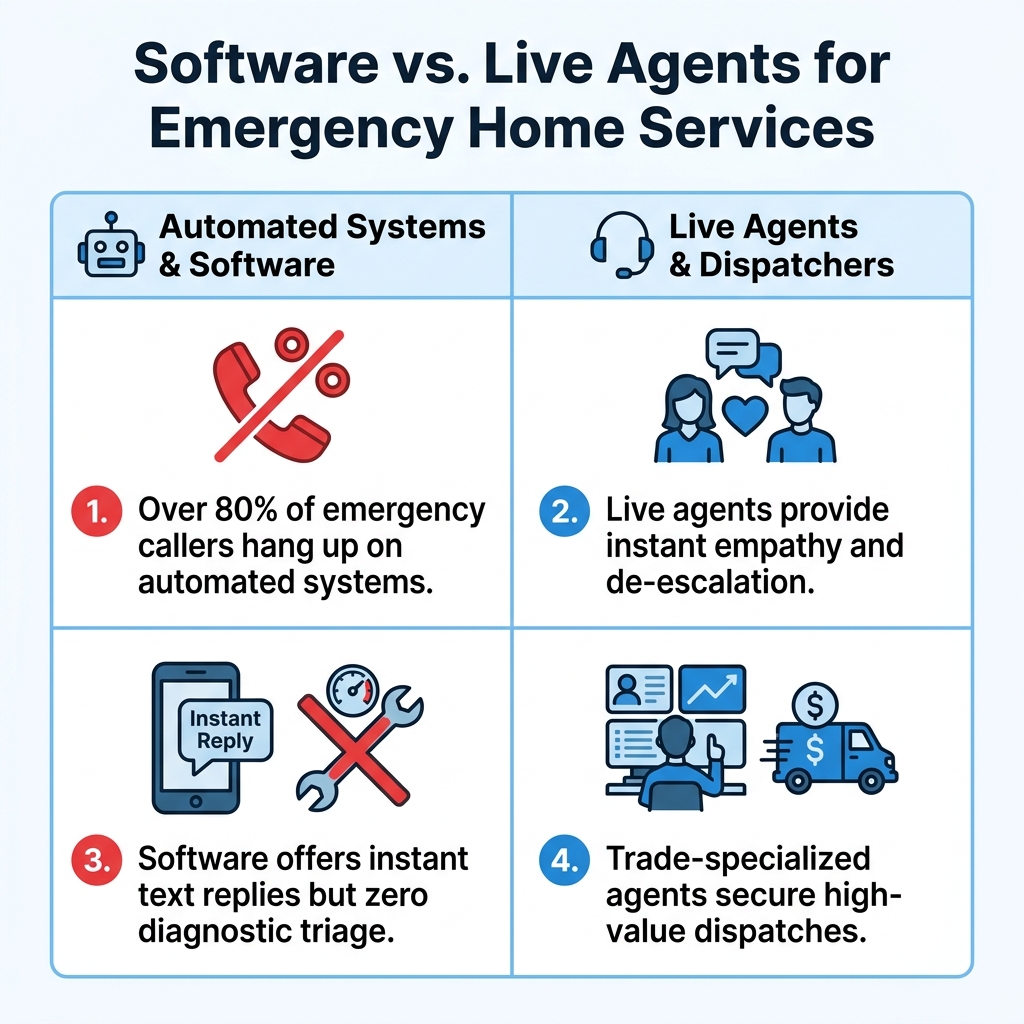
Industry data shows that over 80 percent of callers sent to voicemail or automated systems during an emergency will hang up. They do not leave messages, and they do not wait for a callback. They keep dialing until someone answers the phone.
The Appeal and Limitations of Automated Text-Back Software
Automated missed-call text-back software has gained significant traction in the home service industry, and it is easy to see why. The primary benefit is absolute consistency. The software provides an instant response time and zero human error in the initial outreach. For a busy contractor, knowing that every missed call automatically receives a polite greeting via text feels like a step toward better customer service.
However, while software excels at speed, it completely lacks the nuance required for high-stakes triage. A text-back system cannot differentiate between a customer asking about routine water heater maintenance and a homeowner standing in a flooded basement. When every call is treated with the same generic auto-reply, the system inevitably alienates the most urgent, high-value leads. This leads to a scenario where a high-value emergency dispatch lost to competitors becomes a daily occurrence, despite the software functioning exactly as designed.
When Software Works
It is important to acknowledge that automation is not inherently bad; it simply has a specific use case. Software solutions are highly effective for non-urgent inquiries. If a customer is calling to ask about financing options, request a quote for a future project, or book a standard tune-up, an automated text offering a link to your calendar is often perfectly acceptable. In these low-stakes scenarios, the customer appreciates the prompt digital reply and is willing to navigate a self-service menu. Automation works best as a secondary safety net, catching routine administrative tasks so your team can focus on larger issues.
The Abandonment Rate Reality
The critical failure point for software occurs during active, high-stress emergencies. The statistics behind why customers ignore texts when water is actively damaging their property are clear. When you review missed call statistics for home service companies, the abandonment rate for text-back flows during emergencies is staggering. A homeowner dealing with a burst pipe does not have the patience to text back and forth with a bot. They need immediate verbal confirmation that a truck is being routed to their home. When that confirmation is missing, the text thread is abandoned, and the lead is gone.
The Power of Empathy: Why 24/7 Live Answering Wins the Dispatch
Contrasting the limitations of software with the capabilities of a live human being reveals exactly why live answering captures more revenue. A live human voice immediately stops the homeowner from calling competitors. The moment a professional agent answers the phone, the customer's search ends. They feel heard, their problem is being documented, and the panic begins to subside.
Securing these jobs requires a structured approach that only a live person can execute. Here is how a live agent handles an emergency call compared to an automated system:
1. Immediate Empathy and De-escalation: The agent acknowledges the stress of the situation, offering a calm, professional tone that reassures the caller.
2. Information Gathering: The agent asks targeted questions to determine if the situation is a true emergency (e.g., "Is the water actively leaking?" or "Do you know how to shut off the main valve?").
3. Expectation Setting: The agent provides a clear timeline for when the technician will arrive, establishing firm expectations that keep the customer from continuing their search.
4. Seamless Handoff: The agent logs the detailed notes directly into the contractor's system, ensuring the dispatched technician knows exactly what they are walking into.
Contractor in Charge provides trade-specialized 24/7 Live Agent Call Center Services that deliver this immediate human empathy and industry knowledge. By utilizing professionals who understand the home service industry, contractors can successfully capture the high-value leads that automated text-backs routinely lose.
Trade-Specific Triage
Generic call centers often fail because their operators do not understand the difference between a minor faucet drip and a main line sewer backup. They follow rigid scripts that frustrate callers who are already dealing with peak summer demand stress. Specialized agents, on the other hand, speak the language of the trade. They know which questions to ask to accurately triage plumbing and HVAC calls. This industry-specific knowledge builds instant trust with the homeowner, proving that your company is equipped to handle their specific crisis.
Side-by-Side Comparison: Software vs. Live Agents
To fully grasp the operational impact of your call handling choices, it helps to see the two approaches compared directly. Both systems aim to prevent a high-value emergency dispatch lost to competitors, but they achieve vastly different results when the pressure is on.
• Response Speed — Automated Text-Back Software: Instant (milliseconds after a missed call). — 24/7 Live Answering Agents: Seconds (typically answered within 2-3 rings).
• Empathy & De-escalation — Automated Text-Back Software: None. Relies entirely on pre-written, generic text templates. — 24/7 Live Answering Agents: High. Can adjust tone, express concern, and calm panicked callers.
• Lead Capture (Emergencies) — Automated Text-Back Software: Low. Over 80% abandonment rate for urgent property damage calls. — 24/7 Live Answering Agents: High. Human interaction stops the caller from dialing competitors.
• Triage Accuracy — Automated Text-Back Software: Poor. Cannot ask dynamic follow-up questions based on customer replies. — 24/7 Live Answering Agents: Excellent. Can accurately assess severity and gather critical diagnostic details.
• Dispatch Readiness — Automated Text-Back Software: Low. Leaves the burden of actual scheduling to the in-house team later. — 24/7 Live Answering Agents: High. Can integrate with software to put the job directly on the board.

Operational Efficiency: Seamless Dispatch Integration
Capturing the lead is only half the battle; dispatching the right technician efficiently is the other. Proper call handling requires a system that not only answers the phone but also moves the job forward. Automated software often simply dumps a text notification onto an already overwhelmed dispatcher's plate. During peak summer demand, an in-house dispatcher is already juggling technicians, parts runs, and unhappy customers. Adding a queue of unvetted text messages to their workload creates a massive bottleneck.
Live agents handle actual dispatching and call movement, significantly reducing the operational burden on the business owner. A great example of this occurred during a recent busy summer season. A plumbing business was struggling to handle high call volumes while simultaneously dispatching trucks and moving calls as emergencies popped up. By utilizing a specialized team to handle calls and dispatch them efficiently, the business was able to adjust their board as necessary. The outcome was that calls were managed effectively, providing excellent customer service without burning out the in-house staff.
Reducing Operational Overhead
Properly managed call handling saves money by streamlining operations and preventing dispatch bottlenecks. When live agents integrate directly into your field service management software, they can move calls, adjust schedules on the fly, and ensure that the closest technician is routed to the most urgent job. This allows your in-house teams to focus on complex logistics, inventory management, and technician support rather than answering repetitive panic calls. Integrating Virtual Customer Service into your daily operations ensures that your business runs smoothly, even when call volume spikes unexpectedly.
Protecting Your Bottom Line During the Busiest Season
The financial impact of your call handling choices cannot be overstated. When evaluating communication systems, many contractors focus solely on the monthly subscription cost of software versus the hourly rate of a live answering service. This is a flawed metric. The true cost analysis must include the hidden cost of missed calls and abandoned text flows.
If an automated system saves you a few hundred dollars a month but costs you three major sewer line replacements because those callers hung up and dialed a competitor, the system is actively harming your business. A single high-value emergency dispatch lost to competitors easily eclipses the cost of premium live answering support for an entire month.
Optimizing call center operations provides a strong return on investment by capturing jobs that would otherwise slip through the cracks. Investing in the right communication strategy is a revenue protector, not just an operational expense. It ensures that the marketing dollars you spent to get the phone to ring actually result in booked revenue, rather than generating leads for the company down the street.
Secure Your Summer Revenue with Trade-Specialized Support
While automated text-back software certainly has its place for routine administrative tasks and non-urgent scheduling, human empathy remains irreplaceable for emergency plumbing and HVAC scenarios. The psychological state of a panicked homeowner demands a response that a machine simply cannot provide. We strongly encourage contractors to evaluate their current peak-season call handling processes before the busiest months arrive.
Do not let another high-value emergency dispatch lost to competitors damage your bottom line. By upgrading your systems, you can ensure that every caller is greeted with professionalism, empathy, and industry expertise. Take the next step to protect your revenue and explore specialized 24/7 Live Agent Call Center Services today to guarantee no high-value dispatch is ever lost to a voicemail greeting.
Frequently Asked Questions
Why do automated text-backs fail for emergency plumbing calls?
Automated text-backs fail during emergencies because they lack empathy and diagnostic ability. A homeowner dealing with an active leak is often panicked and needs immediate verbal reassurance that help is on the way. Text messages feel impersonal and force the customer into a self-service loop, prompting over 80 percent of them to abandon the process and call a competitor.
What are the benefits of 24 7 live answering for contractors?
Live answering ensures that every call is met with a professional, human voice, regardless of the time of day. This stops callers from continuing their search for a contractor, effectively capturing the lead. Additionally, specialized agents can accurately triage the issue, de-escalate customer panic, and integrate the job directly into your dispatch software.
Do customers prefer live agents or automated software?
Customers overwhelmingly prefer live agents for urgent, high-stress service issues. While software is acceptable for routine tasks like confirming an appointment time, emergencies require human interaction. A live agent builds trust and provides the immediate confirmation that a panicked homeowner is desperately seeking.
What is a missed call text back?
A missed call text back is an automated software feature that instantly sends a pre-written text message to a caller if their phone call goes unanswered. The goal is to engage the customer digitally before they call another business. While fast, it relies on the customer being willing to communicate their issue via text rather than speaking to a representative.
How do missed calls affect plumbing businesses during summer heatwaves?
Missed calls directly result in lost revenue, especially during peak summer heatwaves when call volume surges. Customers experiencing HVAC or plumbing failures in extreme weather have zero tolerance for waiting. If a business fails to answer the phone, the customer will immediately move down the search engine results page until they find a company that does.
Can live answering services integrate with my existing dispatch software?
Yes, premium trade-specialized live answering services seamlessly integrate with major field service management platforms. This allows agents to not only take the call and gather information but also book the job directly onto your dispatch board. This integration reduces operational bottlenecks and keeps your in-house team focused on logistics rather than data entry.