

Identifying the Drop-Off Point Between Booked Jobs and Completed Revenue

The Illusion of a Full Dispatch Board
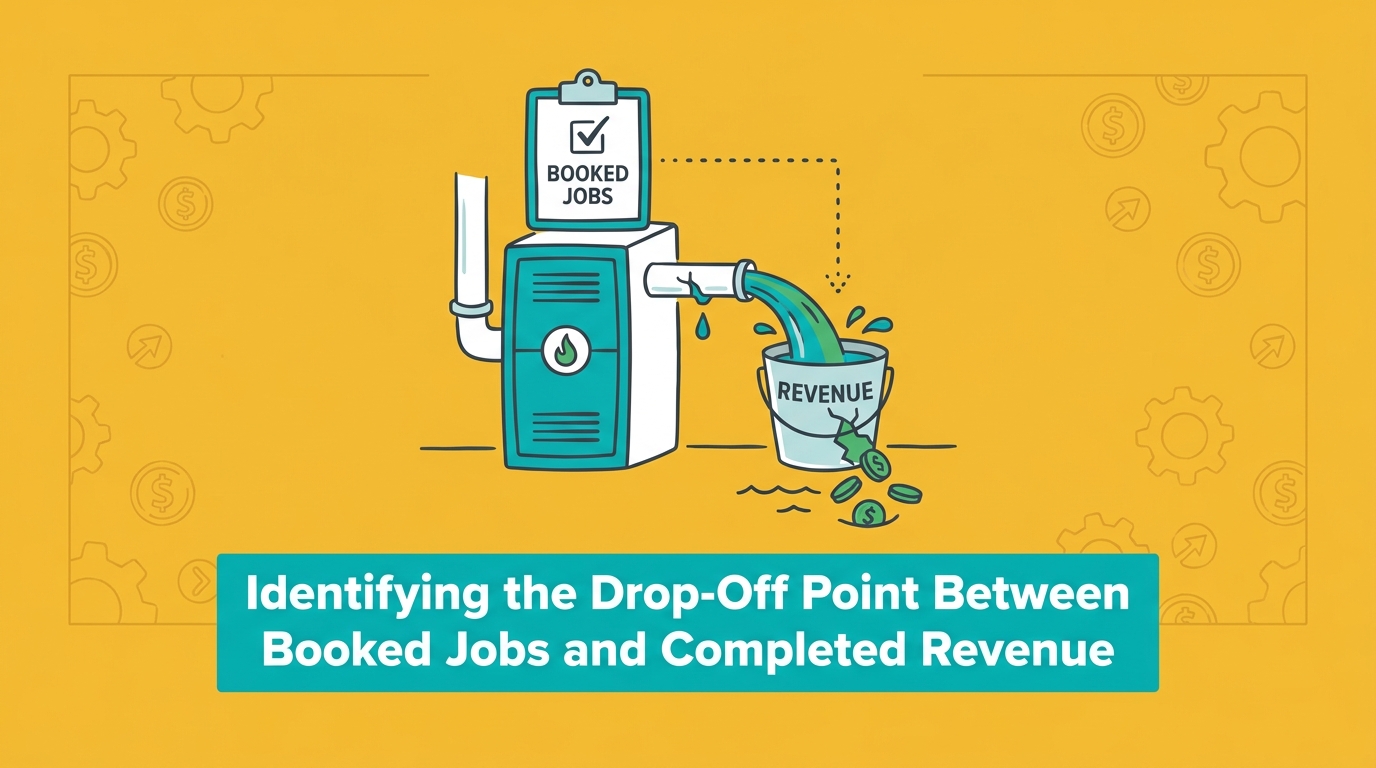
Identifying the Drop-Off Point Between Booked Jobs and Completed Revenue is a critical operational challenge that begins when you realize your technicians are running non-stop, but your bank account isn't growing at the same pace. Your dispatch screen glows with back-to-back appointments, emergency calls are stacking up, and your team is working overtime. It feels like a record-breaking month. However, a fully booked schedule can create a dangerous false sense of financial security, masking underlying operational leaks that quietly drain your profitability. High call volume does not automatically equate to high bank deposits, especially if back-office workflows stall long after the technician leaves the driveway.
To fix this disconnect, you need to implement performance accounting protocols, and leveraging professional fractional CFO and bookkeeping services can provide the structural oversight necessary to plug these leaks.
Business owners must decide exactly where to implement tracking between the field diagnosis and the final back-office approval. Bridging the gap requires looking beyond vanity metrics to analyze true performance accounting. This is especially true during the peak summer dispatch season, when the sheer volume of inbound calls often masks these revenue drop-offs. The chaos of busy season makes it easy to ignore operational leaks until the weather cools down and you finally have time to look at the books—only to discover that your record-breaking month did not result in record-breaking cash flow.
Warning signs that your full board is an illusion:
• High volume, low cash: The peak summer dispatch season shows maximum capacity, but weekly cash flow remains unexpectedly tight.
• Unreconciled job statuses: Technicians mark jobs as "complete" in the software, but the final payment hasn't actually cleared the bank.
• Missing stipulations: Jobs are held up in the back office because financing paperwork is incomplete, yet the field team has already moved on.
• Data silos: Your dispatch software tells one story about your revenue, while your QuickBooks or general ledger tells an entirely different one.
The Disconnect Between FSM Software and Deposited Revenue
The Problem: Field service management (FSM) software excels at tracking dispatch metrics, routing technicians, and monitoring daily call counts. However, it often falls short in reflecting true deposited revenue. FSM platforms are operational tools, not true accounting systems. When business owners rely solely on software dashboards without reconciling them against actual bank statements, they develop massive financial blind spots.
The Cause: The root of this disconnect lies in how data is categorized. In an FSM dashboard, a booked job or an approved estimate often registers as a "win." But in reality, an approved estimate is just a promise. If the job is completed but the financing falls through, or if the customer disputes the charge, the dispatch board call volume vs. closed ticket count will show a glaring discrepancy. Relying on unreconciled operational data to make payroll, purchasing, or hiring decisions is incredibly risky.
The Solution: Accurate financial feedback requires a system that seamlessly integrates operational data with professional accounting. Tracking contractor performance metrics must include the reconciliation phase, not just the booking phase. One typical pattern we see—echoed by a home service client who reached out during a busy summer after struggling to get accurate feedback from four different accountants—is that operational data needs professional oversight. Once a dedicated team took over their accounting, providing organized, reachable, and accurate financial feedback, their numbers finally aligned, and their accounting became spot on.
Vanity Metrics vs. Bank Deposits
Booked jobs are considered a vanity metric if they don't ultimately close and fund. A vanity metric makes you feel good about your business activity but doesn't pay the bills. To understand the difference, you have to look at how data behaves across different platforms.
• Job Status — FSM Software View (Vanity): Marked "Completed" by the technician on site. — True Financial View (Reality): Marked "Reconciled" when funds hit the bank.
• Revenue Tracking — FSM Software View (Vanity): Total value of approved estimates for the week. — True Financial View (Reality): Total value of cleared deposits matching invoices.
• Financing — FSM Software View (Vanity): Customer verbally agreed and signed the tablet. — True Financial View (Reality): Lender has fully funded the project minus fees.
• Call Success — FSM Software View (Vanity): Dispatch board call volume is maxed out. — True Financial View (Reality): Closed ticket count matches actual deposits.
Explaining the danger of making payroll or purchasing decisions based on un-reconciled FSM data is straightforward: if you spend cash based on what your dispatch board says you earned, but your bank account is waiting on stalled financing approvals, you will inevitably hit a cash flow wall.
Micro-Conversions: Tracking the Technician's Field Pitch
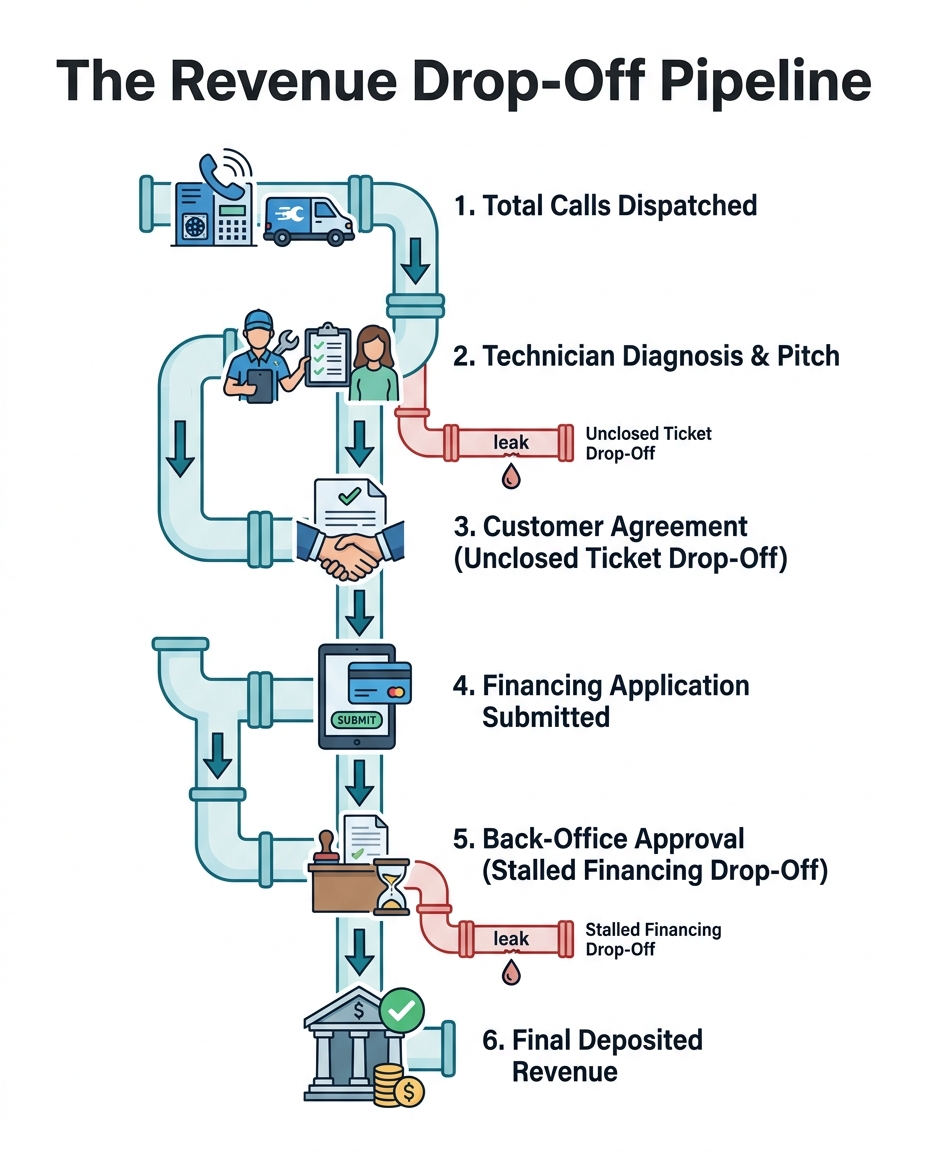
The first major potential leak occurs right in the customer's home, between the technician's diagnosis and the customer's agreement to proceed. If your dispatch board call volume vs. closed ticket count is skewed, this is the first place to look. A technician might run six calls in a day, but if they only close two repairs, that represents a massive drop-off point.
Monitoring unclosed service tickets reveals critical insights into your field operations. It tells you whether technicians lack the necessary sales training, if your pricing structure is misaligned with the local market, or if the options being presented are simply too confusing for the homeowner. Tracking these micro-conversions in the field helps isolate whether the issue is technical competence (they can't figure out what's wrong) or presentation skills (they know what's wrong, but can't explain it in a way that makes the customer want to buy).
When field drop-offs are high, implementing robust inside sales support can help capture leads that technicians fail to close on-site. An inside sales team can follow up on open estimates, answer lingering questions, and save jobs that would otherwise be lost to competitors.
Diagnosing Field Drop-Offs
To effectively audit technician conversion rates, you have to look beyond the overall average. A technician might have a high average ticket size but a terrible close rate, meaning they only sell to "easy" buyers and walk away from everything else. Identifying patterns in unclosed tickets is essential to target training effectively.
• Arrival to Diagnosis: Does the technician spend enough time investigating the system, or do they rush to a conclusion?
• Diagnosis to Pitch: Are they presenting multiple options (good, better, best), or just handing the customer a single, expensive ultimatum?
• Pitch to Close: When the customer says "I need to think about it," does the technician have the skills to handle the objection, or do they just pack up their tools?
• Unclosed Ticket Review: Are certain technicians consistently failing to close specific types of repairs? This indicates a localized training gap rather than a company-wide issue.
The Back-Office Bottleneck: Stalled Financing Approvals
Even when a technician successfully closes a sale in the field, unresolved financing can stall the revenue indefinitely. This is one of the most frustrating drop-off points because the hard work of selling the job is already done. Back-office delays in processing applications, verifying identities, or following up on lender stipulations create massive cash flow gaps that can cripple a growing business.
Treating financing approval stalls as a distinct operational leak separate from field sales performance is crucial. During extreme weather events, back-office staff are often overwhelmed by inbound calls, causing critical financing follow-ups to be delayed or forgotten entirely. When the phones are ringing off the hook, chasing down a customer's missing proof of income falls to the bottom of the priority list. Establishing a clear workflow for daily financing reconciliation prevents these jobs from falling through the cracks, ensuring that the peak summer dispatch season translates into actual revenue rather than just a pile of pending paperwork.
Resolving Pending Approvals
Assigning dedicated accountability for chasing down missing customer stipulations is the only way to clear this bottleneck. Here are the necessary steps to audit and resolve your current financing approval pipeline:
1. Audit the Open Pipeline: Pull a report of all jobs marked "sold" in your FSM software over the last 30 days that have not yet been funded by the lender.
2. Categorize the Stalls: Group the stalled jobs by reason: missing customer signatures, missing proof of income, lender portal errors, or back-office processing delays.
3. Assign Accountability: Designate one specific person in the back office whose primary daily metric is clearing financing stipulations. This cannot be a shared responsibility, or it will be ignored during high call volumes.
4. Implement a 24-Hour Rule: Establish a protocol where any job requiring financing must have its paperwork submitted and verified within 24 hours of the customer signing the estimate.
5. Reconcile Daily: Compare the lender funding reports against your FSM software daily to ensure the dispatch board call volume vs. closed ticket count accurately reflects funded jobs.

Building a True Contractor Financial Dashboard
Moving beyond basic "hustle harder" advice requires structural back-office tracking and deep system optimization. A reliable financial dashboard bridges the gap between field activity and the general ledger, ensuring you are managing your business based on reality, not just the dispatch board call volume vs. closed ticket count. Integrating business systems and software optimizations ensures data flows accurately from dispatch to accounting without getting lost in translation.
Proper financial architecture is essential not just for daily operations, but for maximizing business valuation during a sale or acquisition. Fractional CFO oversight ensures that the financial house is in order, catching discrepancies before they impact cash flow. For example, during a busy winter season, business owners preparing for high-end transactions often realize their financials are too disorganized to secure a top valuation. By bringing in fractional CFO services to organize their financial house, these owners are able to clean up their reporting, align their FSM data with their bank statements, and ultimately achieve the highest end of the valuation range for their sales.
Bridging Software and Accounting
The technical requirements for a seamless data handoff are non-negotiable if you want to eliminate revenue leaks. Why manual double-entry is a primary cause of revenue tracking errors comes down to human nature: when a dispatcher or bookkeeper has to manually type invoice details from the FSM software into the accounting software, transpositions, typos, and omissions are inevitable.
• Automated API Syncing: Ensure your FSM platform (like ServiceTitan or Housecall Pro) has a direct, automated sync to your accounting software (like QuickBooks).
• Standardized Pricebooks: Your chart of accounts must map perfectly to your pricebook categories. If a technician sells a "condenser motor replacement," the revenue must automatically route to the correct HVAC repair income account.
• Daily Batch Reconciliations: Credit card batches and financing deposits should be reconciled daily, not monthly. Waiting until month-end allows errors to compound.
• Exception Reporting: Your dashboard should automatically flag jobs that have been marked "complete" in the field for more than 48 hours without a corresponding payment record.
Realigning Operations to Eliminate Revenue Leaks
The Problem: When the peak summer dispatch season hits, it is incredibly easy to lose sight of the bottom line because everyone is focused on simply answering the next call. The sheer volume creates a chaotic environment where unclosed tickets and pending financing applications pile up unnoticed.
The Cause: This happens because operations are treated as fragmented departments. The field team only cares about closing the job, the dispatchers only care about clearing the board, and the bookkeepers only care about what hits the bank. Without a holistic approach, the dispatch board call volume vs. closed ticket count will always be misaligned.
The Solution: You must conduct a weekly audit comparing dispatched calls to fully funded jobs. Separate field training initiatives from back-office processing improvements, but track them on the same pipeline. Adopt a holistic approach that treats the entire customer journey—from call booking to final bank deposit—as a single trackable entity. Leveraging specialized operational expertise is the fastest way to permanently bridge the disconnect between dispatching software and actual accounting. Working with Contractor in Charge provides this deep expertise in home service operations, seamlessly bridging the gap between FSM software metrics and true financial accounting, ensuring your hard work actually translates into deposited cash.
Frequently Asked Questions About Revenue Tracking
Why does dispatch volume not match deposited revenue?
Dispatch volume tracks the total number of appointments scheduled, while deposited revenue tracks the actual cash collected and cleared. A mismatch usually occurs due to unclosed service tickets in the field, jobs that are completed but waiting on financing approvals, or administrative errors where invoices are never sent. To fix this, you must monitor the dispatch board call volume vs. closed ticket count daily.
How do you track unclosed service tickets?
Tracking unclosed tickets requires filtering your field service management software for jobs marked as "diagnosed" or "estimate provided" but not "sold." You should review these open estimates weekly to identify patterns. If a specific technician has a high rate of unclosed tickets, they likely need targeted presentation or sales training.
How to fix financing bottlenecks in HVAC sales?
Fixing financing bottlenecks requires assigning dedicated back-office accountability to manage lender stipulations. Implement a strict 24-hour rule for submitting all required customer paperwork after the estimate is signed. Regularly reconciling your lender portal against your FSM software ensures that completed jobs don't sit unpaid.
What are the key micro-conversions between a field diagnosis and final payment?
The key micro-conversions include the transition from diagnosis to customer agreement, the submission of the financing application, the lender's approval, the completion of the physical work, and the final clearing of funds into the bank account. Monitoring each of these steps isolates exactly where revenue is leaking out of the pipeline.
How does FSM software data differ from true financial accounting?
FSM software is designed for operational efficiency, tracking things like dispatch times, estimated job values, and technician efficiency. True financial accounting tracks the actual movement of cash, liabilities, and assets. Because FSM software often records an approved estimate as revenue before the cash clears, it can create a false sense of financial health if not reconciled against the general ledger.
Securing Your Bottom Line
A full dispatch board is only valuable if it translates into completed, deposited revenue. When a high dispatch board call volume vs. closed ticket count creates a glaring discrepancy, it is time to stop looking at vanity metrics and start looking at your operational pipeline. By tracking micro-conversions in the field and auditing back-office bottlenecks like stalled financing, contractors can secure their financial health and stop leaving money on the table.
Professional oversight is often the missing link in this process. By utilizing fractional CFO and bookkeeping services, you gain the analytical framework needed to maintain alignment between your dispatch software and your bank account. Explore options to optimize your financial tracking today, and ensure that every job you run actually protects and grows your hard-earned revenue.