

Transitioning Your CSR Team's Mindset from Order-Taking to Active Lead Conversion

Stop Losing Leads: Why Your CSRs Must Move Beyond Answering Questions
If you have ever listened to your office call recordings and heard a potential customer hang up without booking, you already know that transitioning your CSR team's mindset from order-taking to active lead conversion is a critical operational priority. Home service business owners pour massive resources into marketing, SEO, and advertising to make the phone ring. Yet, when those calls finally come in, the opportunity is frequently squandered because the person answering the phone acts as a passive information desk rather than a proactive guide.
This operational bottleneck happens when customer service representatives (CSRs) focus merely on answering technical questions, giving out free advice, or confirming availability. To stop losing leads, your business requires a structured call-handling framework. The goal is to shift your front-line team from simply reacting to inquiries to confidently securing the diagnostic appointment. When you implement specialized virtual customer service protocols, you ensure that every inbound interaction is treated as a valuable opportunity for HVAC CSR lead conversion.
The True Cost of Passive Call Handling in Home Services
Every unconverted inbound call directly reduces your marketing return on investment (ROI). High customer acquisition costs mean you cannot afford to have your team act as a passive answering service. When a homeowner calls about a broken air conditioner or a leaking water heater, they are in a state of distress. If your representative simply answers their questions without guiding them toward a solution, the caller will likely hang up and dial the next competitor on their search list.
The Hidden Costs of Abandoned Revenue:
• Wasted Marketing Spend: Every click or ad impression that generates a phone call costs money. If the call does not result in a booked appointment, that investment is entirely lost.
• Lost Lifetime Value: A single missed diagnostic appointment is not just one lost job. It represents the loss of a potential lifelong maintenance customer and future replacement installations.
• Operational Inefficiency: Time spent giving free advice over the phone is time taken away from scheduling paying customers and routing dispatchers effectively.
There is a stark contrast between an untrained order-taker and a top-performing CSR. An order-taker waits for the customer to dictate the next step, often yielding to demands for blind phone estimates. A highly trained professional in inside sales takes control of the conversation, acknowledges the customer's problem, and steers the dialogue toward booking an in-person assessment.
• Handling Questions — Passive Order-Taker: Gives away free technical advice and blind estimates. — Active Lead Converter: Explains why an on-site diagnostic is necessary for an accurate quote.
• Call Control — Passive Order-Taker: Waits for the caller to ask for an appointment. — Active Lead Converter: Assumes the booking by offering two specific appointment windows.
• Customer Distress — Passive Order-Taker: Reacts defensively to frustration or urgency. — Active Lead Converter: Uses empathy and active listening to de-escalate and build trust.
• Primary Goal — Passive Order-Taker: Getting off the phone quickly. — Active Lead Converter: Securing the paid diagnostic dispatch.
Redefining the CSR Role: The First Diagnostic Responder
To fundamentally change how your team handles inbound calls, you must redefine their role within the company. The CSR is not an administrative assistant tasked with answering phones; they are the critical first step of the diagnostic process. Treating the inbound phone call as the initiation of the repair process changes the entire psychological approach of your front office.
Most homeowners do not understand the complexities of HVAC or plumbing systems. When they call, they are looking for a professional to take the burden off their shoulders. The CSR's job is to lead the conversation rather than reacting to a chaotic stream of questions. This requires a mindset shift from "selling a product" to "facilitating a professional assessment."
Core Principles of the First Diagnostic Responder:
• Leading with Authority: The representative must guide the caller through a structured intake process, projecting confidence that your company is the best equipped to solve the problem.
• Focusing on the Visit, Not the Fix: The primary goal is never to diagnose the issue over the phone. The goal is to book a paid diagnostic visit so a licensed technician can properly evaluate the situation.
• Protecting the Technician's Time: By gathering accurate information and setting clear expectations about dispatch fees, the CSR ensures that technicians are sent to qualified, ready-to-buy appointments.
By empowering your team to view themselves as diagnostic responders, you elevate their status and give them the confidence to take charge of difficult conversations.
Essential Communication Skills for Securing the Dispatch
A successful mindset shift must be supported by tactical conversational skills. Pivoting a caller from asking rapid-fire questions to agreeing to a service visit requires a specific set of communication techniques. If you want to train staff to answer calls professionally, you must focus heavily on the psychology of the interaction.
Active Listening for True Pain Points:
Active listening goes beyond simply hearing the words the customer is saying. It involves identifying the underlying urgency and the true pain point. If a caller says their furnace is making a loud noise, the real pain point might be that they are afraid of a fire hazard or worried about freezing temperatures overnight. A skilled agent picks up on these cues and addresses the underlying anxiety.
Demonstrating Empathy to Build Trust:
Home service emergencies are stressful. A homeowner dealing with a flooded basement or a broken AC in the middle of a heatwave is likely frustrated and impatient. Demonstrating genuine empathy is the fastest way to de-escalate the situation. Phrases like, "I completely understand how stressful it is to wake up to a cold house, and we are going to get this sorted out for you," build immediate trust.
Maintaining Control of the Call Flow:
Whoever asks the questions controls the conversation. If the homeowner is allowed to interrogate the CSR about pricing, parts, and timelines, the call will quickly derail. Skilled representatives maintain control by answering questions briefly and immediately following up with a qualifying question of their own. This natural guidance steers the homeowner away from hypotheticals and toward the concrete step of booking a technician.
Structuring a Winning Call-Handling Framework
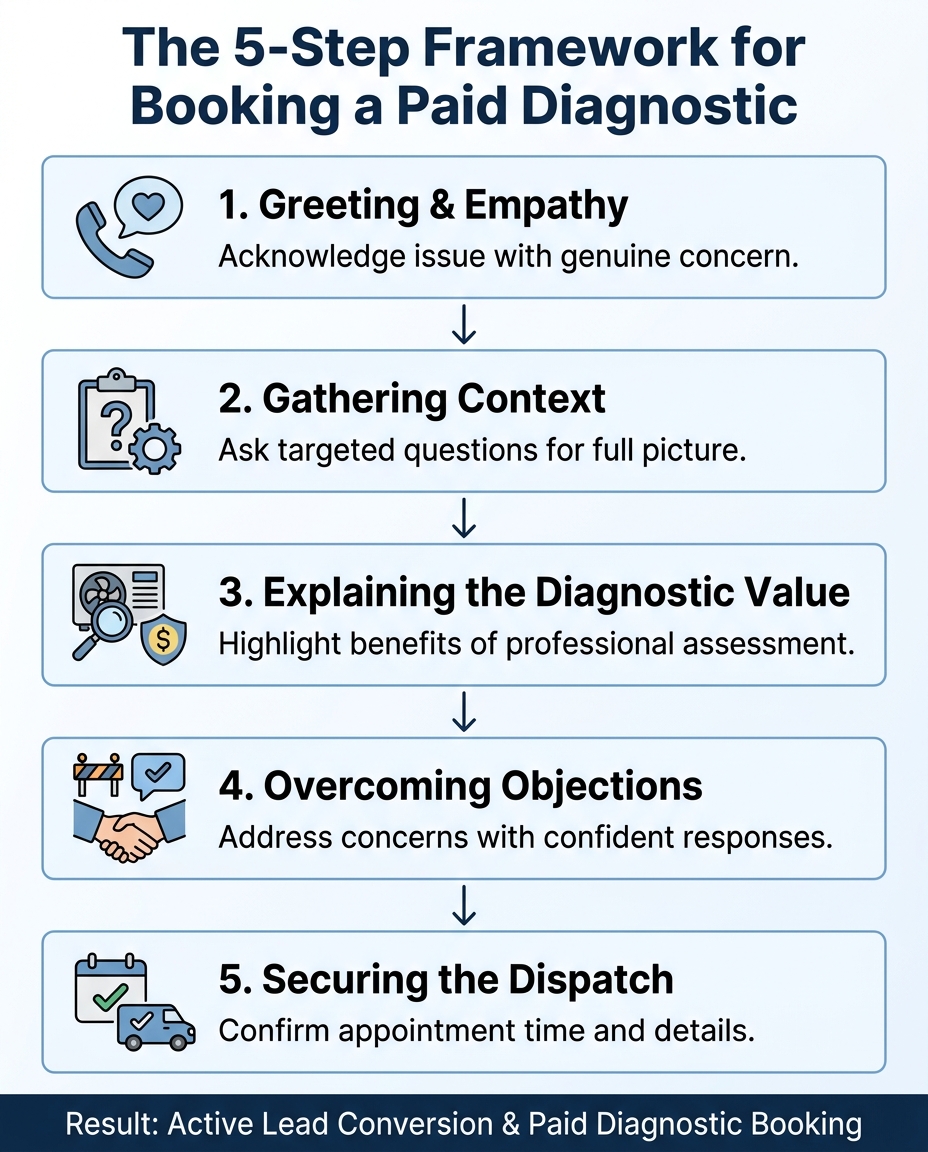
Mindset and communication skills are only effective when applied to a consistent, repeatable process. Business owners must develop effective call scripting techniques that prioritize the dispatch over technical troubleshooting. Establishing a clear, step-by-step flow from the initial greeting to securing the appointment ensures that every caller receives the same high level of service.
This structured approach is particularly vital when resources are stretched thin. For instance, one home service company faced a severe end-of-year staffing shortage during the busy winter season, leaving their leadership unable to handle the influx of calls. They brought in an external team to take over full-time dispatch and call-taking duties. By relying on a proven, structured framework, the company experienced significant growth and stabilized their operations, turning a seasonal crisis into a long-term partnership.
Step 1: Empathy and De-escalation
The first ten seconds of the call dictate the outcome. The representative must acknowledge the customer's frustration immediately and validate their concerns. Reassuring the caller that a professional solution is available sets a collaborative tone. This step is about moving the homeowner from a state of panic to a state of cooperation.
Step 2: Pivoting to the Diagnostic Value
Once the caller is calm, the agent must explain why an in-person assessment is required for an accurate diagnosis. This is where untrained order-takers fail by giving blind estimates. A structured framework requires the agent to firmly but politely decline to diagnose over the phone, explaining that a licensed technician must physically inspect the system to guarantee safety and provide accurate options.
Step 3: Asking for the Appointment
The final step is the most critical: assuming the sale. Instead of asking, "Would you like to schedule an appointment?" the agent should provide two specific options. "I have a technician available today between 2:00 PM and 4:00 PM, or tomorrow morning between 8:00 AM and 10:00 AM. Which works better for you?" The agent must confidently state the dispatch fee and reiterate the value of the professional assessment.

Navigating High-Volume Seasonal Surges with Active Conversion
The necessity of a highly trained CSR team becomes glaringly obvious during peak seasons when call volume spikes. Extreme weather events, such as impending summer heatwaves or sudden winter freezes, place immense operational strain on home service businesses. During peak summer no-cool calls, the phone rings constantly. If your team is composed of passive order-takers, long call queues will result in dropped calls, frustrated customers, and massive amounts of abandoned revenue.
Passive answering strategies fail completely when urgency is high. Callers will not wait on hold for ten minutes just to be told that a technician might be available next week. They need immediate reassurance and a confirmed time window. Maximizing the ROI of urgent calls during these critical periods requires a team that can rapidly de-escalate, qualify, and book the appointment without getting bogged down in unnecessary technical debates.
Having specialized support during these surges is a game-changer. For example, one plumbing and HVAC business needed after-hours call center support during a bitter winter season to handle the overflow. Dedicated agents handled the overnight volume, ensuring that every homeowner received immediate, empathetic customer service rather than a generic voicemail. This reliable extension of their business meant that urgent calls were captured and converted, securing the company's reputation and bottom line. Utilizing a live agent call center equipped with active conversion training ensures that seasonal spikes translate into predictable revenue rather than operational chaos.
Overcoming Customer Objections to the Paid Diagnostic
The most common hurdle any CSR faces is the homeowner who demands a free estimate over the phone and resists paying a dispatch fee. This is a daily reality in the home service industry. The problem arises when callers view the diagnostic fee as an unnecessary charge rather than a valuable service. The cause of this friction is often a lack of understanding about what a proper diagnostic entails—homeowners assume a technician can simply look at a unit and instantly know what is wrong.
The solution requires tactical responses designed for handling price shoppers. Representatives must be trained to articulate the value and necessity of a professional, on-site diagnostic. They must explain that a modern HVAC or plumbing system is complex, and guessing at the problem over the phone often leads to incorrect parts being ordered, wasted time, and ultimately higher costs for the homeowner.
• "Can you just tell me how much a new water heater is?" — The Passive Response: "I think they start around..." (Gives blind estimate) — The Active Lead Conversion Response: "Because every home's plumbing is unique, our licensed technician needs to evaluate your setup to give you an accurate, down-to-the-penny option. I can have someone there by 3 PM."
• "Why do I have to pay a dispatch fee just for you to look at it?" — The Passive Response: "That's just our policy." — The Active Lead Conversion Response: "That fee covers a fully stocked truck and a certified expert arriving at your door to perform a comprehensive safety and performance evaluation."
• "Another company said they would come out for free." — The Passive Response: "Okay, you should probably use them then." — The Active Lead Conversion Response: "Many companies use free trips to get in the door, but we believe in transparent, professional diagnostics so you know exactly what the repair entails before any work begins."
This is where specialized training makes all the difference. Highlighting Contractor in Charge's expertise, business owners can tap into industry-specific Inside Sales and Virtual Customer Service agents who are strictly trained to book paid diagnostics for HVAC and plumbing companies, rather than acting as passive answering services. These specialized agents bypass the learning curve entirely by holding firm on diagnostic requirements and confidently guiding the caller to turn leads into revenue.
Empower Your CSRs to Drive Predictable Revenue
Shifting your front office from passive order-taking to active lead conversion is not a one-time event; it is an ongoing commitment to excellence. By redefining the CSR role as the first diagnostic responder, implementing a structured call-handling framework, and mastering the art of overcoming objections, you empower your team to drive predictable revenue for your business.
Take the time to review your current call recordings and evaluate your call handling processes. Are your representatives passively answering questions, or are they actively guiding homeowners to a solution? If you find that your internal training is falling short, or if you need specialized support to handle seasonal volume, consider exploring dedicated virtual CSR support. Providing actionable training steps and mindset shifts will help your CSR team pivot from passively answering questions to actively guiding homeowners to book a paid diagnostic.
Frequently Asked Questions
How do you train customer service to sell a diagnostic visit?
Training customer service to sell a diagnostic visit starts with shifting their mindset away from technical troubleshooting. The focus must be on communicating the value of a professional, on-site assessment. Role-playing common scenarios helps representatives practice maintaining control of the call, using empathy to de-escalate stress, and confidently presenting the dispatch fee as a necessary step for an accurate, safe repair.
What is active lead conversion in a call center?
Active lead conversion in a call center is the practice of proactively guiding a caller toward booking an appointment rather than passively waiting for them to make a decision. It involves using active listening, structured scripting, and objection-handling techniques to secure the dispatch. This approach ensures that marketing dollars spent generating the call result in tangible, booked revenue.
How can HVAC CSRs improve booking rates?
HVAC CSRs can improve booking rates by strictly adhering to a call-handling framework that assumes the sale. Instead of asking open-ended questions about scheduling, they should offer two specific appointment windows. Additionally, improving their ability to handle price objections by articulating the value of a comprehensive diagnostic will prevent lost leads.
What is the difference between order taking and selling?
Order taking is a reactive process where the representative simply answers questions and waits for the customer to dictate the next step. Selling, in the context of home services, is a proactive process where the representative leads the conversation, identifies the underlying pain point, and guides the customer toward booking a professional assessment.
How do you measure the success of a CSR's lead conversion efforts?
The success of a CSR's lead conversion efforts is primarily measured by tracking their booking rate—the percentage of inbound calls that result in a scheduled appointment. Additional key performance indicators include the number of abandoned calls, average call duration, and the rate at which they successfully secure the dispatch fee without offering discounts.
Why is booking a paid diagnostic more effective than giving phone estimates?
Booking a paid diagnostic is more effective because it ensures accuracy, protects your profit margins, and builds trust with the homeowner. Phone estimates are inherently flawed because the representative cannot see the physical unit or assess the surrounding infrastructure. An on-site diagnostic allows a licensed technician to provide exact options, preventing unexpected costs and customer frustration later on.