

Implementing a Dedicated Supervisor API Workflow for Complex Commercial Plumbing Jobs

The Hidden Risks of Premature Commercial Ticket Closure
If your field technicians are prematurely finalizing work orders before a mandatory review, implementing a dedicated supervisor API workflow for complex commercial plumbing jobs is the most effective way to stop revenue leaks and compliance failures. Field technicians prematurely finalizing multi-day, high-liability commercial plumbing tickets before mandatory supervisor review creates a massive operational risk. When a massive commercial job is closed out in the field without a secondary check, incomplete data flows directly into your accounting software. This leads to inaccurate invoicing, missing compliance documentation, and severe liability exposure in high-stakes commercial environments.
The standard software settings most plumbing companies rely on simply are not strong enough to prevent these errors. To protect your business, you need a strict API-driven approval gate that physically prevents ticket closure and invoice generation until a designated supervisor systemically signs off. By treating ticket closure as a structured administrative event rather than a simple technician task, you shield your operation from costly administrative mistakes. To support these structural changes, many operations turn to professional contractor back office solutions to ensure their systems are configured for maximum liability protection.
Why Manual Approvals Fail High-Liability Plumbing Operations
Relying on basic user interface (UI) permissions and the honor system is a recipe for disaster in commercial plumbing. When you depend on a technician to simply remember not to click "finalize" on a massive, multi-phase project, you are leaving your company's financial accuracy up to chance. A multi-day commercial ticket approval workflow requires systemic enforcement, not just manual oversight.
The structural security of an API gate:
• Eliminates human error: An API rule physically removes the ability for a ticket to bypass the QA stage, regardless of what buttons a user presses on their mobile device.
• Secures compliance records: High-end commercial transactions demand immaculate financial and compliance records. Missing lien waivers or incomplete labor logs can delay payment for months.
• Enforces operational discipline: Commercial ticket closure becomes a rigid, predictable administrative event.
The financial impact of clean operations cannot be overstated. One commercial operation needed to get their financial house in order for a series of high-end business transactions. By bringing in a fractional CFO partner to clean up workflows, enforce liability checkpoints, and organize their books, the owners ultimately achieved the highest valuation range for their sales. Clean data starts in the field, but it must be protected by the software.
• Status Control — Manual UI Permissions: Relies on technicians remembering rules — API-Enforced Approval Gate: Physically blocks status changes automatically
• Error Rate — Manual UI Permissions: High risk of premature invoicing — API-Enforced Approval Gate: Zero risk of bypassing supervisor QA
• Scalability — Manual UI Permissions: Breaks down during high call volume — API-Enforced Approval Gate: Functions perfectly under heavy operational load
• Liability Protection — Manual UI Permissions: Weak documentation enforcement — API-Enforced Approval Gate: Mandates compliance attachments before routing
Understanding Field Service Management API Webhooks
To stop premature closures, you have to understand the technology that controls data flow between the field and the office. Field Service Management API webhooks function as automated status holds. Instead of a mobile app pushing a completed ticket straight to the accounting ledger, a webhook intercepts that data packet and pauses the process.
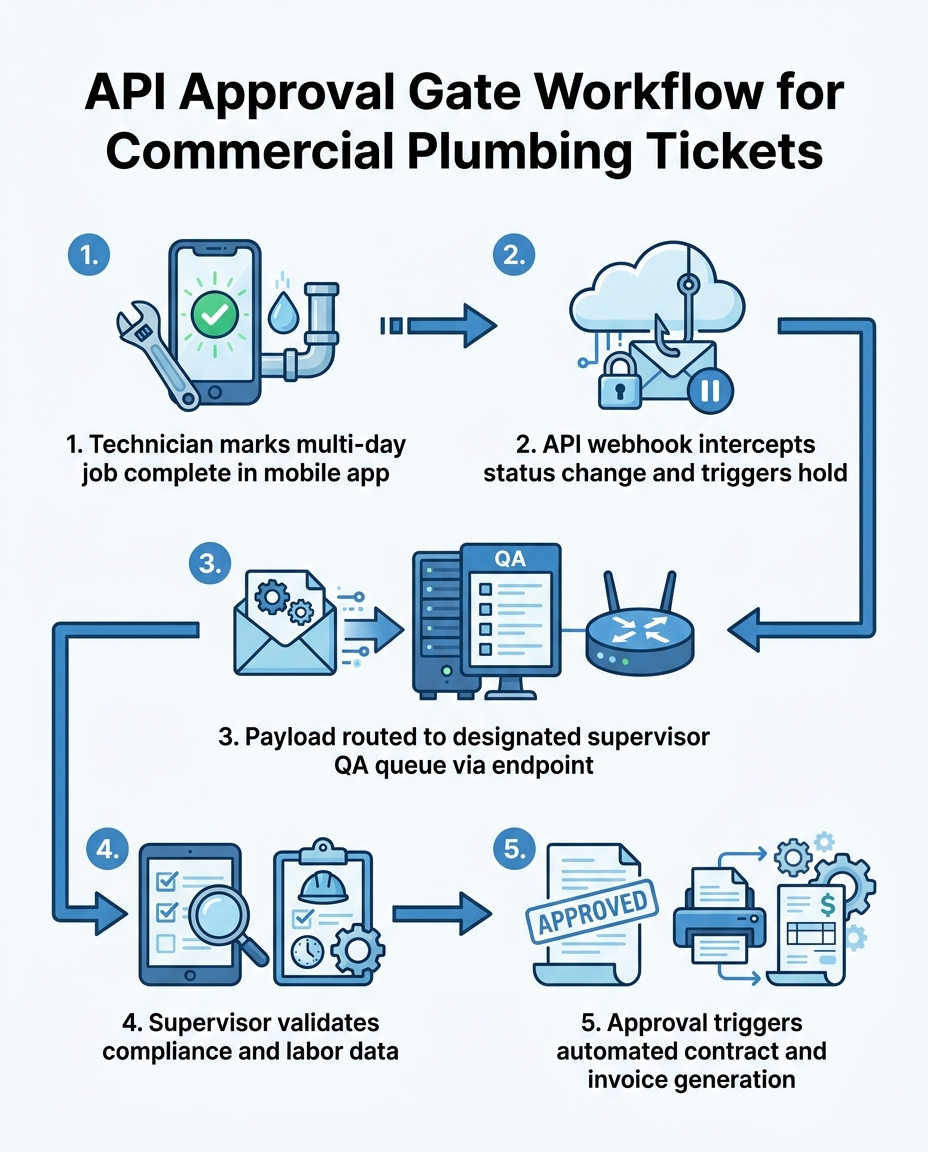
Here is how the mechanism physically prevents invoice generation until supervisor intervention is logged:
1. The Technician Trigger: The field worker attempts to mark the multi-day job as complete on their mobile device. They upload their notes and hit submit.
2. The Webhook Interception: Before the main database updates the job status to "Ready for Invoice," the Field Service Management API webhooks intercept the request. The system recognizes the commercial tag on the job.
3. Status Hold and Proposal Management: The API places the ticket in a holding state. During this phase, the system is actively managing the "contractor's desk" api proposals status, ensuring that all initial estimates, change orders, and final labor hours reconcile perfectly.
4. Supervisor Notification: The secured back-office queue receives a notification that a high-liability ticket is awaiting review. The invoice generation module remains locked.
5. Final Release: Only when the supervisor injects their unique approval token into the system does the webhook release the payload to the accounting software.
This automated interception is exactly why investing in professional business systems and software optimizations is so vital for commercial plumbing contractors who handle complex, multi-phase projects.
Architecting the Supervisor QA Endpoint Logic
Setting up an approval gate requires precise technical routing. When the webhook intercepts the completed ticket, it needs a specific destination. This is where exact endpoints like /api/projects/supervisors come into play. In a "contractor's desk" software environment, routing the payload to a dedicated supervisor endpoint ensures that high-liability tickets do not get mixed in with standard residential service calls.
A multi-day job requires incremental system approvals before it ever reaches that final QA queue. For example, a supervisor might need to approve the rough-in phase before the system allows the technician to log hours against the trim-out phase. The endpoint logic handles these systematic validations, ensuring that compliance documents—such as signed permits, safety logs, and before-and-after photos—are attached to the payload before the final approval token can be generated.
Isolating Commercial Workflows
Not every plumbing job needs a rigorous API approval gate. Isolating your commercial workflows ensures your office doesn't get bogged down reviewing simple residential repairs.
• Tagging at dispatch: Commercial jobs must be tagged with specific custom fields the moment the call is booked. This tag acts as the trigger for the Field Service Management API webhooks later in the job lifecycle.
• Preventing bypasses: Technicians often try to find workarounds when software slows them down. A well-architected endpoint logic prevents bypasses through alternative software modules, ensuring the only path to closure is through the supervisor's desk.

Preventing Bottlenecks During High-Volume Emergency Seasons
The Problem: When winter freeze emergencies strike, massive commercial pipe bursts can exponentially increase your ticket volume overnight. Suddenly, your dispatch board is flooded with high-liability, multi-day repair jobs across dozens of commercial facilities.
The Cause: Under this immense seasonal pressure, manual review processes instantly become bottlenecks. If supervisors have to manually hunt down technicians to verify parts used on a burst pipe repair, the invoicing cycle grinds to a halt. In the chaos, office staff might override manual UI permissions just to push invoices out the door, destroying your compliance standards in the process.
The Solution: A well-architected multi-day commercial ticket approval workflow scales automatically during emergencies. Because the API gate physically intercepts the tickets and organizes them into a clean, digital QA queue, supervisors can review and approve jobs systematically. The software maintains strict compliance and liability checks even when the dispatch team is completely overwhelmed, ensuring that the chaos of a winter freeze doesn't result in messy accounting months later.
Bridging API Approvals to Accurate Accounting
The ultimate goal of a technical API workflow is to produce accurate, organized back-office financials. An API approval gate directly ensures spot-on numbers for your accounting team by preventing incomplete or erroneous tickets from ever reaching the ledger.
During a busy summer season, one growing company needed help managing their ongoing business operations, specifically dispatching calls and accounting services. By partnering with a dedicated team that handled calls, dispatched effectively, and managed the accounting with strict organization, they received accurate numbers and helpful feedback that stabilized their growth. This level of accuracy is only possible when the data handoff from the field is flawless.
A strict multi-day commercial ticket approval workflow eliminates the need for post-invoicing corrections. You no longer have to issue credit memos because a technician forgot to log a massive commercial water heater on the initial invoice. Clean data handoffs improve overall back-office reachability and organization. Emphasizing the value of organized, accurate contractor accounting and bookkeeping backed by strict software enforcement is how commercial plumbing companies scale profitably.
Automating Post-Approval Contract and Proposal Workflows
Once the supervisor validates the labor, parts, and compliance documents in the QA queue, the job isn't just finished—it triggers a cascade of downstream automated actions. The automated transition from ticket approval to final invoicing and contract generation is where the real efficiency gains happen.
By utilizing "contractor's desk" api proposals send contract logic, the software can automatically generate the final billing documents and email them directly to the commercial property manager the second the supervisor clicks approve. This eliminates the lag time between job completion and invoice delivery, drastically improving cash flow.
These seamless transitions rely heavily on trade-specific software integrations. Out-of-the-box software rarely has the deep functionality required to manage commercial lien waivers, phased billing, and automated contract generation simultaneously. Contractor In Charge's deep expertise in trade-specific business systems, software integrations, and back-office optimizations ensures that this API workflow serves as a critical revenue protection strategy. Finding the best FSM software for plumbing companies is only the first step; configuring it to automate your post-approval workflows is what separates highly profitable operations from struggling ones.
Streamline Your Commercial Plumbing Software Ecosystem
Architecting a clear, systemic API workflow enforces supervisor approvals and protects your commercial plumbing business from catastrophic liability and revenue loss. By utilizing Field Service Management API webhooks, you create a physical barrier that prevents technicians from prematurely closing out complex jobs.
Securing multi-day commercial jobs requires much more than basic, out-of-the-box software settings. It demands an intentional software architecture that routes data to the right people at the right time. A clear, systemic explanation of how to architect an API workflow that enforces supervisor approvals on high-liability jobs before invoicing is the foundation of a scalable back office.
If your current software ecosystem allows technicians to bypass QA checks, it is time to tighten your operations. Explore professional back-office and software optimization solutions to build the approval gates your commercial plumbing business needs to thrive securely.
Frequently Asked Questions
How do I require supervisor approval before invoicing a commercial job?
You can require supervisor approval by configuring an API-enforced approval gate within your field service management software. This setup utilizes webhooks to intercept a job's status change when a technician tries to mark it complete. The system then routes the ticket to a dedicated supervisor queue, locking the invoice generation tool until a manager reviews and approves the labor and compliance data.
How do FSM API webhooks prevent premature ticket closure?
FSM API webhooks prevent premature closure by acting as an automated digital checkpoint between the mobile app and the main database. When a technician submits a completed ticket, the webhook catches the payload and places it in a holding state. It physically blocks the job status from updating to "closed" until specific, pre-programmed conditions—like a supervisor's digital signature—are met.
How does an API workflow manage multi-day commercial ticket approvals?
An API workflow manages multi-day approvals by requiring incremental system sign-offs at specific project milestones. Instead of waiting until the end of a massive job, the API can be programmed to require supervisor approval after the rough-in phase before the trim-out phase can begin. This ensures compliance and accurate labor tracking throughout the entire lifecycle of a complex commercial project.
What is an API webhook for job status?
An API webhook for job status is a piece of code that automatically triggers an action in one system when an event occurs in another. In plumbing software, when a field app changes a job status to "done," the webhook instantly notifies the back-office server to hold the ticket for review. It acts as a real-time communicator that enforces your company's operational rules without manual data entry.
How do you prevent technicians from closing incomplete tickets?
You prevent technicians from closing incomplete tickets by removing their manual UI permissions to finalize invoices and replacing them with structural API rules. By making certain fields mandatory—such as attached photos, signed permits, or specific custom tags—the software will reject any attempt to close the ticket if the required data is missing. This forces the technician to complete all steps before the system accepts the submission.
How does an API-enforced approval gate protect commercial plumbing liability?
An API-enforced approval gate protects liability by ensuring no commercial job is finalized without verified compliance documentation. It guarantees that lien waivers, safety logs, and accurate billing records are attached and reviewed by management before the client is billed. This systemic enforcement prevents messy accounting, reduces the risk of legal disputes, and ensures your company meets the strict requirements of high-end commercial contracts.