
How to Systematize Your Way to a Seven Figure Business


The Systems You Need to Scale a Service Business (Without the Chaos)
The systems you need to scale a service business are not complicated in theory, but most contractors never build them — and that gap is exactly what keeps a thriving trade business stuck at the same revenue ceiling year after year.
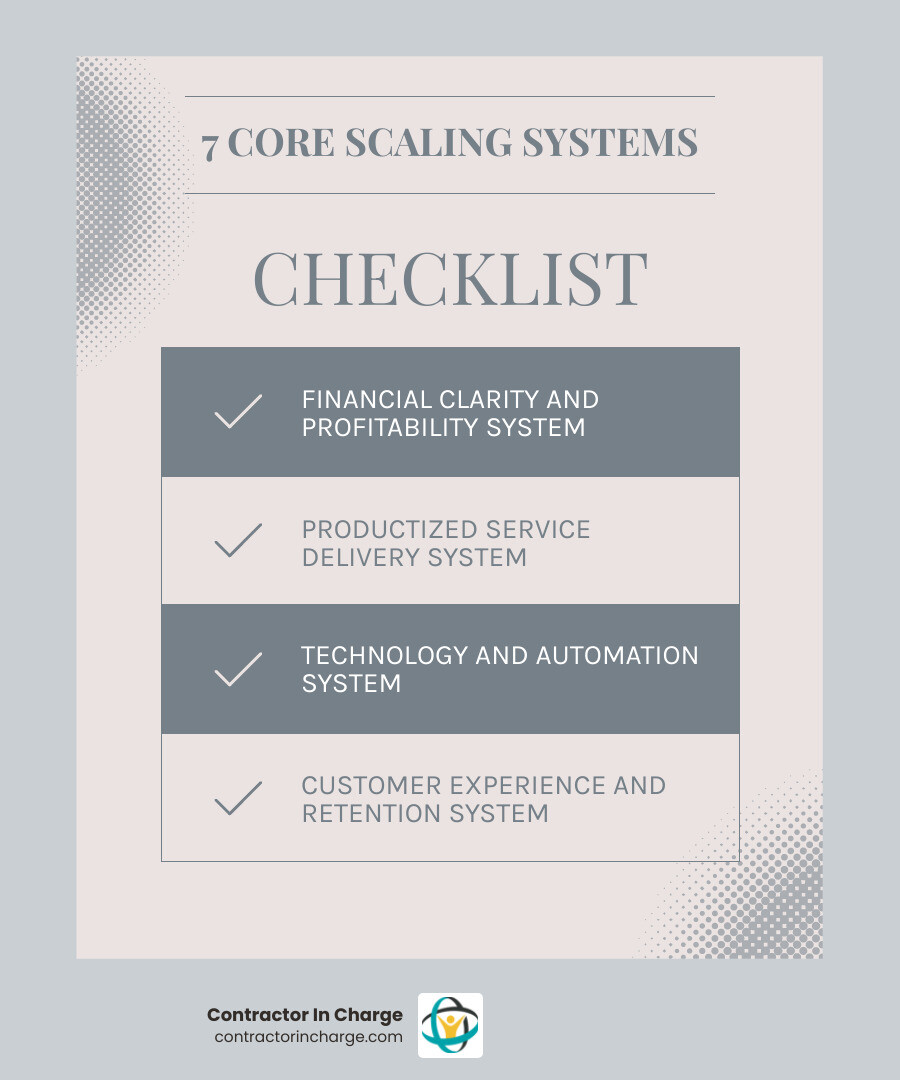
Here are the core systems every home service business needs before attempting to scale:
1. Financial clarity and profitability system — bookkeeping, cash flow tracking, and profit margin visibility
2. Productized service delivery system — standardized, repeatable workflows for consistent results
3. Technology and automation system — CRM, field service software, and automated invoicing
4. Customer experience and retention system — 24/7 availability, booking, and follow-up processes
5. Team building and management system — hiring frameworks, onboarding, and role clarity
6. Marketing and lead generation system — consistent, multi-channel lead flow
7. Operational documentation system — SOPs, playbooks, and checklists that run without you
If your business depends on you showing up every single day to keep things moving, you do not have a scalable business yet — you have a job. And you are not alone. According to McKinsey, 78% of startups never make it through a full scale-up. For home service businesses — plumbers, HVAC techs, electricians — the problem is rarely a lack of demand. It is a lack of structure. Customers want to book jobs, but missed calls, inconsistent service, and no clear process quietly drain revenue before you ever see the problem on paper.
The good news is that building the right systems does not mean rebuilding your entire business overnight. It means putting the right foundations in place — one at a time — so your operation can handle more volume without more chaos.
I'm Anna Lynn Wise, CEO of Contractor In Charge and a former owner and general manager of a plumbing, HVAC, and remodeling company, and I've spent decades helping trade business owners identify and install the exact systems you need to scale a service business without burning out or losing the quality that built their reputation in the first place. In the sections ahead, I'll walk you through each system in practical terms so you can start building yours today.
Scaling vs. Growing: Why Systems are the Secret Sauce
Many contractors use the terms "growing" and "scaling" interchangeably, but in home services, they mean very different things. Understanding the difference is the first step toward building a sustainable seven-figure business.
Growing means you are adding revenue, but you are also adding costs at the same rate. If you hire two more HVAC techs to handle more calls, but your overhead for dispatch, fuel, and management climbs just as fast as the new revenue, you’ve grown, but you haven't necessarily become more profitable. In fact, you might just be more stressed.
Scaling, on the other hand, is about increasing revenue without a proportional increase in costs. This happens when you build a sustainable infrastructure that allows your existing team to handle more volume efficiently. It’s the difference between hiring a new office person for every five techs (growing) and using an automated booking system and outsourced dispatch to support twenty techs with the same internal headcount (scaling).
• Revenue — Business Growth: Increases — Business Scaling: Increases rapidly
• Costs — Business Growth: Increase at the same rate — Business Scaling: Stay relatively flat or grow slowly
• Resource Utilization — Business Growth: Linear (1:1 ratio) — Business Scaling: Exponential (1:Many ratio)
• Owner Dependency — Business Growth: High (Owner works harder) — Business Scaling: Low (Systems do the work)
• Profit Margins — Business Growth: Often stay the same — Business Scaling: Expand over time
To scale, you must move away from "owner-dependency." If the business stops when you take a vacation, you haven't scaled. You need systems that handle market demand and resource utilization automatically. This "secret sauce" ensures that as you book jobs, your profit margins actually improve because your fixed costs are spread over a larger volume of work.
The 7 Core Systems You Need to Scale a Service Business
Scaling a service business is like building a house; you can't put up the roof until the foundation is poured. Many owners try to scale by pouring money into marketing (the roof) while their internal operations (the foundation) are still made of sand.
The goal of these seven systems is repeatability. You want every customer to have the same high-quality experience, whether you are on-site or not. By mapping workflows and assigning clear task ownership, you create a business that delivers quality control at scale.
Financial Clarity and Profitability Systems
You cannot scale what you do not measure. Financial clarity is the absolute first priority. Many contractors operate on "bank balance accounting"—if there’s money in the account, they think they’re doing fine. But scaling requires a deeper look at profit margins and cash flow.
We recommend maintaining a financial buffer of 3-6 months of operating expenses in reserve. This provides the stability needed to weather slow seasons or unexpected equipment repairs. Your financial system should include:
• Real-time Bookkeeping: Knowing exactly where every dollar goes.
• Revenue Forecasting: Predicting future income based on current lead flow.
• Operating Reserves: A "peace of mind" fund that allows you to make strategic decisions rather than desperate ones.
Productized Service Delivery Systems
To scale, you must stop treating every job like a unique snowflake. Productizing your services means turning custom work into standardized packages. Whether it’s a standard water heater installation or a seasonal HVAC tune-up, the workflow should be identical every time.
Standardized packages reduce variability and make it easier to train new technicians. When you have a "fulfillment engine" with repeatable workflows, you ensure service consistency. This quality assurance is what allows a brand to grow from one truck to twenty without the owner personally inspecting every job site.
Leveraging Technology as one of the Systems You Need to Scale a Service Business
In 2025, you cannot scale a pen-and-paper business. Technology is the primary lever for efficiency. A robust CRM (Customer Relationship Management) system integrated with field service software allows for:
• Automated Invoicing: Getting paid faster by sending invoices the moment a job is completed.
• Mobile Accessibility: Giving techs all the info they need on their tablets so they don't have to call the office.
• Data-Driven Decisions: Using reports to see which zip codes are most profitable or which techs have the highest upsell rates.
Cloud-based infrastructure ensures that your team stays connected, whether they are in Tampa, FL, or out in the field in Texas.
Scalable Customer Experience and Retention Systems
Research shows that 52% of customers will switch to a competitor after just one bad experience. As you scale, maintaining a "small business feel" with "big business reliability" is key. This requires 24/7 availability.
If a homeowner in Florida has a pipe burst at 2 AM, they aren't going to leave a voicemail; they are going to call the next person on Google. By using systems for lead capture and immediate booking, you ensure you never miss an opportunity. A scalable customer experience also includes feedback loops—automatically sending a survey after a job to catch issues before they become bad reviews.
Team Building and Management Systems
Your business is only as good as the people running your systems. Scaling requires a shift from "hiring for a pair of hands" to "hiring for a role." You need a hiring framework that prioritizes culture fit and an onboarding process that gets a new tech road-ready in days, not months.
Leadership multiplication is the goal here. You need to empower your team through delegation and clear accountability. When everyone knows their specific role and how their performance is measured, the business starts to run itself.
Automated Marketing and Lead Generation Systems
You can't scale if your phone isn't ringing. A scalable marketing system creates a "growth engine" that provides consistent leads through multiple channels. This might include:
• SEO and Local Search: Ensuring you show up when someone searches for "plumber near me."
• Direct Mail: Did you know 70% of homeowners look at their direct mail the day it arrives? It remains a powerhouse for local services.
• Lead Management: A system to track where every lead came from so you can stop wasting money on ads that don't convert.
Operational Documentation and SOP Systems
This is the "Playbook" for your business. Standard Operating Procedures (SOPs) are step-by-step instructions for every task in the company, from how to answer the phone to how to park the service truck.
Documentation creates business independence. When you have a knowledge base and training manuals, you are no longer the "walking encyclopedia" of the company. If you were hit by a bus tomorrow (the classic "bus test"), could someone else pick up your playbooks and keep the lights on? If the answer is no, this is the system you need to build next.
How to Implement Systems Without Breaking Operations
The biggest mistake owners make is trying to install all these systems you need to scale a service business at once. This leads to "system shock" and team burnout. Instead, we use a 90-day roadmap approach.
Start by identifying bottlenecks. Where is the "traffic jam" in your business? Is it that you have too many leads and can't book them fast enough? Or do you have plenty of techs but no one is answering the phones?
Customer journey mapping is a great way to start. Take a pack of sticky notes and map out every step from the moment a customer sees your ad to the moment they pay their bill. Every "gap" where information gets lost is where a system needs to be built.
Building a Feedback Loop with Key Performance Indicators
You need a "Scorecard" to tell you if your systems are working. Focus on leading indicators—metrics that predict future success—rather than just lagging indicators like total revenue.
• Response Time: How fast do you get back to a lead?
• Booking Rate: What percentage of callers actually schedule a job?
• Average Ticket Value: Are your techs offering the right solutions on-site?
Weekly reviews of these KPIs create data transparency. When the whole team sees the numbers, they take ownership of the results.
Maintaining Quality While Increasing Volume
As volume goes up, quality often goes down. To prevent this, use standardized diagnostics. Give your techs a digital checklist for every service call. This ensures that a tech in Texas is providing the same level of service excellence as a tech in Florida.
Monitor your system-to-admin ratio. Best-in-class service businesses can support a large number of field techs with a very lean office staff because their systems handle the heavy lifting of scheduling, dispatch, and billing.
Common Pitfalls to Avoid When Scaling Your Home Service Business
Scaling is exciting, but it’s full of landmines. Here are the most common ones we see:
1. Over-Automation: Don't lose the human touch. While AI is great for cutting costs (sometimes by 20-30%), 4 out of 5 customers still prefer speaking to a real human, especially during a home emergency.
2. Premature Scaling: Don't spend $10k a month on ads if your booking process is broken. You’ll just be "scaling your problems."
3. The Founder Bottleneck: If you insist on approving every single purchase or estimate, you are the ceiling. You must learn to trust your systems.
4. Neglecting Cash Flow: Growth is expensive. You need to ensure you have the cash to pay for new trucks and equipment before the revenue from those new jobs starts hitting your account.
Frequently Asked Questions about Systems You Need to Scale a Service Business
How do I know if my service business is ready to scale?
You are ready to scale when your revenue is consistent, but you are personally overwhelmed. If you have "lead surges" you can't handle, or if your employees are overworked despite having a full team, it’s a sign that your current manual processes have reached their limit. Profit stability is the green light; if you are consistently profitable, it’s time to build the systems that allow for volume.
Can I scale my business without hiring more office staff?
Yes! This is the core of true scaling. By using outsourced support for tasks like call answering, dispatch, and bookkeeping, you can handle double the volume without adding the fixed overhead of a larger office, benefits, and management. Leveraging technology and specialized partners allows you to maintain a high system-to-admin ratio.
What is the first system I should build?
Start with Financial Management. You cannot make informed decisions about hiring or marketing if you don't have absolute clarity on your profit margins and cash flow. Once you know exactly how much it costs to acquire a customer and fulfill a job, you can safely invest in the other systems.
Conclusion
Scaling a home service business from a "one-man show" or a small crew into a seven-figure operation is a journey of strategic growth. It requires moving from "hustle" to "structure." By implementing the systems you need to scale a service business, you aren't just making more money—you are building a business legacy that provides you with operational freedom.
At Contractor In Charge, we understand that your time is best spent leading your team and growing your vision, not stuck on the phone or buried in spreadsheets. We provide the scalable, dedicated team you need—combining modern technology with old-fashioned customer care—to handle your 24/7 call answering, booking, and bookkeeping.
Are you ready to stop being the bottleneck and start being the CEO? Start building your scalable systems today and see how much faster you can grow when the systems are doing the heavy lifting.