

AI Digital Lead Management vs. Traditional Phone Follow-Up for Cold HVAC Leads

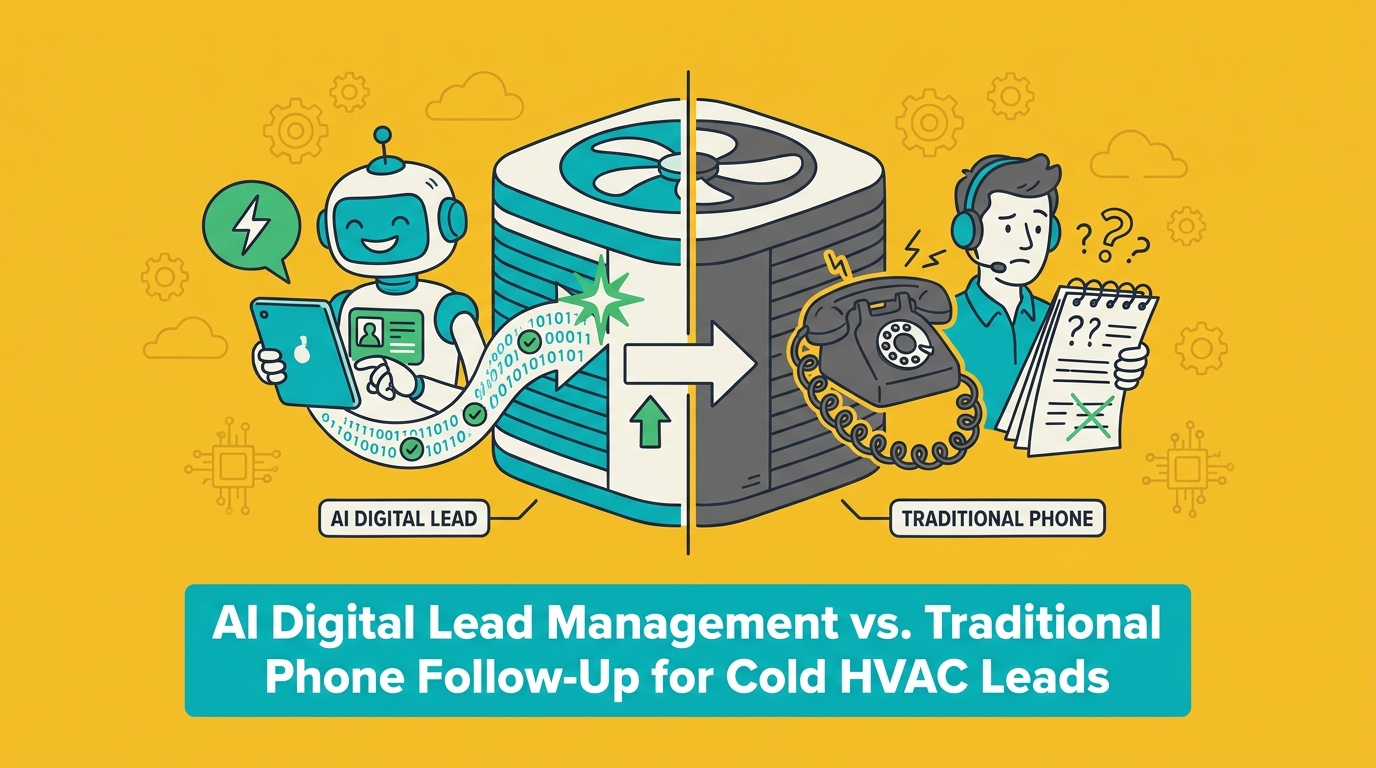
The Myth of the 'Dead' Quote: Why Your CRM is Hiding Unsold Revenue
A common misconception in the home services industry is that an unresponsive prospect is a dead lead. In our years of managing dispatch and CRM pipelines for home service companies, we have found this is rarely the case. In reality, when you compare AI lead management with traditional phone calls for cold HVAC leads, you quickly discover that your customer relationship management (CRM) software is likely hiding a massive amount of unsold revenue. Homeowners who request a quote for a major system replacement—such as upgrading a failing 10 SEER unit to a modern 18 SEER heat pump—often stall for reasons that have nothing to do with choosing a competitor. They get busy, they want to research their options, or they simply forget to call back.
For HVAC contractors, this creates a concrete problem: how to efficiently re-engage these aging, unresponsive quotes sitting dormant in the system without wasting valuable operational hours. The central decision point usually comes down to choosing between high-volume automated AI drip campaigns or deploying live human agents to dial these prospects directly. Both approaches have distinct advantages, but optimizing an leads to revenue strategies framework requires understanding exactly when and how to deploy them.
The true cost of inaction: When seasonal replacement quotes are left to age without a dedicated HVAC cold lead follow-up strategy, contractors leave significant high-ticket revenue on the table. By objectively analyzing the strengths of both automated software and human expertise, our team believes business owners can stop guessing and start converting the hidden opportunities already sitting in their database.
How AI Digital Drips Maintain Top-of-Mind Awareness
The primary advantage of automated digital lead management is its ability to execute consistent, high-volume outreach without requiring manual effort from your dispatchers or sales team. Our team at Contractor in Charge consistently sees that when a replacement quote goes unanswered, relying on human memory to follow up a week later often results in missed opportunities. AI-driven systems eliminate this human error entirely.
By leveraging OnePath AI CRM lead management, contractors can ensure immediate speed-to-lead and establish a relentless, yet polite, follow-up cadence. This technology utilizes omnichannel touchpoints—specifically SMS text messaging and automated emails—to keep your brand visible to prospects who simply aren't ready to make a purchasing decision today, perhaps waiting until the first deep freeze of late November to finalize their choice.
1. Immediate engagement: The moment a quote reaches a specific age in the CRM, the automated system triggers a personalized message checking in on the homeowner's decision process.
2. Consistent touchpoints: Rather than giving up after one or two manual phone calls—a common failure point in standard office procedures—the AI continues to nurture the lead over weeks or months.
3. Behavioral tracking: Advanced systems monitor when a prospect opens an email or clicks a link, signaling renewed interest and moving the lead back into an active status.
The Power of High-Volume Consistency
The sheer scale of automation is where a digital-first HVAC cold lead follow-up strategy shines. Automated systems never forget to follow up, never get distracted by a busy dispatch board, and never take a sick day. This scalability allows thousands of dormant leads to be nurtured simultaneously, keeping the pipeline warm and ensuring that when the homeowner is finally ready to move forward, your company is the first one they contact.
Why Software Struggles with Unstated HVAC Sales Objections
Despite the incredible efficiency of automated drips, relying exclusively on software has distinct limitations, particularly when dealing with complex, high-ticket HVAC replacements. We've observed countless campaigns where high-ticket sales frequently stall due to unstated objections that an automated script simply cannot parse or resolve.
The Problem: A homeowner receives a comprehensive quote for a new heat pump system. They do not reply to the follow-up text messages. The AI system assumes they are no longer interested and eventually pauses the campaign.
The Cause: The homeowner is actually highly interested, but they are waiting on approval from a spouse, or they harbor generic hesitations regarding the financing options presented for transitioning from a traditional gas furnace to a dual-fuel heat pump system. They might also be confused about how generally applicable federal tax credits may apply to qualifying heat pump installations. They are embarrassed or overwhelmed, so they choose silence over engagement. Automated bots cannot read between the lines of this silence. In fact, understanding when bots help and when they hurt conversion is critical; pushing a hesitant buyer into a generic, aggressive automated funnel can sometimes alienate them entirely.
The Solution: Recognizing that while AI is exceptional at identifying engagement and maintaining top-of-mind awareness, it cannot negotiate. It cannot empathize with a homeowner's financial anxieties or explain the nuances of a specific installation process. For these nuanced hurdles, a different component of your HVAC cold lead follow-up strategy must be activated to bridge the gap between interest and closed revenue.
Breaking Through the Silence: The Value of Live Agent Dialing
When automated touchpoints fail to generate a response, traditional phone follow-up by dedicated inside sales representatives becomes the most effective tool for uncovering the real reasons a lead has stalled. A live human voice possesses the unique capability to navigate complex objections, build trust, and reassure hesitant homeowners in real-time.
Dedicated inside sales agents are trained to ask probing, open-ended questions that uncover the true bottleneck holding up the sale. Whether the customer is confused about efficiency ratings, unsure about the installation timeline, or hesitant about the monthly payments, a live agent can pivot the conversation, provide immediate clarity, and guide the prospect toward a confident decision.
Consider a real operational scenario our inside sales team frequently steps into: during the chaotic first heatwave of early July, an HVAC and plumbing company unexpectedly lost its primary dispatcher and call taker. The company leader was suddenly overwhelmed, unable to handle the influx of inbound emergency calls, let alone execute outbound sales dials to follow up on open quotes. By transitioning their full-time dispatch and call-taking operations to a dedicated external team, they not only stabilized their daily operations but established a lifelong partnership that allowed the company to grow and run better than ever before. This highlights a critical truth about outbound dialing: it requires dedicated focus.
Overcoming the Dispatcher Bottleneck
• Operational strain: In-house staff, such as dispatchers and customer service representatives (CSRs), are often too overwhelmed with daily inbound operations to execute consistent outbound dials.
• Divided attention: When a dispatcher attempts to make sales calls between routing technicians, the quality of the conversation suffers.
• Dedicated focus: Utilizing specialized agents ensures outbound follow-ups happen consistently without disrupting your critical inbound customer service workflow. Human empathy remains the deciding factor in closing a dormant high-ticket quote, making dedicated live agents an indispensable part of a complete HVAC cold lead follow-up strategy.
Head-to-Head: AI Automation vs. Traditional Phone Follow-Up
To build the most effective pipeline, our team recommends that business owners understand exactly where each methodology excels. Neither approach is inherently superior; rather, their effectiveness depends entirely on the specific stage and status of the dormant lead.
The table below provides a direct, objective comparison mapping volume capacity, objection handling capabilities, and the best use cases for both automated and traditional follow-up methods.
• Volume Capacity — AI Digital Lead Management: Virtually infinite scale; can nurture thousands of leads simultaneously without fatigue. — Traditional Live Agent Follow-Up: Limited by human hours; highly targeted and requires strategic prioritization.
• Objection Handling — AI Digital Lead Management: Manages basic FAQs and scheduling; struggles with nuanced or unstated hesitations. — Traditional Live Agent Follow-Up: Excels at navigating complex financial, technical, and emotional hurdles.
• Speed to Lead — AI Digital Lead Management: Instantaneous response times; triggers immediately based on CRM rules. — Traditional Live Agent Follow-Up: Dependent on agent availability and current call volume queues.
• Primary Cost Factor — AI Digital Lead Management: Software subscription and setup; highly cost-effective at scale. — Traditional Live Agent Follow-Up: Labor and dedicated training hours; higher cost per touchpoint.
• Best Used For — AI Digital Lead Management: Top-of-mind nurturing of cold lists, filtering out uninterested prospects, and broad outreach. — Traditional Live Agent Follow-Up: Closing high-value, aging replacement quotes and reviving highly qualified but stalled leads.
By objectively mapping these capabilities, it becomes clear that a robust HVAC cold lead follow-up strategy should not force a choice between the two, but rather leverage the strengths of both.


Shifting Gears When Emergency Calls Drop Off
The true test of any lead management system occurs when the weather changes. During peak summer heat or freezing winter nights, inbound emergency calls keep the dispatch board full and revenue flowing. However, the operational reality shifts dramatically during the post-summer shoulder season. When extreme weather subsides and emergency no-cool calls plummet—often during the mild 65-degree weeks of mid-October—inbound volume decreases significantly.
During these mild weather periods, reviving dormant replacement quotes becomes the primary cash flow driver for an HVAC business. We strongly advise our partners that relying solely on inbound marketing when the phone stops ringing is a recipe for seasonal revenue dips. This is precisely when a pre-established HVAC cold lead follow-up strategy proves its worth.
The operational shift: Contractors must transition from an inbound-reactive stance (simply answering the phone and running emergency calls) to an outbound-proactive stance (mining the CRM for unsold quotes and re-engaging them). If your business waits until the post-summer shoulder season to figure out how to follow up with cold leads, you are already weeks behind. Having the systems—both software and human—already in place ensures a smooth transition that keeps technicians busy and revenue stable regardless of the outdoor temperature.
Building a Hybrid Pipeline: Combining Software and Human Expertise
The most successful home service businesses do not force themselves to choose between software or human agents. Instead, they advocate for a hybrid synergy that maximizes the efficiency of AI while preserving the empathy and closing power of live humans. As an unbiased partner offering both advanced AI CRM solutions and dedicated inside sales professionals, our team at Contractor in Charge provides contractors with the ability to deploy a customized, objective approach rather than being forced into a single methodology.
A highly effective HVAC cold lead follow-up strategy utilizes a seamless workflow where technology and human expertise support one another. Here is how a hybrid pipeline is structured:
Step 1: Automate the Outreach
1. Deploy AI drips: Utilize automated SMS and email campaigns to filter the massive list of dormant quotes in your CRM. This handles the heavy lifting of broad outreach without taxing your staff.
2. Identify engagement: Allow the software to identify leads showing renewed interest based on behavioral triggers, such as email opens, link clicks, or brief text replies.
3. Filter the list: The AI separates the truly dead leads from the warm prospects, ensuring your human agents only spend time on high-probability targets.
Step 2: Deploy the Closer
1. Assign live agents: Once a lead is warmed up by the AI, a dedicated 24/7 live agent call center or inside sales rep takes over the communication.
2. Address specific objections: The live agent calls the prospect to uncover any unstated hesitations, explain financing options, and provide the reassurance needed for a major home investment.
3. Finalize the sale: The human touch closes the high-ticket quote, seamlessly bridging the gap between automated marketing and finalized revenue.
This customized, hybrid approach ensures that no lead falls through the cracks, yielding the highest possible conversion rates for aging leads while protecting your team's daily operational bandwidth.
Frequently Asked Questions About Re-Engaging Dormant Quotes
How do you re-engage cold HVAC leads?
The most effective way to re-engage cold HVAC leads is by using a multi-channel approach that combines automated text and email follow-ups with targeted phone calls. Start by sending a polite, non-pushy automated message asking if they are still considering their project. If they engage with the digital content, follow up promptly with a live phone call to answer specific questions. Consistency and timing are key to staying top-of-mind without being overwhelming.
Is AI or phone follow-up better for aging HVAC quotes?
Neither is universally better; they serve different purposes within a complete strategy. AI is superior for high-volume, long-term nurturing to keep your brand visible to hundreds of aging quotes simultaneously. Phone follow-up is better for navigating complex objections and closing high-ticket replacement deals once a lead shows renewed interest. The best results come from using AI to filter the list and phone calls to close the sale.
How many times should you follow up with an unsold quote?
Industry data, backed by our own call center metrics, suggests that high-ticket sales often require five to twelve touchpoints before a decision is made, yet many contractors stop after just two attempts. You should continue to follow up until the homeowner explicitly declines the service, purchases from a competitor, or asks to be removed from your list. Utilizing automated drip campaigns makes this long-term persistence manageable without burning out your office staff.
What is the best follow-up strategy for dormant CRM leads?
The best strategy for dormant CRM leads is a hybrid pipeline that leverages technology for scale and humans for empathy. First, segment your dormant leads by the age and type of the quote. Next, deploy an automated SMS and email campaign to gauge current interest levels. Finally, assign dedicated inside sales agents to call the prospects who interact with the automated messages, focusing on overcoming unstated objections.
Can automated drip campaigns handle financing objections effectively?
Automated drip campaigns can introduce the availability of financing and provide links to generic information, but they struggle to handle specific financing objections effectively. Homeowners often have nuanced anxieties about credit checks, monthly payments, or spouse approval that require human empathy and negotiation. A live agent is much better equipped to reassure the customer and guide them through the financial realities of a major HVAC purchase.
Stop Leaving Unsold Quotes on the Table
An effective HVAC cold lead follow-up strategy requires both the infinite scale of modern automation and the nuanced empathy of live human agents. We see first-hand every day that unsold quotes sitting dormant in your CRM represent significant hidden revenue that has already been paid for through your initial marketing efforts. By adopting a clear, objective framework that maps the right tool to the right stage of the customer journey, you can maximize your lead conversion rates and stabilize cash flow during slower seasons.
You do not have to choose between software and human expertise. If you are ready to stop leaving unsold quotes on the table and want to explore a customized, hybrid approach, reaching out to an unbiased partner can provide the clarity you need. Deploying a balanced strategy ensures you have the right systems in place to capture every available opportunity in your market.