

Scaling Your Team Without Breaking the Bank

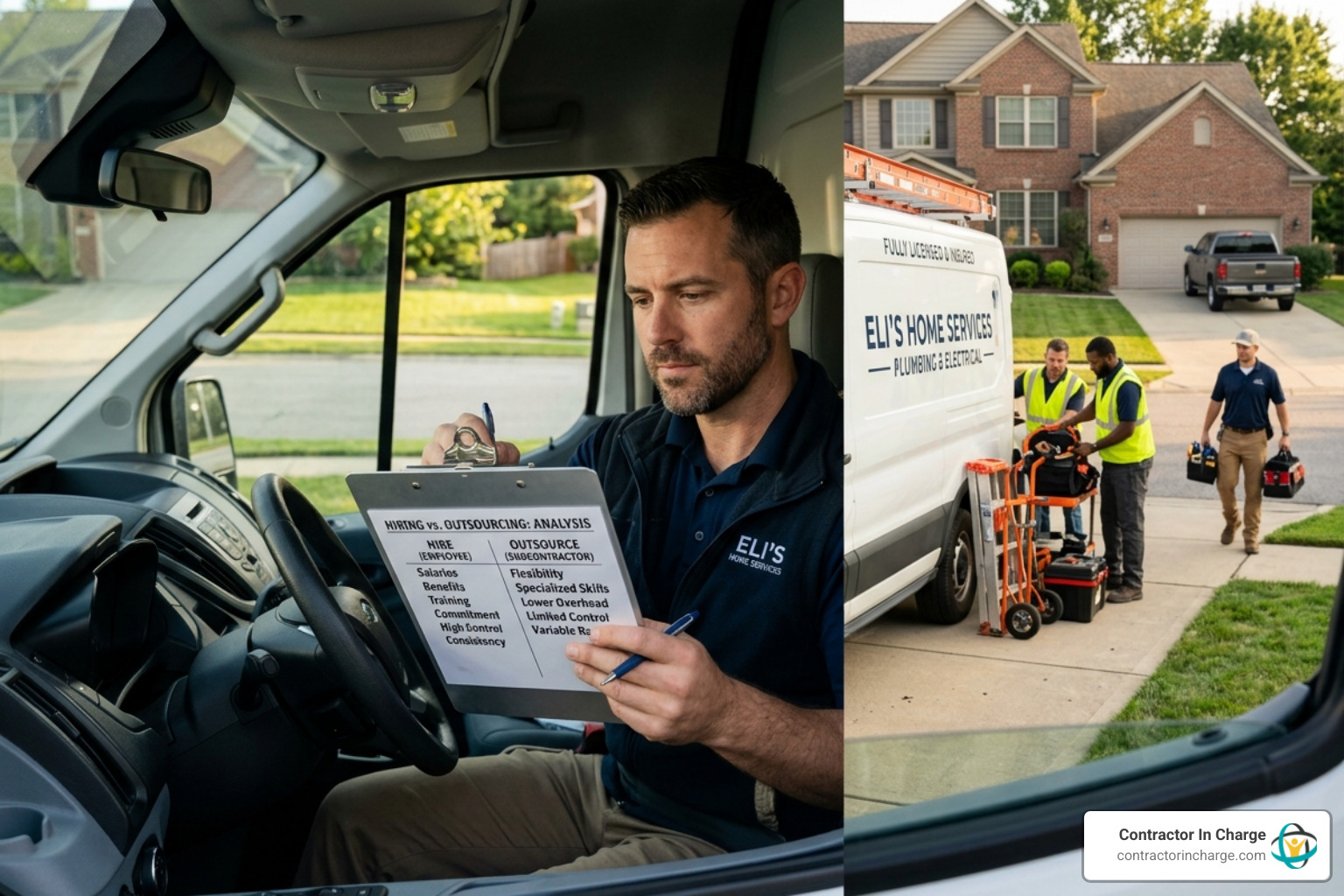
Understanding When to Hire vs Outsource as a Growing Contractor
When you are in the thick of a growth spurt, every decision feels urgent. You might feel like you need a clone of yourself to handle the phones while you are out quoting a major repipe or HVAC install. However, the secret to sustainable growth isn't just adding "more people"; it’s about strategic delegation.
In the home services industry, we generally split business functions into two categories: core and non-core. Core functions are what your customers pay you for—the plumbing, the electrical work, and the specialized technical expertise. Non-core tasks are the necessary "evils" that keep the lights on, such as bookkeeping, answering the phones, and scheduling.
Outsourcing Lets You Focus on What You Do Best by taking those non-core distractions off your plate. When you outsource, you aren't just "getting rid of work"; you are buying back your time to focus on high-level strategy and technical quality.
Comparison: Full-Time Hiring vs. Contracting vs. Outsourcing
• Control — Full-Time Hiring: High (Direct supervision) — Individual Contracting: Medium (Project-based) — Outsourcing (Managed Service): High (Outcome-based/SLAs)
• Commitment — Full-Time Hiring: Long-term (Salary/Benefits) — Individual Contracting: Short-term (Project-specific) — Outsourcing (Managed Service): Flexible (Scalable packages)
• Cost Type — Full-Time Hiring: Fixed (High overhead) — Individual Contracting: Variable (Hourly/Project) — Outsourcing (Managed Service): Predictable (Subscription/Retainer)
• Speed to Hire — Full-Time Hiring: Slow (4-12 weeks) — Individual Contracting: Medium (1-2 weeks) — Outsourcing (Managed Service): Fast (Days to 2 weeks)
• Best For — Full-Time Hiring: Core field technicians — Individual Contracting: One-off specialized projects — Outsourcing (Managed Service): Back-office, dispatch, and phones
Key Differences for Home Service Firms
For a contractor in Florida or Texas, the decision often comes down to control and flexibility. A full-time employee is someone you invest in deeply. You provide the truck, the tools, and the training. This level of control is vital for your lead technicians. You want them to represent your brand perfectly at the kitchen table.
On the flip side, Administrative Services often require a different kind of flexibility. If you hire a full-time in-house receptionist, you are responsible for their payroll taxes, benefits, and management even during the slow months. Outsourcing these roles allows you to scale up or down without the emotional and financial "weight" of a permanent hire.
Evaluating Workload Predictability and Seasonality
If you run an HVAC business in Tampa, you know that when the first heatwave hits, your phone doesn't just ring—it explodes. If you have an in-house team, they might get overwhelmed, leading to missed calls and lost jobs. 80% of callers hang up if they reach a voicemail. That is a lot of "lost profit" just because your team was too busy to pick up.
Using Ongoing Support Contract Contractors or a managed service allows you to handle these seasonal surges. You can have a "bench" of support ready to catch those calls during the peak summer or winter months without having to pay for that same level of staffing during the mild spring and fall.
When Full-Time Hiring is the Best Option for Core Roles

There are some things you simply cannot—and should not—outsource. Your "A-Team" in the field is your greatest asset. These are the people who build your institutional knowledge. They know how you like your pipes soldered or how you want a furnace installed.
Building Your In-House Foundation
Your first few hires should almost always be field-focused. You need technicians who can produce revenue. Once you have a solid crew, you might consider a project manager to oversee larger jobs. These roles require a deep understanding of your company culture and a long-term commitment to your vision.
To ensure these hires are successful, we often recommend Business Process Consulting for Contractors. This helps you build the internal structures that make an in-house team efficient. Without good processes, even the best technician will struggle to stay productive.
When to Hire vs Outsource as a Growing Contractor for Technical Skills
When it comes to specialized certifications and safety compliance, in-house is usually the winner. You want to have direct oversight of safety protocols on a job site. If a role requires specific state-level licensing in Texas or Florida and involves high-risk manual labor, having that person as an employee provides better quality control and legal protection.
Who Offers Business Process Consulting for Contractors to Improve Efficiency can help you determine the exact point where a technical role becomes profitable enough to bring in-house full-time versus using a specialized sub-contractor for rare, niche tasks.
Strategic Outsourcing for Back-Office Efficiency

While your technicians are the heart of the business, the back office is the nervous system. If the nervous system fails, the heart stops. Repetitive tasks like data entry, basic billing, and initial customer inquiries are often "productivity killers" for a growing owner.
Offloading Admin, Bookkeeping, and Marketing
Many contractors try to do their own books at 9:00 PM after a long day in the field. This is a recipe for burnout and expensive errors. Outsourced Accountants Can Help You Find the Profit in Your Company by providing professional-grade financial tracking that a DIY approach simply can't match.
Similarly, Back Office Solutions allow you to automate the "boring" stuff. By Outsourcing Scalable Back Office functions, you ensure that every lead is qualified and every appointment is scheduled without you ever having to touch a keyboard. Back Office Automation can further streamline these processes, ensuring that your field software and your accounting software are always in sync.
When to Hire vs Outsource as a Growing Contractor for Dispatch and Booking
Dispatching is a high-stress role. It requires 24/7 availability and a calm demeanor. If you hire one person in-house, what happens when they get sick? What happens after 5:00 PM?
This is where Modular Support Packages for Trades shine. By outsourcing your dispatch and booking, you get a team of professionals who are always "on." They don't take sick days, and they don't get overwhelmed by a sudden influx of calls. They are there to ensure you book jobs while you are busy working or even sleeping.
Implementing a Hybrid Model for Sustainable Scaling
The most successful contractors we work with don't choose just one path. They use a hybrid model. They keep their "Core Four" technicians in-house and outsource everything else. This provides the best of both worlds: the quality of dedicated employees and the efficiency of a professional support firm.
Transitioning from Outsourcing to Full-Time Hires
As you grow, you might reach a revenue threshold where it makes sense to bring an outsourced role in-house. For example, once you are running ten trucks, you might need a full-time, in-house Operations Manager.
However, you should only make this transition when the role is "validated." Use outsourcing to test the need for a position. If an outsourced service is handling 40 hours of work a week and you find yourself needing even more direct, minute-to-minute control, that is your signal to hire.
A Contractor Service Retainer Model is a great way to bridge this gap. It gives you a consistent level of support while you decide if and when to make that next big permanent hire.
A Decision Framework for Ongoing Growth
When deciding when to hire vs outsource as a growing contractor, ask yourself these four questions:
1. Is this a core revenue-generating activity? (If yes, hire.)
2. Is the workload predictable or seasonal? (If seasonal, outsource.)
3. Does this role require specialized, expensive equipment or software? (If yes, outsource to a firm that already owns it.)
4. How fast do I need this solved? (If you need it solved yesterday, outsource. Hiring takes months.)
Frequently Asked Questions about Contractor Scaling
How do I know if my team is overwhelmed?
The biggest signs are slipping deadlines, missed calls, and a spike in negative reviews. If your technicians are spending more time on paperwork than on tools, or if you are finding "unreturned voicemails" from three days ago, your team is hitting a wall.
What are the hidden risks of outsourcing?
The main risks are quality control and cultural fit. This is why we recommend choosing a partner that specializes in your industry. A general virtual assistant doesn't know the difference between a heat pump and a furnace. A dedicated contractor support firm does. Always ensure your partner uses the same software you do (like ServiceTitan or Housecall Pro) to keep data secure and accurate.
Can outsourcing help with seasonal call surges?
Absolutely. This is one of the primary reasons contractors use our services. We can scale our response team to match your call volume. You don't have to worry about hiring "temp" workers who don't know your business; you have a professional team ready to catch every lead during the busiest weeks of the year.
Conclusion
Scaling your business doesn't have to be a choice between "doing it all" and "spending it all." By understanding when to hire vs outsource as a growing contractor, you can build a lean, mean, profit-making machine. Keep your experts in the field, and let a professional back-office partner handle the rest.
Strategic delegation is the only way to move from being a "worker" to being a "business owner." When you stop answering every single phone call, you finally have the time to focus on the big picture—booking more jobs and providing exceptional service to your community.
At Contractor In Charge, we live and breathe the home services industry. We know the challenges you face in Florida and Texas because we’ve been there. Our goal is to help you grow sustainably, ensuring your back office is as solid as your field work.
Explore our comprehensive support services today and let's get your growth strategy on the right track.