

How to Maximize Contractor Appointments During Weather-Driven Call Spikes


The Breaking Point: When Sudden Demand Overwhelms Your Dispatch Board
When a sudden 20-degree overnight freeze hits and panicked homeowners flood your lines looking for home maintenance tips and troubleshooting or emergency repairs, your dispatch board is instantly pushed to the breaking point. At Contractor In Charge, our dispatch teams have seen firsthand how the first major mid-January deep freeze or summer heatwave completely changes call volume dynamics. A steady stream of predictable maintenance visits transforms into an overwhelming surge of urgent, high-stress service requests. For growing businesses, this sudden influx often exposes critical vulnerabilities in how inbound communications are handled.
In-house staff, who normally manage a balanced workload of dispatching, customer service, and administrative tasks, quickly become overwhelmed by sudden weather-driven call spikes. The immediate result is long hold times, frustrated customers, and a skyrocketing abandoned call rate. When a homeowner with a burst pipe or a failed AC unit is forced to wait on hold, their patience evaporates. They hang up and dial the next company on their search results.
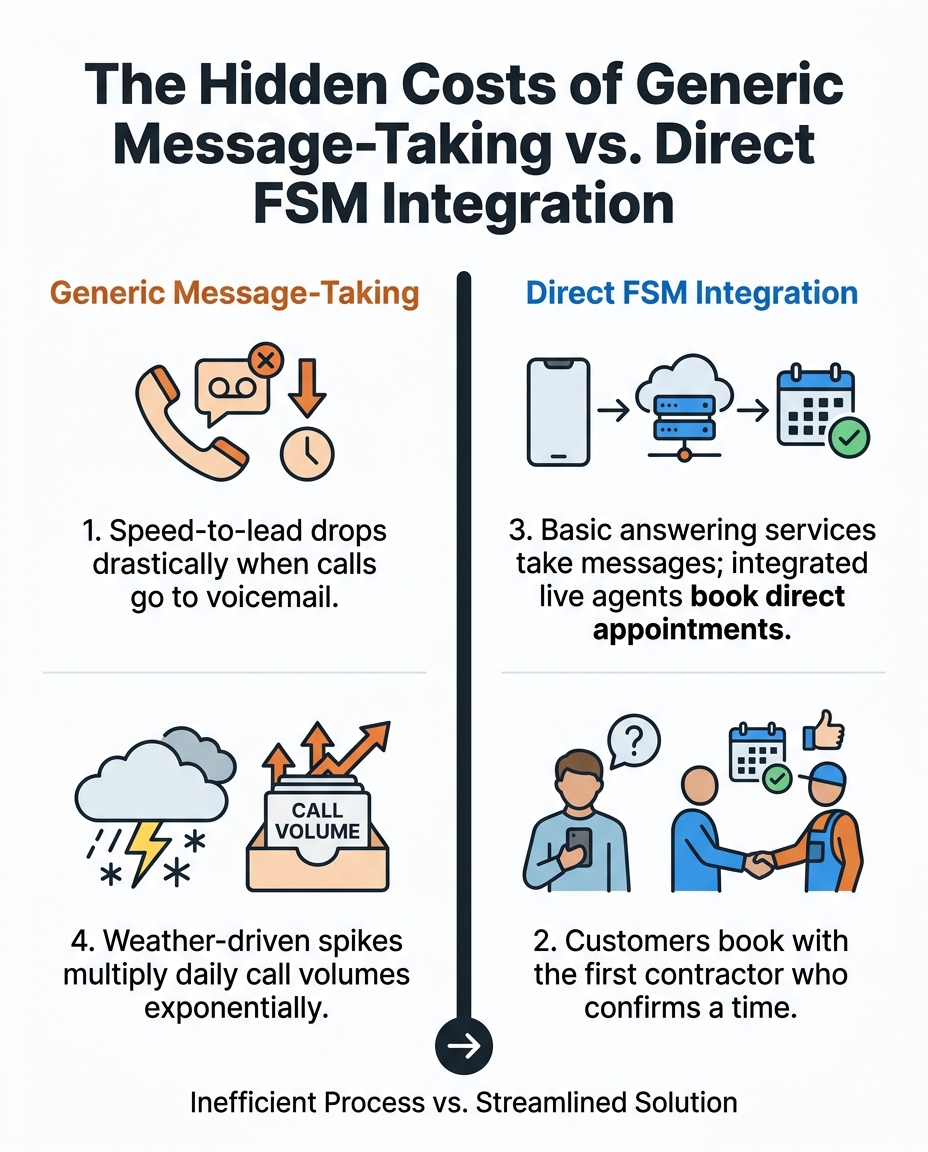
When emergency calls go to voicemail, speed-to-lead drops drastically. The modern consumer expects immediate answers, and in the home service industry, the business that answers the phone first almost always wins the job. Every abandoned call represents massive lost emergency revenue and potential lifetime customer value.
To capture this revenue and protect your brand's reputation in the local market, home service businesses must rethink how they handle inbound demand. Relying solely on office staff during extreme weather events is no longer viable. Contractors need to transition toward dedicated inside sales and robust call center support that can scale instantly when the weather turns.
Why Generic Message-Taking Costs You Emergency Leads
The problem: Customers facing a plumbing or HVAC emergency are significantly more likely to book with the first contractor who actually answers the phone and confirms a time. When a homeowner is standing in a puddle of water from a failed 50-gallon traditional tank water heater, they are not shopping around for quotes—they are shopping for immediate availability. If they reach a service that cannot give them a definitive appointment window, they will keep calling down the list.
The cause: Many contractors attempt to solve after-hours or overflow call volume by hiring basic answering services. These services merely take messages, collect a name and phone number, and promise that a technician will call them back. They leave the actual scheduling work, troubleshooting, and dispatching for your in-house team to sort out the next morning. In our team's experience, this creates a massive administrative bottleneck and fundamentally misunderstands the psychology of an emergency customer.
The solution: This delay allows high-value emergency leads to slip through the cracks, resulting in devastating lost revenue. To secure these jobs, contractors must upgrade to professional virtual customer service teams that actively troubleshoot the caller's issue and secure the appointment on the spot, rather than just passing along a digital sticky note.
• Primary Function — Generic Answering Service: Takes a message and forwards an email/text. — Industry-Trained Virtual CSR: Troubleshoots, qualifies, and books the appointment.
• Industry Knowledge — Generic Answering Service: None. Reads from a generic script. — Industry-Trained Virtual CSR: Trained specifically in HVAC, plumbing, and electrical.
• FSM Access — Generic Answering Service: Cannot access your dispatch board. — Industry-Trained Virtual CSR: Integrates directly into your scheduling software.
• Speed-to-Lead — Generic Answering Service: Delayed. Requires an outbound callback from your team. — Industry-Trained Virtual CSR: Immediate. Customer leaves the call with a confirmed time.

The Power of Direct FSM Integration for Plumbing and HVAC
True appointment maximization happens when your call handling team can book directly onto your dispatch board in real time. The days of logging into a separate portal to copy and paste customer information from an answering service email into your CRM are over. Direct integration ensures that the moment a call concludes, the job is fully built, assigned, and visible to your field technicians.
This operational efficiency requires agents who are trained specifically in the trades and understand how to navigate complex Field Service Management (FSM) software. Generic call center agents often struggle with the nuances of trade dispatching—they don't know the difference between a routine tune-up on a 16 SEER AC unit and a catastrophic R-410A compressor failure, and they don't know how to allocate the appropriate time blocks for different job types.
Working with a team that holds credentials like ServiceTitan Certified — Accounting ensures they understand the deep operational workflows of your business, not just basic data entry. They understand how tags, business units, and marketing campaigns tie together, ensuring your reporting remains accurate even during the chaos of a call spike. Active dispatching allows calls to be moved around efficiently, maximizing technician routes and keeping drive times to a minimum.
Our onboarding specialists recently helped a plumbing and HVAC contractor during a brutal mid-July heatwave because they desperately needed efficient handling of incoming calls and daily job dispatching. Their board was a mess of overlapping appointments and inefficient routing. By taking over their ongoing dispatch and scheduling management, our team managed incoming calls, dispatched technicians, and rearranged appointments dynamically. This seamlessly coordinated their schedules and optimized daily field operations, ensuring no technician was sent across town unnecessarily while a closer job sat waiting.
Bypassing the Middleman in Scheduling
Integrating your call handling directly with platforms like ServiceTitan or Housecall Pro transforms your workflow. Here is what happens when you remove the middleman:
• Eliminates double data entry: Customer details, equipment history, and job notes are entered once, directly into the system of record.
• Accurate job notes immediately: Technicians receive detailed, trade-specific notes on their mobile devices before they even start their trucks.
• Prevents double-booking: Availability is updated in real-time, meaning your internal office staff and your overflow team are always looking at the exact same capacity.
Managing After-Hours Emergencies Without Burning Out Staff
Plumbing emergencies like burst pipes and HVAC failures do not stick to a convenient 9-to-5 schedule. In fact, extreme weather events often cause equipment to fail in the middle of the night. Winter deep freezes routinely cause after-hours bursts in uninsulated 1/2-inch copper supply lines, requiring immediate, reliable dispatching to prevent catastrophic water damage to a customer's home.
Forcing your in-house dispatchers to remain on-call 24/7 leads to rapid burnout, sheer exhaustion, and high turnover. When your core team is awake at 2 a.m. managing a flooded basement call, they are not operating at their best the next morning when the regular daily schedule kicks off. This cycle of fatigue degrades the quality of customer service across the board and creates a toxic work environment for your office staff.
Implementing 24/7 live agent call center services ensures every late-night caller speaks to a knowledgeable human who can dispatch an on-call technician immediately. Reliable after-hours coverage protects your brand reputation, showing your community that you are truly there when they need you most. It also allows you to capture premium emergency revenue without sacrificing the health and sanity of your internal team.
For example, one plumbing business came to our team last winter because they desperately needed reliable management for after-hours incoming customer calls. Their owners were taking turns holding the emergency phone, destroying their personal lives. We handled their after-hours call center coverage and provided excellent customer service, successfully managing inquiries outside of normal business hours so their leadership could finally get some sleep while the business continued to generate revenue.
Overcoming Sudden Staffing Shortages on the Dispatch Board
The problem: Growing contractors often face an operational crisis when a primary dispatcher or lead call taker suddenly leaves the company, gets sick, or takes unexpected leave right as the busy season peaks. The dispatch board is the nerve center of a home service business, and losing the person who manages it creates immediate chaos.
The cause: Many home service businesses operate with single points of failure in their front office. When one person holds all the institutional knowledge about routing preferences, technician skill sets, and scheduling quirks, their absence paralyzes the operation. Without backup, the remaining team is overwhelmed, hold times explode, and valuable contractor appointments fall through the cracks.
The solution: Partnering with a dedicated trade call center allows you to seamlessly transition to full-time coverage without missing a beat. This operational resilience is vital for scaling businesses. Last winter, during the peak mid-December heating season, a growing company faced a sudden staff shortage without a dispatcher or call taker right as the cold weather hit. They transitioned from overflow support to full-time call handling with us. We took over full-time customer service representative and dispatch operations, which allowed the business to continue growing and running smoothly while they took their time hiring the right internal replacement.
Proactive Outbound Scheduling During Shoulder Seasons
While sudden weather-driven call spikes drive massive volumes of emergency inbound calls, the home service industry is cyclical. The mild shoulder seasons—typically late March through April and October through November—require a completely different approach to keep the dispatch board full and revenue flowing. You cannot rely on extreme weather to drive your business year-round.
Utilizing your call center team for proactive outbound scheduling ensures steady revenue when the weather is mild. Instead of waiting for the phone to ring, a trained outbound team can actively generate appointments from your existing customer database. This keeps your technicians busy, prevents seasonal layoffs, and smooths out your cash flow.
Following up on unsold estimates, routine maintenance agreements, and aging equipment checks turns passive, forgotten leads into active revenue. We strongly recommend adopting a contractor service retainer model for call handling, which ensures you have the flexible support needed for both extremes: the scalable inbound capacity for the deep freezes, and the proactive outbound drive for the mild shoulder seasons.
Key outbound campaigns to run during shoulder seasons:
1. Unsold Estimate Follow-ups: Re-engaging customers who received quotes during the busy season but never pulled the trigger.
2. Maintenance Agreement Renewals: Calling existing members to schedule their prepaid tune-ups before the next busy season begins.
3. Aging Equipment Check-ins: Contacting homeowners whose older 10 SEER or 80% AFUE systems are over ten years old to discuss replacement options and potential federal tax credits for qualifying heat pump installations while schedules are flexible.
4. Lapsed Customer Reactivation: Reaching out to customers who haven't booked a service call in over 24 months.
Gaining Visibility: Tracking Call Spikes and Dispatch Metrics
At Contractor In Charge, we believe you cannot optimize what you do not measure. Tracking call volume trends, booking percentages, and abandonment rates is essential for scaling your plumbing or HVAC business. If you don't know exactly how many calls you missed during the last heatwave, you don't know how much revenue you left on the table, making it impossible to justify investments in better infrastructure.
Standard answering services provide a monthly invoice showing total minutes used, but true operational partners provide deep visibility into your demand. Data is the key to moving from reactive chaos to proactive management. Our team built tools like the CIC Client Portal to give owners access to live calls, 7-day forecasts, and proprietary Call-Spike alerting. While most competitors just give you a phone number, we give you a window into your own demand.
This level of data allows contractors to anticipate volume surges and adjust their technician schedules accordingly to maximize booked appointments. By leveraging predictive leads to revenue tracking, you can see exactly which marketing channels are driving the highest quality calls during a weather event, allowing you to double down on what works and cut what doesn't.
Essential metrics to track during a weather event:
• Call Abandonment Rate: The percentage of callers who hang up before speaking to an agent.
• Speed-to-Lead: The average time it takes for a live human to answer the phone (our agents aim for under 30 seconds).
• Booking Conversion Rate: The percentage of answered calls that result in a confirmed appointment on the board.
• Revenue per Call: The total revenue generated divided by the total number of inbound calls received.
Frequently Asked Questions About Contractor Scheduling
How do contractors handle after-hours emergency calls?
The most effective contractors handle after-hours emergencies by utilizing a 24/7 live-agent call center that integrates directly with their dispatch software. Instead of relying on a generic answering service that simply takes messages, these specialized teams troubleshoot the issue, book the appointment directly into the FSM, and dispatch the on-call technician according to the company's specific routing rules. This ensures the customer gets immediate help and the technician gets accurate job notes.
Why do contractors miss so many calls during busy seasons?
Contractors miss calls during busy seasons because their in-house staff is overwhelmed by the sudden multiplication of daily call volumes. When a mid-August 100-degree heatwave or a deep freeze hits, the volume of inbound requests can quadruple overnight, exceeding the physical capacity of the front office to answer the phones. Without a scalable overflow call center in place, these excess calls go to voicemail or are abandoned by frustrated customers.
How can I streamline my HVAC and plumbing dispatch board?
You can streamline your dispatch board by eliminating double data entry and utilizing direct FSM integration for all inbound call handling. By ensuring that every call taker—whether in-house or virtual—books directly into software like ServiceTitan or Housecall Pro, you prevent double-booking and overlapping routes. Additionally, training your team to properly tag jobs and allocate correct time blocks keeps the board clean and predictable.
What is the best answering service for contractors?
Our team at Contractor In Charge believes the best answering service for contractors is one that goes beyond generic message-taking and acts as a seamless extension of your front office. Look for a service that employs industry-trained agents who understand trade terminology, holds credentials like ServiceTitan Certified — Accounting, and offers true direct FSM integration. A true partner will actively book appointments rather than just sending you emails to follow up on later.
How does direct FSM integration improve contractor appointments?
Direct FSM integration improves appointments by ensuring that every booking is immediately visible on the live dispatch board with accurate, real-time availability. It eliminates the delay between a customer calling in and the job being assigned to a technician. This real-time synchronization prevents scheduling conflicts, optimizes technician routing, and dramatically improves the speed at which you can respond to emergencies.
How do you maintain speed-to-lead during a sudden heatwave or deep freeze?
Maintaining speed-to-lead during extreme weather requires a scalable overflow system that automatically routes excess calls to a dedicated virtual team. When your in-house lines are tied up, the overflow system ensures the next caller still speaks to a live, trade-trained agent within seconds. Utilizing proprietary call-spike alerting also helps management anticipate surges and ensure adequate coverage is in place before the board breaks.
Stop Losing Leads and Start Booking More Appointments
Relying on basic message-taking and overwhelmed internal staff during extreme weather spikes costs growing contractors valuable emergency leads. When panicked homeowners need immediate help, the business that answers the phone and books the job first captures the revenue. By upgrading to an industry-trained team that integrates directly with your dispatch software, you can capture every opportunity, even at 2 a.m. Let our team at Contractor In Charge show you how. Explore our 24/7 live agent call center services to learn how seamless integration, proprietary call-spike alerting, and professional call handling can streamline your scheduling, protect your dispatch board, and secure your revenue year-round.