

Calculating the Hidden Financial Impact of Contract Leakage in HVAC Maintenance Plans

The Silent Drain on HVAC Maintenance Plan Profitability
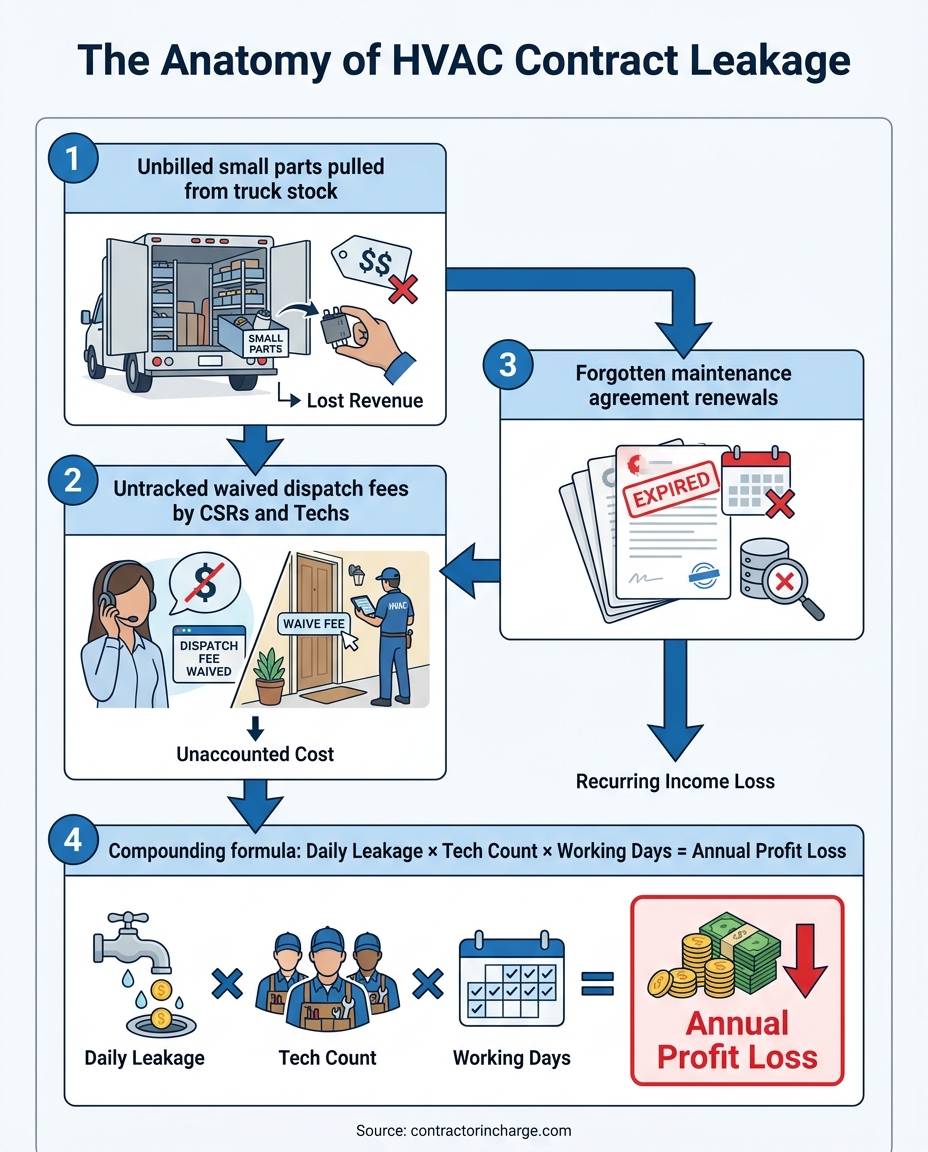
At Contractor in Charge, our team frequently speaks with business owners whose field technicians are running non-stop, but their maintenance plan profitability is inexplicably flatlining. When calculating the hidden financial impact of contract leakage in HVAC maintenance plans, we often discover a massive 10% to 15% gap between expected and actual revenue. This discrepancy rarely stems from a single catastrophic event. Instead, it is a silent, aggressive drain caused by loose standard operating procedures (SOPs) and untracked inventory. Small unbilled parts, waived dispatch fees, and forgotten renewals are not isolated customer service favors—they are systemic failures that erode your bottom line.
To gain full visibility into your numbers and stop the bleeding, you need rigorous performance accounting and the strategic oversight of professional fractional CFO services.
Defining Contract Leakage in Field Service Operations
Contract leakage occurs when a business delivers services, parts, or labor to maintenance plan members without properly billing for them or tracking the costs. In our experience auditing home service ledgers, we see that while field service management (FSM) software captures the physical work completed, weak billing SOPs allow the financial reconciliation of that work to slip through the cracks. This creates a dangerous illusion: your board shows a fully booked schedule, but your ledger reflects missing revenue.
For home service companies striving to hit specific financial benchmarks, stopping this leakage is mandatory. You cannot achieve healthy profit margin targets for home service companies if your daily operations are constantly giving away unmeasured value.
The primary sources of contract leakage include:
• Small unbilled parts: 5-microfarad capacitors, 24-volt contactors, or MERV 11 filters pulled from truck stock but never added to the final invoice.
• Waived dispatch fees: Untracked fee waivers granted by technicians or call center staff to appease frustrated customers within your standard 25-mile service radius.
• Forgotten renewals: Expired maintenance agreements that continue to receive priority service and discounts because 30-day expiration dates were never enforced.
• Unrecorded labor: Technicians spending an extended 90 minutes on a routine 45-minute diagnostic that goes entirely unlogged in the FSM system.

The Compounding Math Behind Minor Unbilled Items
A single unbilled part seems negligible in the moment. A technician grabs a minor component to get a 14 SEER system running quickly, assumes the cost is too small to worry about, and closes the ticket. However, we consistently remind our partners that when you multiply that single omission across hundreds of maintenance plan visits over a 52-week operating year, it equates to massive annual loss.
To understand the severity of this drain, you must look at the formulaic approach to calculating loss: (Average Unbilled Items per Tech per Week) x (Number of Techs) x (Weeks in a Year). If a technician forgets to bill for just a few small parts each week, and you have a fleet of a dozen trucks operating year-round, the resulting missing revenue easily strips away a significant percentage of your net profit. This mathematical drain directly reduces the overall valuation and cash flow of the business.
One ongoing business operation we partnered with struggled with difficulty managing calls, dispatching, and accounting operations during a busy 90-day summer season. Once our dedicated team handled calls, dispatching, and provided organized, reachable accounting services, the business finally received the accurate numbers and valuable feedback needed to see this mathematical drain clearly. Without organized accounting, the math remains hidden.
Variables in the Leakage Equation
To accurately assess your risk, you must track several specific variables within your daily operations:
• Frequency of inventory shrinkage: How often does the physical inventory on maintenance vans fail to match the invoiced materials during weekly audits?
• Percentage of unrecorded diagnostics: The ratio of service calls where standard 15-minute diagnostic steps and minor adjustments go completely unrecorded on the digital ticket.
• Actual time versus billed time: The difference between the 60 minutes your technicians spend on-site for maintenance agreements versus the 30 labor minutes actually accounted for in your pricing model.
How Rushed Technicians During Extreme Weather Accelerate Leakage
Operational chaos is a primary catalyst for billing errors. During extreme weather seasons—whether it is peak July heatwaves in the South or mid-January deep freezes in the North—our team observes that emergency call volume spikes dramatically. Dispatch boards light up with no-heat or no-cool emergencies, creating an intense pressure cooker for your entire team.
When technicians are rushed to get to the next emergency, they frequently skip administrative steps on routine 20-point maintenance calls. The focus shifts entirely to restoring comfort as fast as possible, leading technicians to pull small unbilled parts from their truck stock without attaching them to the customer's invoice. They close the job quickly, promise themselves they will update the notes later, and speed off to the next house. That "later" almost never comes.
This climate-driven rush means that seasonal spikes require even tighter adherence to billing protocols, not looser ones. If your SOPs break down the moment the weather turns extreme, your most profitable seasons will paradoxically become your highest periods of inventory shrinkage and contract leakage.
Reevaluating Waived Dispatch Fees as Systemic Failures
It is common practice for customer service representatives (CSRs) or field technicians to waive dispatch fees to appease frustrated maintenance members. Many business owners write this off as the cost of providing good customer service. However, we strongly advise our clients that this psychological perspective needs to shift: untracked waived fees are not customer service favors; they are unmeasured profit drains.
There is a massive difference between a tracked, strategic discount and an untracked, waived fee that disappears from the ledger entirely. When a fee is simply deleted rather than discounted against a marketing code or retention budget, it skews your data for customers within your local service radius. It artificially lowers your true customer acquisition costs and inflates your perceived lifetime value.
• Ledger Visibility — Tracked Strategic Discount: Recorded as a specific retention expense. — Untracked Waived Fee: Vanishes completely from financial reports.
• Data Accuracy — Tracked Strategic Discount: Maintains accurate customer lifetime value (LTV). — Untracked Waived Fee: Skews LTV and hides the true cost of service.
• SOP Compliance — Tracked Strategic Discount: Requires manager authorization or specific codes. — Untracked Waived Fee: Done arbitrarily by rushed staff.
• Business Impact — Tracked Strategic Discount: Builds loyalty while protecting the data. — Untracked Waived Fee: Creates systemic contract leakage and profit loss.
You must train your teams to provide excellent service without sacrificing the measurable financial integrity of the visit. Empower them to use authorized discount codes that track the concession, ensuring the business still accounts for the waived dispatch fees in its monthly 30-day financial review.
The Revenue Gap from Forgotten Maintenance Renewals
The third major source of contract leakage is failing to renew or bill for ongoing agreements. In our back-office operations, we see that when a business relies on manual tracking methods—such as spreadsheets, whiteboards, or sticky notes—it inevitably leads to expired contracts. Customers whose agreements lapsed 60 days ago often continue to receive priority scheduling and discounted services simply because the dispatch team is unaware of the expiration.
This creates a dual financial loss. First, you are providing discounted or free services to a customer who is no longer paying for that privilege. Second, you are losing the recurring renewal revenue itself. To stop this specific leak, you must implement automated workflows.
By investing in business systems and software optimizations, you remove the burden of manual tracking from your overtaxed dispatchers. Automated systems track expiration dates and trigger renewal workflows automatically.
1. Audit your current member list: Cross-reference active paying members against the list of customers tagged for priority service in your FSM.
2. Automate expiration alerts: Configure your software to flag accounts 30 days before their maintenance agreement expires.
3. Standardize the renewal follow-up: Create an automated email and text sequence, followed by a mandatory phone call from your CSR team.
4. Lock expired profiles: Ensure your dispatch software automatically removes priority status and discounts the moment an agreement lapses.
Auditing CSR and Technician Standard Operating Procedures
Stopping contract leakage requires a step-by-step approach to auditing current billing practices for both field technicians and call center staff. Without dedicated bookkeeping and accounting oversight, these SOPs will be ignored the moment things get busy. You must establish mandatory fields in your FSM software to prevent a job from being closed without accounting for all parts and fees.
During a harsh winter season with sub-zero temperatures, one plumbing and HVAC business needed a partner to extend operations and manage after-hours support. By utilizing our dedicated after-hours call center, they successfully managed late-night customer interactions while enforcing strict billing SOPs, ensuring that no dispatch fees were arbitrarily waived during 2:00 AM emergency calls. This level of discipline is what separates highly profitable operations from struggling ones.
Contractor in Charge brings deep expertise in HVAC-specific FSM software (like ServiceTitan) and proven CSR/technician billing SOPs designed specifically for the trades. By leveraging this expertise, you can implement routine checks, such as matching truck inventory depletion to invoiced materials on a weekly basis, ensuring nothing slips through.
Field Technician Accountability
Field staff must understand that administrative accuracy is just as important as technical proficiency. Implementing 5-point digital checklists before leaving the driveway ensures that all small unbilled parts are accounted for. Standardizing truck stock replenishment highlights discrepancies immediately—if a technician needs five new capacitors but only billed for three this week, the leakage is instantly visible.
Customer Service Representative Protocols
Your call center is the first line of defense against revenue loss. Creating strict authorization tiers for waiving any fees prevents CSRs from giving away revenue just to get off the phone with an upset caller. Furthermore, automating 30-day renewal reminders and follow-up calls ensures that your recurring revenue base actually recurs.
Leveraging Back-Office Expertise to Plug Revenue Leaks
Most HVAC owners do not have the time to audit every invoice for a missing filter charge or a waived fee. You are busy managing technicians, dealing with supply chain issues, and driving growth. This is where specialized back office solutions provide the ongoing oversight needed to catch leakage before the 30-day month-end close.
At Contractor in Charge, our fractional financial experts organize your financial house, enforce strict SOPs, and hold your team accountable to the math. During a recent winter, business owners needed financial organization for high-end transactions. By bringing in a fractional CFO to organize financial records, the owners were able to achieve the highest valuation range for their businesses. Plugging these leaks ultimately leads to a higher business valuation, healthier cash flow, and a more resilient operation.
Frequently Asked Questions About HVAC Contract Leakage
What is contract leakage in field service?
Contract leakage in field service occurs when a company provides labor, parts, or services to a customer without accurately billing for them or tracking the associated costs. This commonly includes minor unbilled parts, waived dispatch fees, and providing priority service to expired maintenance agreements. Over time, these small omissions compound into significant profit loss over a 52-week operating year.
How do you calculate the profitability of an HVAC maintenance plan?
You calculate the profitability of an HVAC maintenance plan by subtracting the true cost of labor, materials, and overhead from the recurring revenue generated by the agreement. You must also factor in the average revenue generated from additional repairs discovered during routine 20-point maintenance visits. Accurate calculations require strict tracking of all time and materials used on every service call.
Why do HVAC companies lose money on service agreements?
HVAC companies often lose money on service agreements because they fail to track the actual time technicians spend on site, allowing labor costs to exceed the price of the plan. Additionally, loose inventory tracking leads to technicians giving away small unbilled parts like MERV 8 filters during routine tune-ups. Without automated renewals, companies also continue to provide discounts to customers whose agreements have long expired.
How often should you audit HVAC maintenance contracts?
You should audit your HVAC maintenance contracts at least quarterly (every 90 days) to ensure all active members are accurately billed and receiving their scheduled visits. Monthly spot-checks on technician invoices are also highly recommended to catch unbilled parts or unauthorized waived fees early. Regular audits prevent small administrative errors from compounding into massive annual losses.
How does FSM software prevent unbilled parts?
FSM software prevents unbilled parts by requiring technicians to complete mandatory digital checklists before a job ticket can be closed out. By linking truck stock inventory directly to the invoicing module, the software flags discrepancies if a part is removed from the van but not added to the customer's bill. This forces accountability and ensures all materials are properly documented.
What is the true cost of a waived dispatch fee?
The true cost of a waived dispatch fee extends beyond the immediate loss of that specific revenue; it artificially skews your customer acquisition costs and lifetime value metrics. When fees are waived arbitrarily and untracked, the business loses visibility into its actual operational expenses. It also sets a dangerous precedent that conditions customers to expect free services in the future.
Securing the Financial Future of Your Maintenance Agreements
We have seen firsthand that small leaks in your billing processes compound into massive profit loss over a 365-day operating cycle if left unchecked. Whether it is a handful of small unbilled parts, arbitrarily waived dispatch fees, or forgotten renewals, these systemic failures drain the lifeblood out of your recurring revenue model. Auditing your CSR and technician SOPs is the clearest path to restoring profitability and ensuring that every hour of labor and every piece of inventory is accounted for.
Do not let poor tracking undermine the hard work of your field team. By implementing strict accountability and exploring professional fractional CFO services, you can gain total control over your maintenance plan math and secure the financial future of your business.