

Solving Revenue Leakage With a Custom Contractor Financial Dashboard


Stop Guessing: Identifying Hidden Revenue Leaks in Your Home Service Business
While you spend your days offering your customers essential home maintenance tips and troubleshooting advice, the most critical troubleshooting you need might actually be inside your own business operations. Your dispatch board looks full, and your technicians are running calls all day, but what happens when sudden weather-driven call spikes hit? Plumbing and HVAC contractors frequently lose high-margin emergency jobs simply because their in-house customer service representatives (CSRs) are completely overwhelmed. When after-hours or overflow calls go straight to voicemail, it creates an invisible revenue leak that standard accounting software entirely misses.
In our years of experience supporting growing home service contractors at Contractor In Charge, our team typically sees owners face a critical decision during these busy seasons. You have to decide whether to blindly hire temporary in-house CSRs—hoping the volume justifies the payroll—or integrate a 24/7 live-agent service directly into your Field Service Management (FSM) software. A custom contractor financial dashboard exposes these hidden leaks, turning missed calls and abandoned leads into actionable operational data. By implementing robust performance accounting, you gain the clarity needed to plug those leaks and capture the revenue you are already generating.
The Symptoms of an Unseen Revenue Leak
Many contractors do not realize they are losing money until the end of the quarter. If you notice any of the following patterns, your business is likely suffering from operational revenue leakage:
• High voicemail abandonment: Customers calling for emergency service rarely leave a voicemail; they simply call the next company on Google.
• Stagnant revenue during peak weather: If your local area experiences extreme temperatures but your revenue remains flat, you are missing the overflow.
• Overworked dispatchers: When your front office is too busy answering basic inquiries to prioritize high-value emergency tickets.
• Marketing mismatch: Spending heavily on lead generation but seeing a low booking rate because calls are not answered promptly.
Why Standard FSM Reports Fall Short for Plumbing and HVAC Demand
The problem: Native FSM reports are excellent for basic dispatching and tracking day-to-day technician efficiency, but they often lack true predictive demand visibility. They tell you what happened yesterday, but they struggle to show you the exact cost of the calls you missed today.
The cause: Relying solely on generic, out-of-the-box reports creates a massive disconnect between incoming live-agent data and your company's true financial health. Standard software is built to track booked jobs. It is not inherently designed to calculate the lost profit margin of an emergency plumbing call that bounced to voicemail at 7:00 p.m. on a Saturday. Without custom dashboard integration, you cannot see the true cost of unbooked emergency calls or identify the operational bottlenecks holding your growth back.
The solution: Navigating these software limitations requires specialized accounting expertise that deeply understands home service workflows. This is where teams holding a ServiceTitan Certified — Accounting credential make a massive difference. They know how to extract raw data and structure it so you can see exactly where your operations are leaking. Proper business systems and software optimizations bridge the gap between your dispatch board and your balance sheet.
Native Reporting vs. Custom Dashboards
• Missed Call Tracking — Native FSM Reporting: Logs the missed call, but assigns no financial weight. — Custom Financial Dashboard: Calculates potential lost revenue based on average ticket value.
• Forecasting — Native FSM Reporting: Looks backward at historical job completion data. — Custom Financial Dashboard: Projects future demand using predictive models and call trends.
• Alerts — Native FSM Reporting: Basic notifications for technician arrivals or delays. — Custom Financial Dashboard: Real-time call-spike alerting to pivot resources instantly.
• Financial Integration — Native FSM Reporting: Requires manual export to accounting software. — Custom Financial Dashboard: Seamlessly blends live operational data with financial health metrics.
Tracking Missed Opportunities During Seasonal Extremes
The highest margin jobs in the plumbing and HVAC industries rarely happen on a sunny Tuesday at noon. They often come in after normal business hours or during extreme weather events. Sudden summer heatwaves or deep winter freezes routinely overwhelm standard in-house CSR capacities. When a polar vortex hits and pipes freeze, or a July heat dome pushes AC units to their breaking point, call volumes explode. If your team cannot handle those sudden weather-driven call spikes, those high-value customers will immediately dial your competitor.
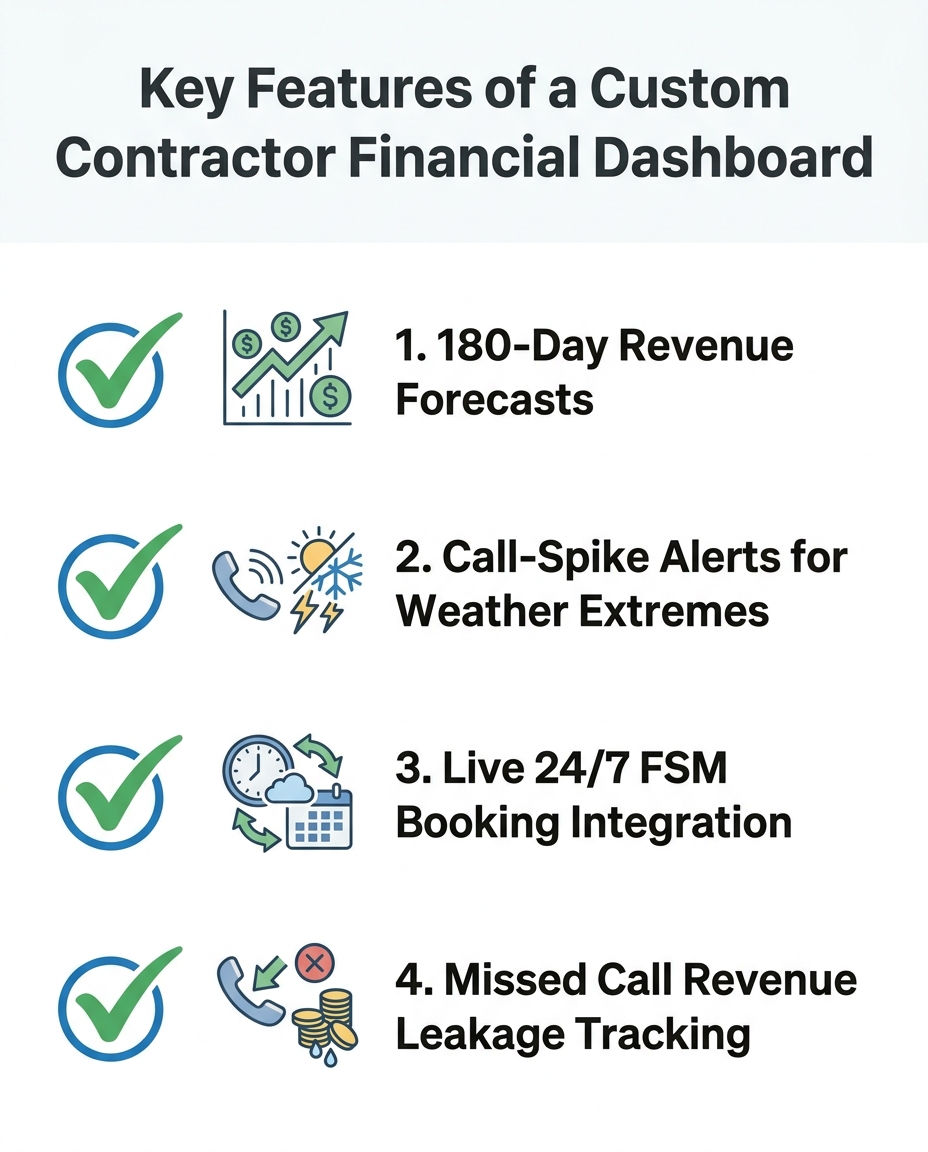
Call-spike alerting tools notify owners when call volume suddenly surges, allowing for real-time resource pivoting. Instead of finding out on Monday morning that you missed forty emergency calls over the weekend, you receive alerts as the surge happens. This allows you to activate overflow live-agent support instantly.
Tracking these spikes ensures that your hard-earned marketing dollars aren't wasted on leads that cannot be answered. Visualizing this data on a specialized dashboard directly connects your operational capacity to your revenue capture, making real-time alerts critical for maximizing peak-season profitability.
The True Cost of a Missed Emergency Call
To understand the severity of this leakage, you have to look beyond the single missed job. When you fail to answer an emergency call during a weather extreme, you lose much more than the initial dispatch fee:
• The immediate repair revenue: The direct profit from fixing the broken AC or burst pipe.
• The replacement opportunity: Emergency calls frequently turn into full system replacements, which carry your highest profit margins.
• The lifetime customer value: A customer saved during an emergency becomes a loyal client who signs up for annual maintenance agreements.
• The brand reputation: Unanswered calls lead to frustrated customers and missed opportunities for five-star reviews.

Building a 180-Day Forecast to Anticipate Demand
Moving from historical reporting to predictive modeling is essential for scaling your business into a larger, multi-truck enterprise. A pattern we see often is that most contractors operate in a reactive state—they hire when they are already too busy and lay off staff when the schedule empties out. A 180-day forecast maps out upcoming slow periods versus expected peak seasons based on historical data, weather patterns, and live call trends.
Predictive dashboards allow owners to plan capacity and budget effectively without blindly hiring in-house staff. By utilizing teams with ServiceTitan Certified — Accounting expertise, you can build a forecast that accurately reflects your unique operational rhythm. This forward-looking approach stabilizes cash flow and helps contractors make data-driven decisions about marketing spend, inventory purchases, and temporary staffing.
Steps to Building a Reliable 180-Day Forecast
1. Analyze historical call data: Look back at the previous three years to identify exact weeks when call volumes naturally rise and fall.
2. Factor in marketing initiatives: Align your upcoming ad spend with your operational capacity. If you plan a massive spring tune-up push, ensure your forecast accounts for the expected call surge.
3. Incorporate seasonal weather patterns: Adjust your baseline based on expected regional weather shifts that historically drive emergency service requests.
4. Establish baseline conversion rates: Use your custom dashboard to determine your average call-to-booked-job ratio, allowing you to predict revenue based on expected call volume.
5. Plan overflow capacity: Decide in advance exactly when you will activate a 24/7 live-agent service to handle the forecasted peaks without adding permanent payroll.
Bridging the Gap Between Live-Agent Operations and Financial Strategy
Integrating 24/7 live-agent booking data directly into your dashboard reveals the true return on investment (ROI) of lead generation versus lead conversion. It is not enough to simply generate the lead; you must track exactly how that lead moves through your operational pipeline. Treating missed calls, dispatch times, and booking rates as financial metrics—rather than just operational ones—uncovers hidden profit centers within your existing workflow.
Reliable accounting requires highly organized support to ensure the numbers on the dashboard are spot-on and actionable. Raw data is useless if it is not categorized correctly. As we often advise our clients, dedicated accounting guidance transforms raw dashboard data into consistently good business advice. For example, during a particularly busy winter season, one contracting business owner realized they urgently required professional bookkeeping and accounting advice to make sense of their operational numbers. By partnering with a dedicated accountant who answered their specific questions and provided actionable advice, their bookkeeping and accounting needs were fully met with reliable support. This level of clarity makes analyzing and deconstructing an HVAC balance sheet much easier and far more accurate.
When you have experts with ServiceTitan Certified — Accounting credentials reviewing your data, you bridge the gap between the CSR answering the phone and the bottom-line profitability of your entire enterprise.
How Spot-On Dashboard Metrics Maximize Business Value
Clean, predictive data proves business stability and operational efficiency to potential buyers, investors, or lending institutions. Advanced dashboard metrics provide the foundation for high-level financial strategy and securing top-tier business valuations. If you ever plan to sell your business, acquire a competitor, or secure a large line of credit for expansion, your financial house must be in perfect order.
Utilizing expert financial oversight ensures that your business is prepared for any high-end transaction. We see this impact directly in the field. In one instance, our team worked with a contracting business that needed advanced fractional CFO services to prepare for a high-end business transaction and valuation. By bringing in expert oversight during the business sale transaction, the owners achieved the highest end of their valuation range. Accurate data gave them the leverage they needed.
A transparent view of demand, revenue leakage, and forecasting gives owners unparalleled leverage in the market. This is exactly why Contractor In Charge offers the CIC Client Portal. It provides a distinct window into your demand with live calls, 7-day and 180-day forecasts, and Call-Spike alerting. It goes far beyond basic bookkeeping to give you a strategic command center for your entire operation.
Frequently Asked Questions About Contractor Financial Dashboards
How do contractors track lost revenue from missed calls?
Lost revenue is tracked by integrating call center data directly with FSM software. Dashboards assign an average ticket value to abandoned or unbooked calls based on historical data. By multiplying the number of missed calls by your average ticket size, you can instantly see the exact amount of revenue leaking out of your business each week.
What metrics should an HVAC financial dashboard include?
An effective dashboard must include revenue by trade, 180-day forecasts, and real-time call-spike alerts. It should also track live call booking rates and dispatch efficiency. Monitoring these specific metrics ensures you have a complete picture of both your operational capacity and your financial health.
How does a 180-day forecast help plumbing businesses?
It predicts seasonal lulls and spikes, allowing for highly accurate staffing and inventory planning. This forward-looking view helps manage cash flow during shoulder seasons when demand naturally dips. By knowing what is coming six months out, you avoid the panic of over-hiring or being caught short-staffed during a rush.
What is a financial dashboard?
A financial dashboard is a centralized visual tool that consolidates accounting, operational, and booking data into one clear interface. It provides real-time insights into a company's financial health, moving beyond static spreadsheets. This tool translates complex data into actionable charts, graphs, and alerts for business owners.
Why do I need a custom dashboard if I already use native FSM reporting?
Native reporting often misses the predictive elements of demand and focuses only on jobs that were actually completed. Custom dashboards bridge the critical gap between operational failures, like missed emergency calls, and long-term financial forecasting. They provide the specialized visibility needed to scale a home service business efficiently.
Turn Your Operational Data Into a Strategic Advantage
A specialized dashboard provides a clear, actionable framework for anticipating demand without the financial risk of over-hiring. By moving away from reactive management and embracing predictive data, you take control of your company's growth trajectory. Integrating 24/7 live-agent teams with your FSM software ensures every single lead is captured, tracked, and converted into measurable revenue.
Stop letting sudden weather-driven call spikes turn into invisible revenue leaks. The data you need to scale is already flowing through your business; you just need the right tools to harness it. Talk to an expert today to see how predictive forecasting and fractional CFO services can transform your business operations and secure your financial future.