

Deconstructing a High-Converting Fall Furnace Tune-Up Outbound Call Script


The High Cost of Triggering Homeowner Sales Defenses
In our years of managing thousands of outbound calls at Contractor in Charge, consumer behavior consistently reveals that outbound calls opening with a traditional sales pitch face an immediate rejection rate nearly double that of calls framed as routine customer service updates. When breaking down an outbound call script that books fall furnace tune-ups, the first thing our operations managers discover is that sounding like a telemarketer instantly burns through valuable seasonal leads. HVAC customer service representatives (CSRs) and dispatchers frequently struggle to convert these calls because their approach inadvertently triggers the homeowner's defensive reflexes. To stop wasting opportunities during the critical fall heating transition, contractors must restructure their scripts to disarm that resistance immediately.
For businesses looking to optimize their inside sales services, we've learned that success relies on framing the conversation as a preventative necessity rather than an unexpected solicitation. High-converting calls do not just sell a routine service visit; they sell the peace of mind of avoiding a mid-winter breakdown. When a homeowner answers the phone, their primary goal is to determine if the caller is a threat to their time or wallet. If the script sounds like a generic pitch, the defense goes up, and the call is effectively over before the value proposition is even delivered.
The Shift from Selling to Servicing
To understand why traditional scripts fail, our team always looks at the structural differences between a sales mindset and a service mindset. The goal is to move the homeowner from a state of interruption to a state of collaboration.
• Focuses on booking an appointment immediately to fill the board. — Preventative Service Approach: Focuses on updating the customer's account and equipment status.
• Leads with promotional offers, discounts, or urgency tactics. — Preventative Service Approach: Leads with historical data, previous service dates, and equipment age.
• Treats the homeowner as a cold prospect needing persuasion. — Preventative Service Approach: Treats the homeowner as an established client needing proactive care.
• Results in high hang-up rates and defensive homeowner posture. — Preventative Service Approach: Results in a collaborative conversation about home comfort and safety.
By restructuring the opening and the core value proposition, we've seen dispatchers successfully bypass the automatic "no" and engage the homeowner in a meaningful conversation about their heating system's health.
The Psychology of Interruption: Why HVAC Demands a Tailored Approach
The Ten-Second Window: The first ten seconds of an outbound call are the most critical. In this brief window, a homeowner makes a subconscious decision about whether to engage or hang up. This cognitive load is heavy; the person on the other end is likely busy, distracted, or entirely unprepared for a conversation about their HVAC system. If the CSR sounds like a telemarketer reading from a generic B2C script, the prospect's sales defense is instantly triggered. A tailored approach is required to lower this defense and establish immediate trust.
Customer Service Mindset vs. Sales Mindset: Generic telemarketing scripts fail in the HVAC industry because they ignore trade-specific realities. A successful script requires a "customer service and account update" mindset. Instead of pushing a product, the CSR is calling to inform the homeowner about a critical maintenance milestone. HVAC scheduling involves addressing severe inconveniences—like a heating failure in freezing temperatures—and the finite lifespan of mechanical equipment. Our deep expertise in HVAC-specific inside sales at Contractor in Charge avoids generic telemarketing approaches, ensuring scripts are tailored to actual trade realities rather than superficial sales tactics.
Stabilizing Operations with Professional Support: Relying on overwhelmed internal staff to execute nuanced psychological scripts often leads to poor conversion rates and burned leads. Professional call handlers can stabilize a business's outbound efforts, ensuring every call is executed with precision. For instance, at the end of 2023, a pattern we saw often emerged when one of our partner HVAC and plumbing companies suddenly lost its dispatcher and primary call taker right as the winter season ramped up. The business leader was overwhelmed and unable to handle the call volume effectively. Our team at Contractor in Charge stepped in to take over full-time dispatch and call-taking services. By applying trade-specific communication strategies rather than generic scripts, the company stabilized its operations and is now growing and running better than ever before. This level of professional intervention is crucial for converting leads to revenue, especially when internal resources are stretched thin during seasonal transitions.
Phase 1: Crafting a Disarming Opening Hook
When our agents execute the first phase of deconstructing a high-converting fall furnace tune-up outbound call script, the focus is on perfecting the opening hook. The primary goal is to sound like a familiar, helpful account update rather than a cold solicitation. This prevents the immediate hang-up and buys the CSR the time needed to deliver the value proposition.
1. Deliver a Neutral, Service-Oriented Greeting: Start with a calm, professional tone that implies an existing relationship. Avoid overly enthusiastic "salesperson" energy. A greeting like, "Hi [Name], this is [CSR Name] calling from the service department at [Company Name]," immediately positions the caller as an internal team member rather than an external marketer.
2. Validate the Call with Service History: The psychological "why" behind this step is profound. By referencing the customer's specific history, you prove that the call is targeted and relevant. State something factual: "I'm giving you a quick call because I was reviewing your account and noticed it has been over a year since we last serviced your furnace." This validates the interruption.
3. Pause for Acknowledgment: After delivering the service history validation, pause briefly. Allow the homeowner to process the information and agree with the premise. This small "yes" or acknowledgment shifts the dynamic from a monologue to a dialogue.
4. Align with Broader Campaigns: The opening hook should feel like a natural extension of your company's overall marketing efforts. When structuring outbound scheduling campaigns for fall maintenance, ensure that the language used on the phone matches the messaging in your email and direct mail outreach, creating a cohesive customer experience.
By mastering these steps, our CSRs consistently navigate past the initial wall of resistance and move smoothly into the next phase of the conversation.
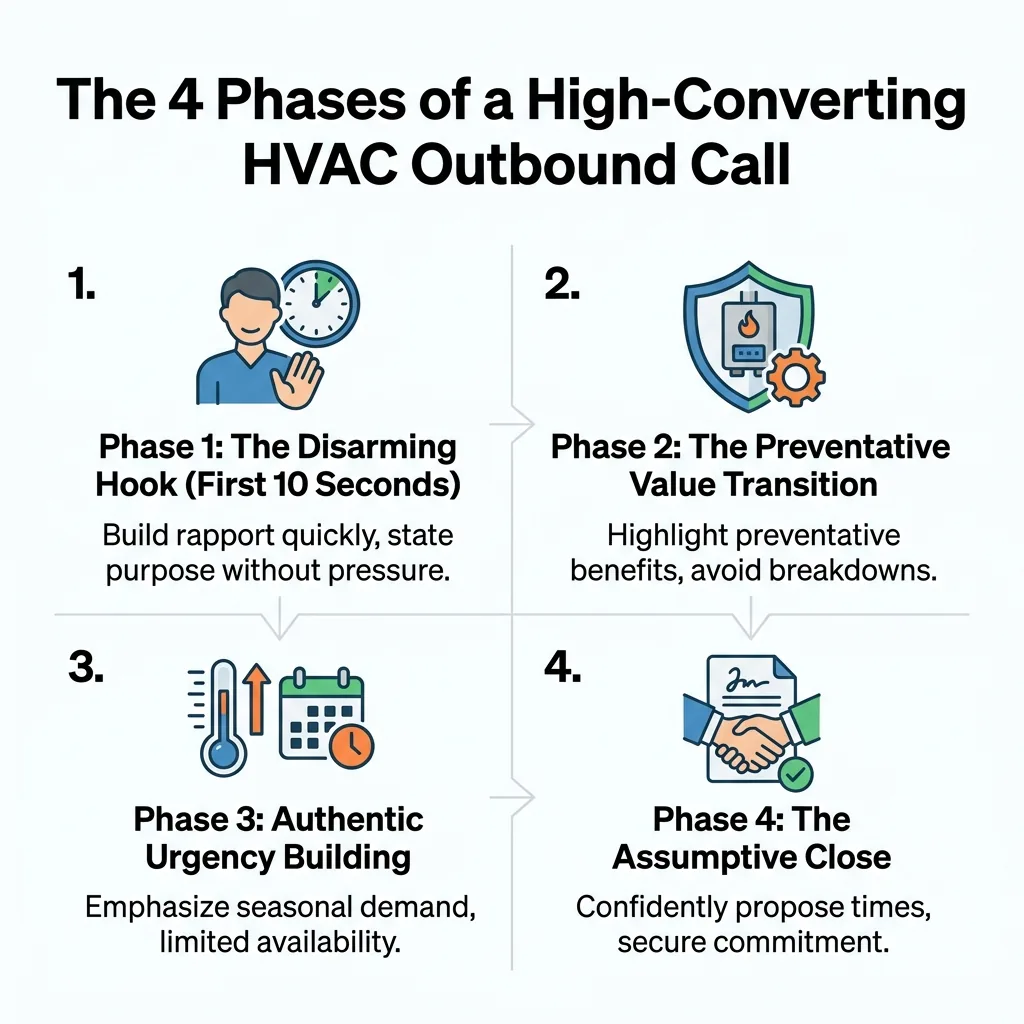

Phase 2: The Preventative Value Transition
In our experience on the phones, once the homeowner's initial defense is lowered, the script must seamlessly transition from "who is calling" to "why this matters right now." This is the preventative value transition, and it requires shifting the CSR's role from a scheduler to a proactive customer care advisor.
Framing the Preventative Necessity: The goal here is to explain the "why" without sounding pushy. The seasonal tune-up must be framed as a necessary step to protect the homeowner's investment in their HVAC system. The key phrasing: "We are reaching out to our existing customers to get their systems prepped and safety-checked before the heavy usage begins." This language implies exclusivity (reaching out to existing customers) and responsibility (safety-checked).
Integrating Climate Realities: The transition becomes significantly more effective when tied to real-world conditions. When the rapid onset of fall weather arrives and the forecast points to the upcoming first major cold snap, the script should validate the timely necessity of the maintenance. Mentioning that temperatures are about to drop sharply provides a logical, external reason for the call, reinforcing that the CSR is acting in the homeowner's best interest.
Mastering Tone and Pacing: During this critical transition, pacing is everything. If a CSR rushes through the value proposition, they sound anxious and sales-driven. If they speak slowly, clearly, and with a tone of helpful authority, the homeowner is far more likely to listen. The preventative value transition should feel like a doctor's office calling to schedule an annual physical—routine, expected, and highly beneficial.
Phase 3: Building Authentic Seasonal Urgency
We consistently remind our call handlers that high-converting scripts do not rely on artificial scarcity or high-pressure tactics. Instead, they build authentic urgency based on the calendar and the reality of dispatch operations during the fall heating transition.
Leveraging the Fall Heating Transition: Natural urgency is built by explaining the logistical realities of the HVAC industry to the homeowner. The reality: Once the first freeze hits, dispatch boards fill up instantly with emergency no-heat calls. By communicating this fact neutrally, you empower the homeowner to make a smart decision. "We want to make sure your system is ready now, so you don't get caught in the rush when the first freeze hits and technicians are booked out for days."
Focusing on the Inconvenience Factor: The primary risk factor for a homeowner is not just a broken furnace; it is the severe inconvenience of a mid-winter breakdown. Families do not want to wake up to a freezing house, scramble to find space heaters, or pay premium rates for emergency after-hours dispatch. By gently reminding them of this inconvenience, the script creates a strong motivation to act proactively.
Avoiding Fear-Mongering: It is crucial that this urgency feels helpful and informative, never manipulative. Statements like, "Your furnace might break down and leave your family freezing," cross the line into fear-mongering and will immediately trigger defensive reactions. Instead, keep it operational: "Booking now ensures we can catch any small wear-and-tear issues before they turn into major repairs during the peak winter season."
Phase 4: Navigating Common Tune-Up Objections
Even with a perfectly executed opening and value transition, homeowners will still raise objections. Deconstructing a high-converting fall furnace tune-up outbound call script requires a structured approach to handling this pushback neutrally and effectively. The goal is not to argue, but to understand and redirect.
Problem: "My furnace worked fine last year, I don't need a tune-up."
Cause: The homeowner equates a lack of catastrophic failure with optimal system health, misunderstanding the cumulative nature of mechanical wear and tear.
Solution: Utilize the "feel, felt, found" method adapted for HVAC preventative maintenance. A trained CSR should respond: "I completely understand how you feel. Many of our customers felt the same way because their system ran great last winter. But what we've found is that small issues—like a dusty flame sensor or a struggling motor—often develop silently over the summer. A quick check now ensures those small issues don't turn into a surprise breakdown in January."
Problem: "I'm just too busy right now to deal with this."
Cause: The cognitive load of scheduling, waiting for a technician, and taking time off work feels overwhelming to the homeowner in that specific moment.
Solution: Remove the friction of standard business hours. For homeowners who are genuinely too busy during the day, offering extended availability captures lost opportunities. One of our plumbing and HVAC clients required reliable after-hours support during a busy winter season. Our team at Contractor in Charge—specifically a dedicated agent named Danielle—handled these after-hours calls effectively, capturing bookings that would have otherwise gone to voicemail. Leveraging live agent call center services ensures that when a homeowner finally has the bandwidth to address their maintenance, a professional is ready to navigate their scheduling concerns without pressure.
Problem: Cost and Budget Hesitations
Cause: The homeowner is worried about the immediate out-of-pocket expense for a service they didn't wake up planning to purchase.
Solution: Provide psychological framing to bypass price objections without discussing specific dollar amounts. Shift the focus from the cost of the tune-up to the value of efficiency and longevity. "Preventative maintenance actually pays for itself by keeping your energy bills lower and extending the lifespan of the equipment. It's about protecting your investment rather than just paying for a visit."
Phase 5: Executing the Assumptive Close
The final phase of the script is where the appointment is actually secured. If the previous phases have been executed correctly, we find that the close feels like a natural, low-friction next step rather than a high-pressure demand.
1. Define the Assumptive Close: In the context of a customer service call, an assumptive close means operating under the assumption that the homeowner agrees the maintenance is necessary. You are not asking *if* they want to book; you are asking *when* is the most convenient time for them to receive the service.
2. Offer a Double-Option Window: Never ask an open-ended question like, "When would you like us to come out?" This forces the homeowner to check their calendar and creates friction. Instead, offer two specific appointment windows: "I have a technician in your neighborhood on Tuesday morning, or would Thursday afternoon work better for your schedule?" This simplifies the decision-making process.
3. Execute the Confirmation Process: Once a time is selected, immediately solidify the booking to reduce buyer's remorse and prevent no-shows. "Great, I have you down for Tuesday between 8 and 10 AM. You will receive a text message confirmation shortly, and the technician will call you when they are on their way."
4. Summarize the Flow: The entire script flow naturally leads to this point. By disarming the homeowner, providing preventative value, building authentic urgency, and navigating objections smoothly, the assumptive close feels like a helpful service rather than a sales transaction.
Transforming Outbound Efforts into Reliable Dispatch Boards
A clear, psychological breakdown of an outbound script proves that lowering homeowner resistance is the key to successfully booking preventative maintenance. Deconstructing a high-converting fall furnace tune-up outbound call script reveals that wording, tone, and pacing matter just as much as the service being offered. When dispatchers sound like helpful advisors rather than aggressive telemarketers, we consistently see conversion rates naturally rise.
As an extension of your operations, we always remind operations managers that training CSRs on the "why" behind the script yields significantly better long-term results than demanding rote memorization. When call handlers understand the cognitive load of the homeowner and the trade-specific realities of the fall heating transition, they can adapt to objections dynamically and authentically.
Before the peak season hits and the dispatch board becomes chaotic, take the time to evaluate your current outbound approach. By refining your scripts to prioritize customer service, validate the necessity of the visit, and build natural urgency, your team can transform cold outbound efforts into a consistently reliable schedule of preventative maintenance visits.
Frequently Asked Questions
What is the best way to start an outbound scheduling call?
In our experience, the best way to start is with a neutral, service-oriented greeting that immediately references the customer's service history. This validates the reason for the call and positions the CSR as a helpful account manager rather than a telemarketer. By avoiding overly enthusiastic sales tones, you prevent the homeowner's immediate defensive reaction.
How do you overcome objections when scheduling HVAC maintenance?
Overcoming objections requires active listening and the use of the "feel, felt, found" method to validate the homeowner's concerns. Instead of arguing, a CSR should acknowledge the hesitation and smoothly pivot to the preventative benefits of the tune-up. Addressing the severe inconvenience of a mid-winter breakdown often effectively neutralizes objections about time or immediate necessity.
How do you sell HVAC maintenance over the phone without sounding pushy?
You avoid sounding pushy by framing the maintenance as a necessary, proactive step to protect the homeowner's investment and ensure their family's comfort. Build authentic urgency based on the changing seasons and the reality of busy dispatch boards rather than using artificial scarcity. When the call feels like a routine health check for their home, the "sales" pressure disappears.
Why do generic telemarketing scripts fail for HVAC dispatchers?
Generic scripts fail because they do not account for the trade-specific realities of the HVAC industry, such as equipment lifespans and seasonal weather urgencies. They treat the homeowner as a cold prospect rather than an established client needing proactive care. Furthermore, generic scripts often trigger the homeowner's sales defenses within the first ten seconds, leading to high hang-up rates.
When is the most effective time to run a fall furnace tune-up campaign?
The most effective time is during the early fall transition, right before the first major cold snap hits your region. Reaching out during this window allows you to build natural urgency by helping homeowners avoid the inevitable rush of emergency no-heat calls. Securing these appointments early keeps your dispatch board stable before peak winter chaos begins.